
Paul Theroux Is ‘Crazy for You’ in Graphic Detail
Steve Lafler’s art dramatically alters the presentation of the story
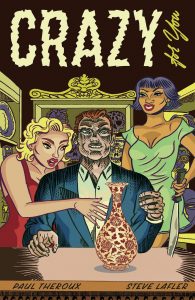
While Paul Theroux is a highly published long-form writer, with a dozen travel books and dozens of novels to his credit in his decades-long career, his short stories are somewhat more obscure, for the same reason short stories generally are — hidden, if anywhere, in the middle of collections. The new Fantagraphics volume Crazy For You is no different in that regard, as it expands two of Theroux’s stories, Minor Watt and Siamese Nights into full-on graphic novels, even if neither of them have quite the depth necessary to justify publication on their own.
Indeed, they don’t only lack depth but, despite being some of Theroux’s more recent work, dating to 2011 and 2012 respectively, they also seem oddly out of step with the current literary moment.
Crazy For You
By Paul Theroux writer and Steve Lafler illustrator
Fantagraphics; 208 pages
Minor Watt depicts Minor, real estate tycoon turned art collector who’s finalizing his divorce from Sunny in the opening pages. But this set-up ends up only being incidental to the real story, which concerns Minor accidentally (or not?) breaking a precious vase that Sunny had specifically requested in the settlement. Minor soon finds that he loves destroying precious art. However, he can only really enjoy doing so if someone who appreciates the art is in the room with him, so he can see the terror in their eyes.
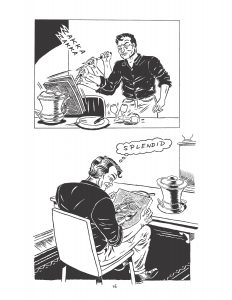 Destroying art has long been a pastime of the vengeful. And, possibly because the satisfaction is proportionate to the worth, artists have more recently gotten in on the act — most notably in 2018 when Banksy deliberately set up art to self-destruct right after it sold at auction. This postmodern idea of art is briefly referenced in Minor Watt when Minor receives accolades from some young artistic types. But Minor himself refuses to dignify any of his own actions with any greater meaning, describing himself in internal monologue as simply a destructive child.
Ironically, destroying his own art has virtually no effect on Minor’s fortune, both because he has so much of it to begin with (having accurately predicted the 2011-adjacent downturn) and because his existing collections increase in value when he destroys similar artifacts. Minor Watt resists meaningful classification. Minor’s definition of art as quite literally being beautiful things that can be destroyed defies allegory and, whatever his satirical intent, Theroux has met an art world increasingly embracing literal self-destruction as art.
The presence of Steve Lafler’s art likewise dramatically alters the presentation of the story. Theroux’s short story, with its emphasis on the written word, hints at a more philosophical pretension. But seeing Minor with childish glee in his eyes, and other characters lacking much more maturity, greatly accentuates the farce of the characters above the speculation of the narrator. Perversely, the cartoonish nature of Lafler’s linework makes Minor’s behavior more childish. It’s an effective communication of a fundamentally silly idea, a man who wants to live like he’s a character in Looney Tunes because nothing else can thrill him quite the same way anymore.
The second story in Crazy For You, Siamese Nights starts off as a more typical kind of Theroux joint, depicting Boyd, an older businessman on the verge of retirement going to Thailand and amusing himself with amateur sketchings of the local environment. But then it gets into ladyboys and katoey. Not quite inevitably, though. Once again, Lafler’s images show a new angle through their depiction of a genuinely uncomfortable interaction at the Bangkok Central Railway Station. No amount of prose can quite so effectively communicate what it’s like when a probably mentally ill person starts credibly acting like they’re going to go crazy if the probably rich guy they just met doesn’t give them spare change.
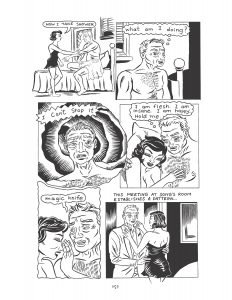 Siamese Nights is far less lurid than its premise suggests, in part because it opens with this viscerally uncomfortable scene. Even the specter of racism is mostly kept at a distance; in fact, the ending comes closest to crossing that line, and not for any of the obvious sexual reasons. The larger issue is that the story can verge on self-parody — less of itself than of the generation of writers Theroux represents: older Western men adrift in foreign cultures they barely understand, getting in over their heads. When the story first appeared in 2012, social media existed, but today’s culture of public shame did not. Yet Boyd is saturated in private shame, often without quite knowing why, his anxiety rendered in the art through a constant, clammy unease.
“Parody” isn’t quite the right term, though, because the text is sharply aware of Boyd’s disorientation and his slow, inward unraveling as he’s left alone with his thoughts. Theroux, unlike his protagonist, is entirely in control, sketching Boyd’s experience in jagged, revealing fragments. Boyd stumbles through a series of awkward, almost clinical experiments, trying to determine whether he’s drawn to sex tourism in general or to one particular person. This framing allows Theroux to explore Boyd’s muted orientalism — not as the product of strong preconceptions about Thai culture, but of near-total ignorance. Ironically, Boyd is pulled deeper into the ladyboy romance scene partly because he recoils from the familiar vices of his fellow Western businessmen, whose banal indulgences he understands all too well, and can therefore more easily reject.
It remains unclear who this book is really for. The kind of people likely to enjoy Theroux aren’t the ones to open up a comic book even if it’s called a graphic novel. On the flip side, much graphic novel culture is quite literally a rejection of what Theroux represents, which for me at least, was an irony intriguing enough to warrant taking a serious look at the book. What do the mild fantasies of white boomers look like when exposed to the infinite canvas? Surprisingly enough, the combination comes out like a well-aged Roy Lichtenstein, petty drama blown up to such an extent it’s hard to tell who’s laughing at who.
You May Also Like
-
 January 18, 1995
 -
 April 27, 2022
 -
 November 7, 2018
