
What Does ‘Network’ Have To Tell Us About Outrage, 50 Years On
We’re still ‘mad as hell’ but now everyone is yelling into the ether
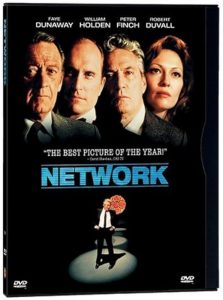
Made quickly and on a small budget, Network’s jaded look at the media’s sausage factory took movie theaters by storm in 1976. It made its money back and garnered no less than ten Oscar nominations, winning four. It also popularized the famous line “I’m mad as hell and I’m not going to take it anymore” which, for good and ill, couldn’t be more relevant to today’s discourse of perpetual outrage.
Network isn’t anti-outrage; it’s outraged at the way the manipulation of outrage has become so outrageous. If anything, it saves its true venom for the fact that the very same people who create the conditions for our degraded democracy profit from the anger which it generates.
Howard Beale, rumpled old news anchor at UBS network, is having a bad break. His marriage has fallen apart and, worse, his ratings are low. He and his longtime pal Max Schumaker (played with wintry melancholy by the great William Holden) go out drinking. They start bantering about bumping up the network’s sagging numbers by featuring a suicide of the week or terrorist of the week live on primetime.
After a sudden visitation suddenly turns him into some kind of mad prophet, Beale starts his next show by spontaneously threatening to blow his brains out live on air. Miraculously, viewers start tuning in. The honchoes at the network, one of whom is named Hackett (the movie is not subtle with names) are thrilled to have a hit show for once and decide to capitalize on this newfound hype.
Platforms that foment anger and then profit from it, tend now to be part of what is misleadingly called “social media,” but Beale’s wild threat isn’t that far from the many freak shows which have become a popular television fixture. Fifty years after his joking, desperate suggestion, millions of people have tuned in to bask in contestants humiliating themselves and each other for our amusement. It shouldn’t be surprising that a nation that constantly snacks at the theater of cruelty would develop a cruel body politic.
Beale starts ranting and utters the now-iconic line “I’m mad as hell and I’m not going to take it anymore.” People get up off their couches and start yelling it in the streets. The line expresses the justified anger lots of people felt during the 70s, an admittedly depressing decade. Most importantly it demonstrates the utter meaninglessness of such sloganeering. Mad as hell, you say? Well, who isn’t! Everything is terrible! When isn’t it? At one point, the entire studio audience merrily shouts the line all together like a pep rally.
Nowadays you don’t need to have a TV broadcaster tell us that and it wouldn’t be news if they did. There’s a million little Howard Beales contributing to an entire industry (algorithmically boosted of course) of tweets and podcasts and blogs and YouTube clips of someone DESTROYING someone else and performatively snarky online influencers whose meal ticket depends on being very pissed off at everything, all the time, and needing to make you pissed off too. Being mad as hell isn’t anything. What matters is what you’re mad as hell about.
 Paddy Chayefsky’s screenplay certainly is angry but brilliantly avoids easy moralizing. Searing indictments of media sensationalism has been done plenty of times. What’s more impressive is how Network becomes a searing indictment of the ironically self-defeating nature of searing indictments. Even the obviously odious characters have a certain frankness; they’re just in it for the money like everyone else, and if searing indictments will pay the bills, well who’s going to turn down that sweet searing indictment cash?
Enter Faye Dunaway’s glamorously amoral Diana Christensen. Like the goddess she’s named after, her hunt is for ratings. She’s a career woman who is perfectly comfortable with not caring about anything else but making it to the top. Effective as she is, Diana admittedly has no real life other than her job, and no real desires beyond success. She is such a product of America’s win-at-all-costs culture, — fueled by TV’s appetite for spectacle — that she at one point literally orgasms while monologuing about being sued by the government.
When Diana argues that “the American people want someone to articulate their rage for them” she is accurately diagnosing what Beale brings to the airwaves and taking the exact wrong lesson from it. As Diana understands it, the television industry’s only purpose is to not to educate or inform but to generate profit. Tragically, this includes the news. She’s all for whatever gets the station more eyeballs: “the news is showbiz!” she exclaims in all her gilded ignorance.
As far as real human emotion, one of the film’s most poignant moments belongs to Beatrice Straight for playing Max’s anguished wife Louise, whose eloquently indignant response to his infidelity with Diana certainly deserved the Oscar she won. Her small amount of screen time speaks volumes on behalf of any number of jilted spouses, which probably resonated even louder in Hollywood. It’s the polar opposite of Diana’s glib shallowness; she really makes us feel the shattering of years working towards building a marriage and a family. Granted, these characters do tend to speak in slightly unrealistic Aaron Sorkin-esque dense paragraphs, but these are highly educated New Yorkers back when people still read books.
At one point Beale is led into UBS’s corporate sanctum and is treated to a hellfire sermon over his on-air disavowal of where his network’s bread is buttered. Ned Beatty’s portly, affable Arthur Jensen delivers one of movie history’s great monologues. He gesticulates like a mad preacher as he lays out the facts of life to an astonished Beale:
You are an old man who thinks in terms of nations and peoples. There are no nations, there are no peoples, there are no Russians, there are no Arabs, there are no third worlds, there is no West! There is only one holistic system of systems, one vast and immane, interwoven, interacting, multivariate, multinational dominion of dollars!… It is the international system of currency which determines the totality of life on this planet. That is the natural order of things today…There is no America. There is no democracy. There is only IBM and ITT and AT&T and DuPont… Those are the nations of the world today… The world is a business, Mr. Beale. It has been since man crawled out of the slime.
What’s striking about this monologue fifty years later is how both the left and right could conceivably nod along to every word, agreeing that this is indeed the order of things today. Then they would argue bitterly over what to do about it. The monologue lays out what’s at stake when we talk about topics like globalization, neoliberalism, and terms like “the end of history,” all of which are still hotly debated today. One way to map your spot in the political divide is whether you think it’s good, terrible, or simply inevitable to assume that the world is and has always been like this.
The idea that the news is highly sensationalized isn’t news. The pervasive commercialization which Network is warning us about isn’t necessarily as outrageous as it used to be; now it’s pretty much taken for granted. Howard Beale’s outrage ultimately doesn’t change anything about UBS and even his own downfall ends up feeding the machine even more. Jamelle Bouie, an influential political commentator and New York Times columnist, makes this point when he ends his essay for the Criterion Collection by ruefully pointing out that “one imagines, however, that the final show itself was a hit. The network, no doubt, was pleased.”
The Vice President recently remarked that Watergate would probably be a minor blip on the news media radar these days. He’s right, but that’s precisely the problem. We gobble up so much of the never-ending buffet of dubious information these days that it’s easy for massive corruption to float by without being properly understood, analyzed, or reflected upon. That doesn’t mean that we should ignore it and chalk it up to the price of doing business in an attention (and dopamine-based) economy. What it means is that we need to listen more carefully to the people who aren’t in it for the clickbait or the billionaire’s handouts.
Whenever hear someone lament that journalism is all a bunch of propaganda I wonder why, if they really feel that way, they don’t watch something like the PBS Newshour. If objectivity is what they really care about, that’s about as close to objectivity as possible. Whatever else they are, the people working at PBS aren’t trying to climb the corporate ladder; they just want to provide seasoned, nuanced debate and analysis because it is valuable to the public. The response that I get is that it’s boring. Which is precisely what a real-life Christensen would say.
Maybe some sober analysis is precisely what’s required to get past crazy times like these, especially since our society balks at any pause in its appetite for sensation. And thus, we fall back on the never-ending, lucrative cycles of outrageous statements, wild accusations, and salacious hearsay.
We’re mad as hell, sure, but we just keep on taking it. Maybe because we like it that way, and maybe because it keeps getting worse.
You May Also Like
-
 June 9, 2022
 -
 October 1, 2019
 -
 November 16, 2018
