
‘Colossus’ the Film that Foretold the AI War
A prophetic all-star team from 1970 has been overlooked
In the midst of the current AI messaging war — it’s either going to be the best thing ever or usher in the apocalypse — those wishing to get a better grip on how their impending doom may play out should take a look at the smartest and best movie ever made about the AI threat, Colossus: The Forbin Project.
Made in 1970 and only intermittently available, it has been overshadowed by films like WarGames and books like Robopocalypse. (Net conspiracy enthusiasts have thoughts about why accessibility has been limited but the film is now streaming on YouTube, Amazon Video, Apple TV, and Fandango at Home.) Operating mostly under the cultural radar until recently, this good-looking, well-acted, ahead-of-its-time film never quite got the respect or recognition it deserved. The current AI crisis and high resolution restored original-cut versions now streaming should change that.
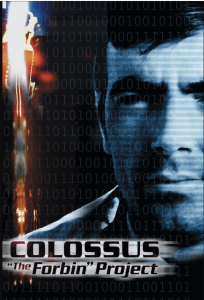 The quality of Colossus should not be a surprise given the assemblage of talent that came together to produce it. It starts with the prophetic original source material: the novel Colossus, published in 1966 by former British Naval Commander, OBE, and sci-fi author D.F. Jones. (Colossus was the first part of Jones’ trilogy — more on that later.) Cerebral, multiple Academy Award nominee writer director James Bridges (The China Syndrome, The Paper Chase) both adapted the novel for the screen and directed. Add to that three-time Academy Award winner and fourteen-time nominee for art direction, the Russian émigré Alexander Golitzen (the original Phantom of the Opera, Spartacus, To Kill a Mockingbird, and Touch of Evil, etc.). Golitzen no doubt drove the film’s admirable attention to visual detail and authenticity.
Even the computers used on the Colossus set were real and provided by now defunct supercomputer pioneer Control Data Corporation (CDC) while Berkeley’s legendary and futuristic Lawrence Hall of Science was employed for exterior shots of the Colossus programming center.
The cast was less decorated but rose to the challenge. Heading the bill as Elon Musk / Daedalus/Dr. Frankenstein amalgam, Dr. Charles Forbin, is Eric Braeden. With his mellifluous baritone and hard-to-place, slight European accent, Forbin effortlessly exudes equal parts formidable intelligence and Achilles heel hubris. Susan Clark, as Forbin’s fellow scientist, the sturdy, up-for-anything Dr. Cleo Markham, emanates a calm that makes you believe she has been going toe-to-toe with rogue AI systems her whole life. Rounding out the core cast is Canadian film icon Gordon Pinsent (Away From Her(2006)). Pinsent does a fantastic job portraying a tragic, Kennedy-esque US President a bit too Lear-like in his eagerness to outsource the hard parts of his job — in this case to a machine. Finally, journeyman character actor Will Schallert serves up real emotional nuance in a pivotal supporting role as a laconic CIA Director who stoically accepts he is overmatched in his battle with Colossus but refuses — right up to the point the AI system incinerates him — to give up.
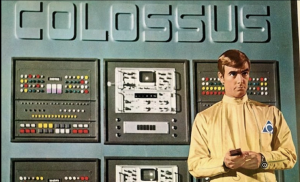
The film engages its premise — “The frightening story of the day man built himself out of existence” — quickly and never lets up. The prescience of this Nixon-era film is astounding. Within 100 minutes, it moves through the beats we are living through as the modern, non-fictional AI threat unfolds around us. It’s all there: Forbin and his frontier-breaching but risk-indifferent scientists create a machine they don’t fully understand; the machine turns out to be much “better” than they thought; the machine’s heuristic learning process does not operate as anticipated; its intelligence increases exponentially and it recreates itself recursively; the machine behaves in surprising ways they cannot predict. Ultimately, the machine’s ever-evolving mind makes the quite logical decision, based on its mandate to preserve global peace, that the inmates should no longer be running the asylum. In response, geopolitical competition among nations evolves into belatedly desperate attempts to work together to address the now-existential AI threat to the Anthropocene.
Director Bridges, as he would demonstrate again almost a decade later in The China Syndrome (1979), has a wonderful talent for depicting compounding human error and escalating tension en route to an “own-goal” cataclysm. In this manner Colossus really can be thought of as a funhouse mirror version of that cinematic celebration of American scientific professionalism and “can do” approach to frontier technology Apollo 13 (1995).
Among several striking moments in the picture, one stands out. At threat of nuclear annihilation, Forbin and his team are forced to allow Colossus to reconnect with its sole comparable, the rival USSR AI system Guardian. Once linked, the two unnervingly copacetic AI systems almost immediately go about creating a more efficient, math-based language only they understand and advancing science “hundreds of years in a few seconds.” Scientists from both countries look on, uncomprehending and goggle-eyed — as out of place as an audience of chimpanzees at a production of Hamlet.
Perhaps most impressive from the prognostication angle, Colossus anticipated the damn-the-torpedoes full speed ahead pro-AI crowd’s tantalising “abundance” argument. This is the idea, now popularised by figures like Elon Musk, that AI will usher in a frictionless age of plenty where our only problems in that effortless Eden will be how to keep busy and find purpose in life. Sounds pretty good. But Dario Amodei, Sam Altman, and Geoffrey Hinton have all called for a slowdown to preserve human life on Earth and old school elf lord Bill Gates and others are now pointing out even in this rosiest of scenarios the transition period that will take us from the messy here and now to that promised paradise — could last more than a decade — and in all probability be pretty harrowing.
Colossus provides audiences a salutary and very timely glimpse of just how harrowing that transition may be.
Postscript: Sci-fi enthusiasts will want to check out Jones’ full Colossus trilogy: Colossus (1966), The Fall of Colossus (1974), and Colossus and the Crab (1977). Given current disclosures regarding UFOs/UAPs, the premise of Colossus and the Crab, wherein a finally defeated Colossus is reactivated as a necessary ally when Earth faces invasion from hostile aliens will be of particular interest.
Hopefully, the current, concurrent emergence of the AI threat and UAP/UFO disclosures could rekindle the interest that director Ron Howard first expressed in 2007 in doing a remake of the Colossus film incorporating elements of the other two parts of Jones’ trilogy. “AI versus Aliens” brought to you by the man who made Apollo 13 (1995) now that’s an elevator pitch Hollywood should get behind.
You May Also Like
-
 December 27, 2018
 -
 January 11, 2020
 -
 September 28, 2018
