
Norm Was a Vibe
Judd Apatow takes a different tack in ‘Norm: The Tale Of Norm Macdonald’
Man, do I hate writing this as much as he would hate hearing it, but…
Norm Macdonald was a vibe.
To clarify, I’m not just updating the term “voice.” That applies more specifically to writing style, one which I’ve put to use working in late-night for almost 20 years. A voice, in brief, can be captured and replicated, at scale. Whereas a vibe cannot really be captured, barely described. At best it can only be manifested — in Norm’s case, in the form of a perma-smirk, and the thrilling awareness you were about to hear something you could never predict, and was going to shock a laugh out of you.
So, how do you make a documentary about someone whose entire creative legacy by definition eludes capture? Not to mention, one poised to answer the slightly fuzzy question of Who was that guy? SNL anchor? Full-time late-night guest? In a sitcom once every 8 years? In, like, movies around Rob Schneider sometimes?
Maybe instead of a more linear narrative, you strive to create a vibe yourself.
Judd Apatow – currently claiming his title as the Herodotus of late 20th/early 21st century American comedy – has taken the more traditional approach with his magisterial (reviewer-speak for “really really, really LONG”) docs on Garry Shandling, George Carlin, and Mel Brooks. All of those traced meticulous, chronological storylines from childhood through sharply contoured career turns.
By contrast, in Norm: The Tale Of Norm Macdonald, which just debuted on Netflix (and may be the most Norm title ever), Apatow seems to take more of a page from other comedy chroniclers. Like Matt Wolf’s Pee Wee As Himself, this documentary shows more interest in what kinds of creative waters Macdonald soaked in early, rather than, say, where he played Little League. And like Rob Reiner’s Albert Brooks: Defending My Life, it stitches together a tapestry of indelible, endlessly rewatchable moments (also from late-night shows) into a coherent comedic presence.
Formally, Norm follows the usual comedy-doc conventions: talking heads from across comedy royalty, clips from all eras and levels of graininess, countless behind-the-scenes stories of the comic being always “on,” even when offstage. But Macdonald’s career trajectory doesn’t quite lend itself to the sort of ever-bigger-platform story of a Carlin or Shandling or Brooks. Instead, he kept just making himself culturally relevant in a variety of ways.
To use another term the late Macdonald (who passed from cancer in 2021) would have shuddered at, he was a disruptor. But – and this is key to both Macdonald’s and the film’s charm – not in one of the louder, buzzier ways. Norm Macdonald was no Bruce/Carlin/Pryor language-shocktroop, no Rivers/Silverman/Schumer sex-talk-sniper.
Instead, Macdonald’s provocations were of a more subtle, maddening variety, a bit closer to Andy Kaufman in obnoxiously, gleefully throwing off the shackles of creative convention.
While a standup comedy’s set is classically a “tight five” (minutes), Macdonald’s legendary Moth Joke is like a shaggy dog mated with a 1970s carpet, clocking in at 4:16 to deliver one punchline.
Likewise, as shown in Norm, Macdonald pulled off a major zag in the 2008 Comedy Central Roast of Bob Saget. The comedy roast is a meticulously scripted arsenal of brutal personal hits that only the target’s celebrity protects them from – and its jokes must be sharp, cutting, and shocking.
Macdonald went up to the dais and unleashed this fusillade against one of the world’s most infamously dark comics:
“Bob has a beautiful face, like a flower – yeah, a cauliflower.”
“Bob thinks the English Channel is a British TV station.”
“There are times when Bob has something on his mind — when he wears a hat!”
It’s particularly delicious because the comics are dying at these painfully-wrong cornbombs, while the “normie comedy fans” in the crowd are looking around, uncomfortable. Isn’t this Norm guy supposed to be “edgy?” But Macdonald’s only beginning to provoke! He doubles down on the crickets from the hat gag, asking the audience with believable irritation, “Like, no thoughts, just a hat — how could you not get that?”
Perhaps it’s not even fair to call these provocations, which can often have a calculated or strategic quality. With Macdonald, this style of reaction is just who he was. A guy whose facial expressions refused to hide his searing allergy to either your bullshit, or the bs being perpetrated around us at the moment.
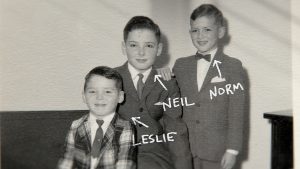
Of course, it was a much bigger provocation that threatened to write Norm Macdonald’s professional epitaph. As host of Saturday Night Live’s “Weekend Update” for 3+ seasons, at the peak of OJ Simpson trial-mania, Macdonald went after the Juice almost as viciously as he did with Ron and Nicole.
This earned the ire of then-NBC President Don Ohlmeyer, who also happened to be besties with the aforementioned glove-wearer. He pressured Lorne Michaels to end the Simpson jokes, and eventually had Macdonald fired. Ohmeyer also refused to let NBC and its affiliate promote Macdonald’s 1998 movie Dirty Work.
But the true magic was that these two body blows from Ohlmeyer hardly ended Macdonald’s career – they arguably revived it, or at least the public’s appreciation for his neo-Lettermanist swagger against The (Broadcast TV Network) Man. Now suddenly Macdonald was regaling TV, radio, and podcast audiences with the story of his executive-suite SNL-sacking, like a Capra underdog who loves saying the word “crack.” The provocation had become a self-renewing engine, and it was driven by how Macdonald never launched into tirades or ad hominem cracks on Ohlmeyer – he would just murmur with devilish faux-naivete, “The guy just hates me for some reason!”
Perhaps Macdonald’s best punchline (and there is an Avengers: Endgame battle on for that honor) is that in Ohlmeyer’s 2017 obituary, his firing of Macdonald takes top billing over his decades-long career. The provocateur had taken his target down with him.
The documentary wraps things up, appropriately, by a relatively brief, graceful, and most of all low-key recounting of Macdonald’s passing to cancer. Which is exactly how Macdonald treated his own condition publicly. The film movingly shows Anthony Jeselnik hearing the news during a taping and succumbing to pure shock — nobody knew. Macdonald didn’t tell anyone for the near-decade he struggled with it, translating his visible weight gains from chemo steroids into “fat guy” jokes.
And, as it illustrates, this was perhaps Macdonald’s lasting legacy, his vibe: He took in the poisons of this world and this existence, turning them even more toxic with his gleeful cutting-the-bone-phrasing. But in so doing, Macdonald also absorbed some of the toxins for us – ultimately reducing them to nothing but an unforgettable, and deeply powerful, smirk.
You May Also Like
-
 September 15, 2021
-
 October 27, 2026
-
 October 22, 2026
