
A Concrete Example of a Documentary Masterpiece
John Wilson’s ‘History of Concrete’ is so much more than its boring title suggests
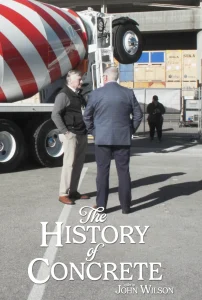
It is hard to think of a more boring title for a film than The History of Concrete, yet John Wilson (of HBO’s hit comedy series How To with John Wilson) has deliberately made a movie with that very title — and it is not only an entertaining film, but a masterclass in existentialism. Comedy and tragedy can go hand in hand, and existentialism provokes both of them, as Wilson shows while bumbling his way across the New York streets, on the roads of Rome, and in a convention center in Las Vegas (among other locales).
By the end of his feature, Wilson has created a tapestry of recurring philosophical themes that he has somehow managed to pack into a movie about one of the dullest topics imaginable.
Entropy — the theory that everything in the universe is prone to inevitable decay and chaos—is a recurrent theme in the documentary. Wilson was spurred to make the film after being confronted with leaks in the concrete floor of the basement of the townhouse he owns in Ridgewood, Queens. Wilson tried filling the cracks in himself with concrete bought from Home Depot; and we see the plumber whose services he hired afterwards proceed to criticize the faulty job as he surveys the damage. Wilson does not return to this thread for the most part, and drops it, like many subplots, with little to no resolution.
Concrete is proverbially tangible and one of the building blocks of our daily life, yet we rarely think about it until it inconveniences us in some way. Throughout the film, though, Wilson films various examples of concrete failing, whether in the case of cracks in a random sidewalk or in the form of crumbling parts of the infamous Brooklyn-Queens Expressway, long overdue for maintenance. Water, time, and erosion works its magic on all forms of concrete eventually, sweeping it away and breaking it down. Though Wilson later does a panicky drive on the BQE, he also does not return to this plot thread.
Late in the film, Wilson befriends musician Jack Macco, whom he meets at a liquor store handing out free samples of mezcal, after he learns that Macco is in a band. (Prospective backers announced they would only finance the film if a prominent musician was featured; after floating numerous underground musical artists, Wilson had given up, before meeting Macco and learning of his talents.) Over the next few scenes, Wilson follows Macco to various gigs and concerts across Long Island, as Macco struggles to make an impression on crowds more interested in football games and beer than in hearing some original songs.
Tragedy strikes, however, as Wilson follows Macco around. One night, Wilson meets him and gets the news that Macco’s fiancée of eleven years has passed away unexpectedly of “Natural causes.” “Nobody dies of natural causes,” Macco says. One of the reasons humans fear death so much is when it comes unexpectedly. “She’s not supposed to be dead,” Macco says a few days after her passing. “She’s supposed to be here.” Macco’s fiancée passed away from sepsis suddenly in a hospital, as Wilson learns from her New York Times obituary.
It turns out, Macco’s fiancée was Dorothy Chin Brandt, a judge and well-known trailblazing Chinese American jurist. When Wilson attends her memorial service, however, Macco is not in attendance — he’s at a concert, performing, which he feels is what his fiancée would have wanted.
One night, after a performance, Macco and Wilson step outside of Macco’s hotel room to stare at the Atlantic Ocean. Wilson asks Macco if he believes in “constructive trauma” — he is hearkening back to a Hallmark filmmaking class Wilson took early on in the film in which the instructor said that trauma in a Hallmark movie is acceptable, but that it must be “constructive.” “Making lemonade [out of lemons], you mean?” Macco asks. “I guess, yeah,” he says, with a tentative smile. In the end, despite his grief, Macco overcomes it and is able to press on, continuing to pursue his dreams and his career in the face of overwhelming unknowns. None of this has anything to do with concrete, of course, which is the point of the documentary—the film isn’t really about concrete, but a whole host of other things Wilson finds interesting as he gets increasingly distracted while making his movie.
But perhaps the most poignant expression of existentialism comes close to the film’s climax. Earlier on in the film, Wilson discusses the Buddhist practice of making sand mandalas. This comes as Wilson discusses how Buddhist monks have more respect for sand, an integral part of concrete, than most concrete-makers. Sand mandalas are a type of Buddhist artwork made by intricately placing grains of colored sand in elaborate patterns, before being eventually washed away, a reminder of life’s impermanence. The Rubin Museum of Himalayan Art featured monthly mandala creations and destructions for the public’s viewing prior to the institution’s closure. Wilson was able to visit the museum during the creation of one such mandala to film the process.

Later on in the film, Wilson covers the attempts by the city’s Adams administration to pass its “City of Yes” bill, allowing for legislation and modification of zoning laws to build more affordable housing. Despite heated opposition, the bill ultimately passes, to the pleasure of Mayor Eric Adams and Governor Kathy Hochul. The existentialism comes at their press conference following the bill’s success.
The mayor and the governor’s celebration of their bill’s passage cuts back and forth to the destruction of the sand mandala, as the Buddhist monks wash it all away. Wilson at one point blocks out the mayor’s head with just his thumb and pointer finger, showing how small the mayor looks when viewed at a distance. The implication was clear to the audience, who burst into uproarious laughter throughout the scene — although the mayor may have secured his victory today, all human progress is impermanent, and one day even his triumphs will be washed away like the sands of time. The juxtaposition between the mayor’s plans for building and the destruction of the mandala echo the ancient expression: Man proposes, nature disposes.
In the end, The History of Concrete, like the building blocks of cities themselves, is another shot in the dark, another attempt by a builder to leave his mark on a world hostile to all things except change. Denial of change, Wilson says, is the source of all pain according to one Buddhist doctrine. Change comes for everything, and everything will be destroyed, eventually. Yet Wilson, much like the world’s concrete-pourers, from the Roman builders of the Pantheon to the construction workers who built the BQE, has made something that will last, at least for a while. So does Wilson make his war upon entropy, and the result is a combination, a farrago, a mishmash of themes of existentialism.
You May Also Like
-
 November 16, 2022
-
 March 1, 2019
-
 December 13, 2018