
When Ali G Meets the Stanford Prison Experiment
Reality satire has to contend with the everyday cruelty of Meta and X
Watching a guy in a tracksuit play dumb and ask Buzz Aldrin, a man who walked on the moon, whether we could walk on the sun if we went in winter was peak comedy.
I used to watch Da Ali G Show in the early 00s. Sacha Baron Cohen put on a series of ridiculous disguises, most famously Ali G, a clueless wannabe gangster who interviewed politicians and celebrities who had no idea they were part of a joke. The genius was watching powerful people try to maintain their dignity as they answered him seriously. It was subversive, proof that the people running things are papier-mâché puppets, and someone just had to be willing to make them look like idiots. Twenty years later, the joke lands flat. We live in an always-on reality show, even if we don’t watch: watching, being watched, performing and consuming other people’s theater until it becomes a never-ending feedback loop of bullshit.
According to Pew Research Center, only 17% of Americans trust the federal government to do the right thing always or most of the time. In 1958, that number was 73%.
It’s an easy cash grab to take something Millennials loved and farm it for content. It’s everywhere, from a new Gremlins movie to Netflix’s The New Stanford Prison Experiment, released October 21, and Ali G: Who Iz I?, which opened in theaters October 23 before landing on Prime Video five days later.
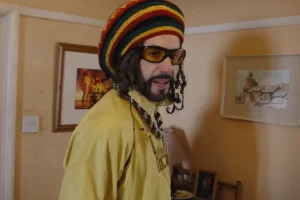
Neither is an easy watch, thanks to one flawed premise: that no one is paying attention in the margins. Both depend on a gap between how people act on camera and how they really are. In 2026, that gap is history. Everyone performs all the time, attention gets farmed down to the last feet pic sold to cover rent, and the cruelty these projects used to work so hard to draw out is already immediately on hand, in everyone’s phone.
Pew found that 38% of Americans under 30 regularly get their news from social media influencers. (Shout out Aaron Parnas.) The distance between professional authority and some guy with a ring light has never been shorter.
And then we land on the Stanford Prison Experiment, reality TV’s cruel grandfather.
In 1971, Stanford psychologist Philip Zimbardo recruited college students for a simulated prison experiment, randomly assigning them roles as guards and prisoners inside a makeshift jail in a university basement. It was a follow-up to the famous Milgram experiments at Yale in the early 60s where students routinely obeyed figures in authority even if these authority figures had no power over them — and even if they were (seemingly) causing people excruciating pain.
What was supposed to last two weeks at Stanford collapsed after six days amid humiliation, psychological distress and abusive behavior. It became a cultural landmark, supposedly proving that ordinary people did not only obey monstrous authority, but could become monsters themselves when handed authority.
I first saw it in the late ’90s at a house party, on a shaky VHS some older brother’s weird friend brought over. It was something you learned about in psychology classes or read about in books, but watching it was different. You talked about it at length: how cruel people are, how quickly the thin veneer of civilization disappears when someone gets a little power.
Except the researchers were helping manufacture the behavior they claimed to discover. A 2019 investigation by Thibault Le Texier examined the experiment’s archives and interviewed 15 participants, finding that guards had received specific instructions about how to treat prisoners. The cruelty wasn’t merely observed. It was coached.
The participants weren’t operating in some vacuum of human nature. They were responding to expectations, instructions and the knowledge that someone was watching, which makes the whole thing less a scientific revelation than an early blueprint for reality television. The camera doesn’t necessarily reveal who people are. It encourages them to become whatever the production needs.

Now Netflix has yassified it into some Mind of a Murderer-esque binge for the serial-killer-documentary crowd. Call it cruelty with a safe word. Even the producers admit it’s not science. Executive producer Jane Lipsitz said recreating the original “would be unconscionable.” Participants get psychological screenings and can leave at any time by using a safe word. Lipsitz says the show is timely because we’re in “a moment where we are constantly confronting questions about authority, conformity, group identity, and the systems that divide us.”
Watching it was an exercise in futility. Producers hand out instructions, participants sit for confessionals, and there’s no real cruelty beyond “the guard was mean to me and I felt dehumanized, so let’s talk about it.”
But what is being exposed here that the audience doesn’t already understand? We’ve watched the internet turn public humiliation into an industry and human suffering into entertainment. The original Stanford experiment was a disaster masquerading as science. Its modern incarnation is entertainment masquerading as an experiment.
Who Iz I? takes the opposite approach, mixing a scripted comedy with Baron Cohen’s old hidden-camera tricks. The film’s climax is where the whole thing gets particularly fucked up. Baron Cohen resurrects his former Israeli military officer character, Erran Morad, who recruits a group of anti-immigrant conservatives for a bizarre training exercise. What begins with ridiculous military gadgets, including a weaponized pair of fake butt cheeks, escalates into a staged kidnapping of Ali’s pregnant girlfriend, Julie. The men — leaders of local Republican groups — help abduct her, participate in a fake childbirth and attempt to prevent the newborn from becoming an American citizen by sending it to Mexico. Eventually, a fake baby is attached to a drone, and one participant is persuaded to press a button that would send it plummeting to the ground. He does.
The authenticity gets murkier offscreen. One participant later maintained to The Guardian that he recognized Baron Cohen and played along, while another told them he had been deceived.
Netflix built a jail and got contestants. Baron Cohen built a fake commando unit and got the real thing.
And there’s your issue. Baron Cohen doesn’t have to manufacture cruelty. He only has to permit it. At least one participant goes along with an increasingly deranged scenario under the pretense of defending America, to the extent of killing a baby. It’s disturbing, sure, but is it revelatory? Baron Cohen gets the footage, but the audience knows the punchline. The real experiment is happening every day outside the movie.
And bro, have you met the President? The movie opens with archival footage of Donald Trump telling Ali G that people were doing business transactions with rocks hundreds of thousands of years ago. That man runs the country. The call is coming from inside the stupidity house, my dude. Satire needs a sense of shame to push against, and that shame is gone.
The people in charge don’t need a comedian to make them look foolish. They do it themselves. The performance has devoured the punchline. Twenty years ago, reality television needed to manipulate people into becoming spectacles. Now people volunteer, and the platforms distribute the results. Follow and Like for more.
You May Also Like
-
 June 4, 2019
-
 October 28, 2026
-
 October 2, 2019
