
Join Brad Pitt for ‘The Further Mis-Adventures of Cliff Booth’
With Tarantino on pen and David Fincher in the director’s seat, the latest vibe is beyond
The Further Mis-Adventures of Cliff Booth, directed by David Fincher and written by Quentin Tarantino, is both a spiritual sequel to Tarantino’s 2019 vibe epic Once Upon A Time In Hollywood, and also an actual sequel. Once Upon a Time is close to a perfect movie but, if anything, Cliff Booth is even more perfect, tighter, sexier, more fun, and vibier. It’s both a throwback to pre-blockbuster cinema and a guide forward to a new kind of blockbuster. It’s my favorite movie of the year, by miles.
The Further Mis-Adventures of Cliff Booth ★★★★★ (5/5 stars)
Directed by: David Fincher
Written by: Quentin Tarantino
Starring: Brad Pitt, Elizabeth Debicki, Scott Caan. Yahya Abdul-Mateen II, Peter Weller
Running time: 140 mins
You don’t have to have seen Once Upon A Time to enjoy Cliff Booth, but it helps. Tarantino has filled his screenplay with Easter eggs about the Booth-verse. We learn that Leonardo DiCaprio’s Rick Dalton, completely absent in the sequel, is now in Australia, shooting a TV series called Dingo Dan. There are callbacks to the thwarted Manson murders, to Cliff’s epic Hollywood lot throwdown with Bruce Lee, and to Red Apple cigarettes. The opening scene takes place entirely in the New Beverly Cinema on Melrose Boulevard — now owned by Tarantino — which is still a total dump where you can watch blaxploitation flicks on the reg.
Whereas Once Upon A Time was a kind of alternate history of Hollywood, taking place in the late 1960s as the old studio system was crumbling in favor of a new generation of auteurs and styists (exemplified by the swagger of Roman Polanski), Cliff Booth exists in the exhausted and exalted moment of 1977, with Star Wars on the marquee and the blockbuster era on the horizon.
It’s as ahistorical as America can get — with a shoutout to Paul Thomas Anderson’s Licorice Pizza, another fabulous tribute to L.A. in the 1970s. Brad Pitt’s Cliff Booth, an ex-stuntman with a noticeable limp, is a kind of Hollywood fixer who people can call upon to do violent, unpleasant jobs. He’s a kind of noir antihero in the mold of Elliot Gould in The Long Goodbye, Joaquin Phoenix in Inherent Vice, and even Jeff Bridges in The Big Lebowski. Cliff Booth fits squarely into the tradition of L.A. noir, but is the hippest possible version of it.
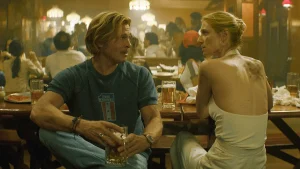
The plot is ridiculously simple. Karen Crosby, a long-legged Hollywood agent to the stars (beautifully played by Elizabeth Debicki, who hovers over the movie’s many Short Kings like a magnificent ostrich) contacts Cliff to do a job for one of her clients, a smarmy but charming TV star played by Scott Caan, who shows that he can hold the big screen as well as the small one. The job turns out to be unpleasant and violent, and we’ll leave it there to avoid further spoilers.
As with any classic noir, the journey is more important than the destination, and Cliff Booth takes its sweet time getting there. Whereas Once Upon A Time was basically a buddy comedy about the Manson Murders, Cliff Booth is a kinky romantic comedy. Karen is Cliff’s sidekick, his equal and his better. And because this is Fincher directing, not Tarantino, we don’t have to see closeups of her feet. Carla Gugino, who plays Caan’s wife, is also on hand, looking great and playing her part with terrific magnetism. Peter Weller plays Booth’s dad and is the most realistic cool old dude on screen in many years.
This movie succeeds so well because Cliff Booth is a kind of fantasy object. For women, the appeal is obvious. It’s Brad Pitt, at the height of macho nonchalance. For men, he’s The Most Interesting Man In The World, despite having less than no money. He ticks all the boxes: He races cars, can mix the best cocktail in Southern California while high on mushrooms, picks up a tennis racket and delivers a kill shot with ease, knows everything every woman wants, is a genuine war hero, beat both Bruce Lee and Jim Brown in fights, and, most importantly, has the respect of a father who clearly loves him.
Tarantino’s screenplay delivers Booth with only the slightest hint of irony. This is clearly the man he aspires to be. It’s What Men Want. And the film also delivers a terrific monologue, through the mouth of Karen Crosby, about Tarantino’s philosophy of moviemaking. I don’t remember it exactly, but he’s basically saying that film is entertainment, a hamburger. Burgers can be tasty, but they’re still just burgers, and Cliff Booth is a kind of thumb in the eye to cineastes everywhere.
A brief note about AI before I go Figure 8 racing and work my night shift at Lucy’s El Adobe: Fincher has been quite open about his use of the technology to color around the edges, using it to enhance dialogue and fill in the blanks in certain kinds of pseudo-historical footage. Yeah, it’s there, and you can notice it if you squint.
But not only does AI not take away from the experience of enjoying this film, it adds to it. Because if Tarantino’s Once Upon A Time-verse is about anything, it’s about how cinema, and entertainment, is always changing, and the winners are the people who can flow with the times. Like Cliff Booth, the old guys may be archaic, but they’re still useful in their own way. This may be the first mainstream film to admit to using AI, but it won’t be the last. And it might always be one of the best.
You May Also Like
-
 May 15, 2017
-
 July 16, 2021
-
 November 8, 2022
