‘The Golden Door’ Reminds Us That Thanksgiving Is an Immigrant Story
Emanuele Crialese’s depiction of a Sicilian family at the turn of the twentieth century feels more potent and relevant than ever
As Americans prepare to celebrate Thanksgiving, I wonder how much we have forgotten about our own immigrant ancestors’ experiences.
Recently, I rewatched Emanuele Crialese’s 2006 film The Golden Door (Nuovomondo in the original Italian, now widely available to stream), which follows a Sicilian family’s journey to America. Crialese’s depiction of a Sicilian family at the turn of the twentieth century feels more potent and relevant than ever.
The film opens with Salvatore Mancuso (Vincenzo Amato), a poor Sicilian farmer, climbing a mist-covered mountain with his older son, each holding a rock in his mouth. Salvatore prays for a sign about whether he should leave home. Seeing several photos of giant vegetables and money that seems to grow from trees, Salvatore takes them for signs and, with his prayer answered, he decides to leave Sicily with his sons. He takes the eager sons Angelo (Francesco Casisa) and Pietro (Filippo Pucillo), along with his elderly mother, Fortunata (Aurora Quattrocchi), who doesn’t want to go.
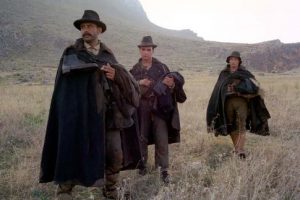
Crialese reunites with Amato, who starred in his earlier films Once We Were Strangers (1997) and Respiro (2002), set on the Sicilian island of Lampedusa. Amato brings a rare combination of innocence and strength to his performance in Golden Door. Beneath his earthy dependability lies a touching vulnerability, a natural dignity that makes us want to follow him every step of the way.
As the primary entry point for Africans entering Europe, the island is now a watchword for immigration, not emigration, lending the film a certain irony. Although Crialese employs magical realism throughout The Golden Door, he never lets us forget the Mancuso family’s brutal existence, rooted in the earth. Now the islanders welcome refugees from elsewhere but, looking back over a century ago, Salvatore and his sons seem almost inseparable from the rugged Sicilian landscape. As they prepare to leave, we can almost feel their bodies being pulled from the land itself, as though they are being uprooted.
Before departing, the villagers give the family their finest clothes. The village elder offers shoes that once belonged to a scoundrel with a heart of gold and the son of a baron who died as a child. In these secondhand garments, the Mancusos will carry a piece of their village’s history to America, its rich and poor, its saints and sinners.
They are urged to plant seeds in more fertile soil. As the ship pulls away from the port, Crialese’s camera captures a sea of faces, those aboard staring toward the unknown and those left behind watching their loved ones disappear. As the ship leaves the harbor, the promise of a better life gives way to the frightening realization that the journey itself is only the beginning of their struggle.
The narrow distance separating them grows wider by the minute, a few yards of water becoming an ocean that, for some, might as well be eternity.

In the ship’s cramped quarters, men drum and sing, women wash one another’s hair, and men shave one another. These rituals seem essential to their survival, a way of preserving their humanity and the familiar bonds of home even as they prepare to embrace America. Although they have left everything familiar behind, the passengers are determined to create a community of their own. Holding on to their cultural identity helps them cope with the hardships of the journey and preserve their dignity in the face of uncertainty.
Aboard the ship, Salvatore grows close to Lucy (Charlotte Gainsbourg), a single Englishwoman traveling alone to America. Although strangers, they seem to form an unlikely family as they embark on their journey toward the New World. In one scene, Salvatore catches sight of Lucy, and the two seem to perform a lyrical dance as they move through the ship, a courtship unfolding somewhere between the sea and the clouds. Crialese choreographs their movements, turning their attraction into a vision, suggesting the possibility of new bonds even as the passengers leave their old lives behind. For Salvatore, a widower, Lucy makes the promise of a new beginning tangible. Even before reaching America, he is already imagining a future beyond the life he has known. But in The Golden Door, the Mancusos discover that their willingness to embrace America doesn’t guarantee America will embrace them.
At Ellis Island, passengers undergo physical examinations and intelligence tests. Salvatore cannot read or write, but he is willing to work hard to give his sons a better future. The mythical country, full of unimaginable abundance and wealth, now appears to be a place where he and the rest of his family are measured and weighed by the ounce. The Mancusos soon discover they must prove themselves worthy of admission.
Fortunata presents the film’s most complex challenge. Unlike Salvatore, she has never wanted to leave Sicily. At Ellis Island, her unwillingness to submit to authority leads to her being refused admission. She chooses to return home. For Fortunata, America does not represent freedom if it demands that she surrender her independence. The Mancusos will not embark on their new life as the same family that left Sicily.
Watching the film brought back memories of my father. Every Thanksgiving, he’d pull out a map of Massachusetts, point to Plymouth, and tell us about our family history, going back to Edward Doty, a Mayflower passenger from whom he was descended. He also told stories about Dutch farming families who came to Brooklyn when it was still New Netherland.
This Thanksgiving, I think again of my father’s map and the stories he told with such pride. His ancestors’ voyage across the Atlantic became part of our family’s history. Today, descendants of Mayflower passengers are celebrated as part of America’s founding heritage. Yet we tend to romanticize those early crossings, forgetting that not everyone aboard was privileged. Edward Doty, for example, traveled as an indentured servant, much as Salvatore Mancuso would cross the Atlantic centuries later in search of a better life.
Thanksgiving is a story of welcome where we all play the role of immigrants who have left a hostile home country. Even as we display gratitude for our new home in America, we begin to forget the troubles that we fled and the trek that escape entailed.
Crialese’s film beautifully strips away convenient romantic visions of the immigrant experience and shows just how perilous and uncertain the journeys were. The Golden Door follows the Mancusos as they leave Sicily believing in a country of almost mythical abundance, only to discover that entering the New World may require sacrificing part of the old one. For Fortunata, that price is too high: belonging is not worth losing everything that makes us who we are. It turns out that even Golden Doors open both ways.
You May Also Like
-
 January 4, 2025
-
 November 25, 2020
-