
Fed to the Dogs
James Thurber’s hilarious takes on canines and our relations with them enter the Library of America canon, at a fitting moment in our national life
“The public and the press had found something pretty special to kick around, and they kicked it around in that peculiar American way, which encompasses everything from elaborate gags to solemn senatorial investigation,” James Thurber writes of a scandal in the story “Blaze in the Sky,” one of the pieces included in the new Library of America collection Thurber’s Dogs.
Right now, after the midterm elections, Thurber’s characterization of “that peculiar American way” seems particularly apt. We are likely to face our fair share of “solemn senatorial investigations” in coming months, along with possible impeachments. Meanwhile, those despondent about the electoral outcomes, their remaking of the political map, and the ugly battles ahead may find refuge in his absurd humor.
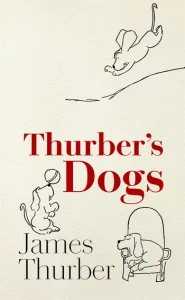
Thurber’s Dogs
By James Thurber
Library of America; 292 pages
Thurber offers an abundance of gags, some narrative and some visual, along with thought-provoking takes on the excesses of bureaucracy and its potential to make the lot of Americans all the more miserable and in need of comic uplift.
“Blaze in the Sky” is about the uproar that ensues after a bull mastiff, Blaze, secures a place on an Army transport plane headed from Memphis to Southern California one day in January 1945 – a flight too full to accommodate three active-duty servicemen desperate to get to the West Coast. Blaze belongs to an L.A. actress and the wife of a lieutenant colonel who is part of the Roosevelt dynasty, but surely a dog’s interests are not more important than those of enlisted personnel, including two Seabees hell-bent on getting home to a bereaved mother and a sick wife, respectively.
The sequence of events that ends up with Blaze on the cargo plane and the enlisted men off it is like something out of Catch-22. An Air Transport Command (ATC) lieutenant examines the dog’s official priority and that of the men. “He said the men would have to get off the plane to make room for 300 pounds of B-priority freight that had piled up at the Memphis field,” Thurber writes. “Blaze outranked the cargo, but the cargo outranked the servicemen.”
 More concerning than the dearth of available flights for California-bound personnel is the blame game that ensues when the national media get wind of the snafu. Secretary of War Henry Stimson points his finger at unnamed subordinates, while the ATC’s head honcho, General Harold L. George, admits that “somebody” in the chain of command showed poor judgment. “Mrs. Eleanor Roosevelt, cornered in Washington, said she did not believe any plane dispatcher would be stupid enough to put a serviceman off a plane in favor of a dog.” But someone, somewhere must be responsible. How very like Washington!
The furor morphs into a full-blown political scandal, with Rep. George P. Miller of California writing to Stimson to demand a full report on “a deplorable incident,” and Rep. Clare E. Hoffman of Michigan giving a speech on the floor of the House asking “what the boys in the Pacific would think if they found out that three of their buddies had been bumped off a plane to make room for a dog.” Few people, in or out of Franklin Delano Roosevelt’s administration, see humor in the situation, as talk of high-level investigation abounds. How familiar this sounds in 2026.
In mid-century United States, as now, it took a certain bold comic spirit to make light of the incompetence and sententiousness of the gargantuan bureaucracy that FDR helped make a lasting feature of American life. There is much else in Thurber’s Dogs that will ruffle feathers or, in the words of Patrick J. Buchanan, set off every poodle in liberalism’s kennels.
A case in point is “The White Rabbit Caper,” whose opening is straight out of one of Raymond Chandler’s hard-boiled exercises in L.A. noir. A Mrs. Rabbit steps into the office of Fred Fox, private investigator, with a request in mind. She wants the PI to help find a relative who has abruptly gone missing – one of her “thirty-nine thousand descendants,” a young hare named Daphne, who has apparently run into trouble after visiting the Lily Pad Night Club.
When the PI and his new client arrive at the club, and the PI grills Ben Rat, Hoot Owl, Franz Frog, and other of the seedy regulars, Fred Fox quickly deduces (spoiler alert) that Mrs. Rabbit is not what she claims to be. Mrs. Rabbit is, in fact, Daphne, who murdered and then impersonated her own older relative and came up with a hare-brained ploy to cover her tracks. This theory of the crime is of interest to Inspector Mastiff and Sergeant Dachshund. It may upset people indoctrinated into the Abbie Hoffman school of thought, which holds it a mistake to trust anyone over 30.
Along with the humor and whimsy, there are somber strands in Thurber’s tales of dogs and other creatures. “Josephine Has Her Day” is the story of a couple, Dick and Ellen, who decide that making a home of their bull terrier has become more trouble than it is worth. Dick came up with the name for the dog with the wife of Napoleon, “the famous runt,” in mind, as he puts it.
“As the days went on, Josephine seemed to have taken the stigma of runt literally, as a thing to be religiously lived up to,” Thurber writes. “She remained undeveloped physically and, Mrs. Dickinson declared, mentally, too.” Even games of fetch leave the dog nonplused and the owners all the more dissatisfied. They resolve to give Josephine away to a family in the area surrounding their cottage in the Adirondacks. But finding a host for the dog proves harder than it sounds. At last they find a farmer, Floyd Timmons, who will take in the puppy.
After giving up Josephine, the former owners begin to feel some stirrings of remorse. They attempt to get the dog back, but Timmons has passed on the animal to another foster owner, who has given it to still another. At length the dog has ended up in the care, if that is the right word, of a large-bodied lout named Norb Gibbs, who becomes violent at the suggestion of letting Josephine’s owners reclaim her. They could have avoided the mess in the first place if they had acted with decency and not decided that the time and trouble of keeping a so-called runt was a valid excuse for abrogating their responsibility to an animal they had let into their lives.
“Josephine Has Her Day” will remind some readers of Guy de Maupassant’s great story “Pierrot,” in which two French ladies decide that the cost of keeping their loyal dog is too much. So they take Pierrot out to a remote cave where others have left pets, and deposit him there. Out of a residual sense of obligation, and guilt, the two ladies make forays at night to provide food for Pierrot. But ultimately the fate that they did not want to admit to wishing for arrives as another, more savage beast attacks and mauls the poor abandoned dog.
The moral message of both stories is clear: allow questions of simple convenience to weigh on moral decisions, and the decisions cease to be moral. In post-midterm America where the swing was so big, it’s not clear what the specific mandates actually are for the newly-governing democratic decisionmakers, it is a message that may not hold up well.
You May Also Like
-
 August 4, 1996
-
 December 12, 2018
-
 June 7, 2020
