
Taking a Dunk in ‘The Mosquito Bowl’
Peter Berg turns a true story of football players fighting in the Pacific into a gory spectacle
Peter Berg’s The Mosquito Bowl is based on the 2022 book, The Mosquito Bowl: A Game of Life and Death in World War II by Pulitzer Prize-winning author — and Berg’s cousin(!) — Buzz Bissinger. Bissinger and Berg have collaborated before to great effect: Bissinger authored Friday Night Lights, which Berg turned into a film and then a culture-changing award-winning TV series.
The Mosquito Bowl centers on the stunning true story of four star college football players who enlist in the United States Marine Corp after the bombing of Pearl Harbor, and wind up serving together from boot camp to Okinawa. But this is not a football movie. It’s a war movie. Or, as Berg would call it, an anti-war movie — though I question whether this harrowing depiction will leave a bad taste in audience members’ mouths, rather than whet some appetites for graphic, realistic violence.
The Mosquito Bowl★★★★ (4/5 stars)
Directed by: Peter Berg
Starring: Nicholas Galitzine, Bill Skarsgärd, Ray Nicholson, Tom Francis
Written by: Peter Berg, Mark L. Smith, Buzz Bissinger
Running time: 127 mins
The film opens with an epigraph from Herbert Hoover, “Older men declare war but it is the youth that must fight and die.” We then meet our gladiators, each on his respective football field: John McLaughry (Nicholas Galitzine) at Brown, “Touchdown Tony” Tony Butkovich (Ray Nicholson) at Purdue, and both Bob Bauman (Bill Skarsgärd) and Dave Schreiner (Tom Francis) at Wisconsin. Each young man has a bright future, some already lauded for their greatness and tasting fame (Butkovich and Schreiner were both first round NFL Draft picks). We see them choose to enlist, confident that they can make a difference, that their country needs them. We watch them leave their families and girlfriends, nervous but self-assured.
Boot camp on Parris Island is a wake-up call, but these athletes have had demanding coaches before; they’re up to the task. When they are literally dropped into the middle of a land-sea battle on Tarawa, everything changes. The world is bigger than they imagined. They have less control than they realized. People are being blown to bits within arm’s reach. Somehow, our four gladiators survive battle after battle and find themselves on leave in Guadalcanal being entertained by Bob Hope and singer Frances Langford. The disconnect is too much for some and troop morale stays low.
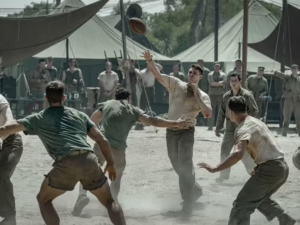
Sensing the men need something more, and recognizing the depth of talent in camp, General Buckner (played by Berg) organizes a football game. On Christmas Eve Day 1944, the 4th regiment squares off against the 29th for “The Mosquito Bowl.” The touch football game quickly becomes full tackle – not surprising, given 56 of the 65 players had reportedly played college ball and 16 had been drafted or would go on to receive offers to play in the NFL. Our heroes light up on the dirt field. This is a world they understand. This is a world where they are safe and happy. It takes 90 minutes for us to get to that football field, and we only stay there for about 10.
Seeing the unbridled joy on Butkovich’s face made me nervous for what lay ahead for him, and for the audience.
The ethical line between depicting violence — which this film does in graphic detail — and glorifying it has often been discussed. I definitely felt part of that discussion while watching. While the innovative technology, cinematography, editing and sound design are impressive, some images were simply too repellent, I had to look away. I wonder if the quest to make war look so violent that we won’t want to participate engenders a fascination with the violence and its realistic depiction. Does it make us want to avoid war, or thirst for more realistic video games, curious about the many innovative ways that humans have to inflict pain and death, to dominate and win and crush our opponents? Like we do in football?
Despite being centered around the game, the film perhaps misses an opportunity to explore its parallels with war. There are a couple satisfying moments when the teammates use their grid iron skills to strategize and persevere on the battlefield, but that’s where the comparisons end. Instead, the football field serves as a contrast to the battlefield, an ephemeral island of familiarity and safety in the terrifying and foreign South Pacific. We may draw comparisons, but the film does not, nor does it interrogate the voyeurism that feeds the battle both on the field and the screen.
Berg may hope that explicit, gruesome battle scenes will serve as a deterrent, but my attention was captured by a couple more subtly subversive elements. The Marines refer to their counterparts as “Japanese people.” Although accurate, it also struck me as a humanizing mode of language. They don’t use nicknames or slurs or even a monolithic term like “The Japanese” or “The Enemy.” They call them people, which they are. This subtle motif recurs throughout and struck me every time.
Another, more overt motif is that of The Overview Effect. I was a little confused the first time the camera “pulled back” from a battle to a suspended, silent shot of the earth from space. Then, I thought of a time I flew over Nicaragua as a teen and thought the impermeable canopy looked like the perfect cover for the guerilla warfare that dominated the news – everything below was invisible to me. Seeing Earth from space is supposed to bring up feelings of compassion and love, The Overview Effect. Berg interrupts battle scenes with shots of our peaceful planet more than once, reminding us that all of the destruction we’re witnessing, the horrors of Okinawa, which claimed the lives of nearly a quarter million people, is the work of human beings. We are doing this to each other, it doesn’t even pierce the canopy.
Though the film mostly occupies itself with the seemingly endless capacity of human cruelty, it also captures moments of tenderness between the players and their comrades. The choice to make a film based on actual events and focus on four real people drives home the human toll of combat, and some of the most engaging moments in the film are quiet ones between these four men.The actors do good work, creating compelling dynamics and believable camaraderie – and I could mostly tell them apart! This is no small feat, as not only do they wear the same uniform, but are covered in dirt and blood, sometimes dimly lit and are surrounded by explosions for much of the film. Nicholson’s vigorous portrayal of the competitive, cheeky Butkovich is especially engaging.
The immersive shooting style, intense violence and sheer length of the war scenes in The Mosquito Bowl reminded me of a roller coaster ride that’s simply too fast and too curvy. I found myself white-knuckling it, glad that the violence and gore would end. Berg has said he wants the audience to actually feel what it’s like to be in battle, not just think about it, and in that he succeeds. The shots from space offer a kind of respite from the ride, until the final celestial shot of the explosion and mushroom cloud over Hiroshima. That exclamation mark of the Anthropocene – where we inflict so much violence on each other that it rips the natural world apart – marks the end of that war and, perhaps, of peace.
You May Also Like
-
 December 27, 2018
-
 January 11, 2020
-
 September 28, 2018
