
Paweł Pawlikowski Drives Us Through a Decimated ‘Fatherland’
Postwar Germany views itself through the monochromatic portrait of the Mann family
Outside in postwar Frankfurt, the streets connect rubble-strewn neighborhoods full of buildings with scarred facades and bombed-in roofs. Inside, glittering cocktail parties roar with life and an insulated sense of detachment — willfully denying the cataclysmic Nazi failures that the complicit revelers quietly endorse.
Two young men, Wolfgang and Weiland, the grandsons of Richard Wagner and the hopeful stewards of his tattered legacy, appeal to the fete’s honoree: Nobel Prize-winning author and noted Wagnerian Thomas Mann (Hanns Zischler). They want him to talk to the Bavarian Minister of Culture about reviving Wagner’s beloved opera house in Bayreuth for the glory of the music and despite Hitler’s well-known affection for the Nazi sympathizer.
Fatherland ★★★★★ (5/5 stars)
Directed by: Paweł Pawlikowski
Written by: Paweł Pawlikowski, Hendrik Handloegten
Starring: Sandra Hüller, Hanns Zischler, August Diehl
Running time: 82 mins
“The music isn’t the problem,” Mann says flatly. They press him again for his endorsement. “The Bayreuth Opera should be razed, and your mother should be put on trial.” And with that, he politely excuses himself to go to bed.
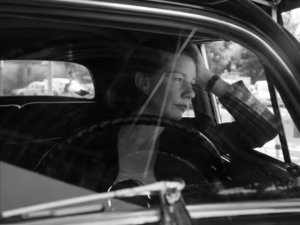 An austere meditation on mourning that’s as slim and dense and sharp as a saber, the monochromatic Fatherland cuts into midcentury European rootlessness with steely precision, using the broad canvas of nationalism to amplify a startling family portrait of personal loss. At the heart of this potent political drama is Mann, the renowned intellectual who left his birthplace in 1933, swapping a rising Nazi party for the capitalistic bosom of California.
Now, in 1949, he’s returned to his home country for the first time in 16 years to receive not one but two competing Goethe prizes: the first in the freely democratic West German city of Frankfurt (where the towering 18th century philosopher was born), and then another in Soviet-occupied Weimar, East Germany (where he lived and died).
Mann can’t simply pick one over the other, precisely because the world expects him to choose a side. Life magazine lumps him with other red sympathizers (along with Chaplin and Einstein), even as the CIA provides protection for the now-American citizen. Mickey Mouse or Stalin? He’s a shill for neither. “My heimat — where I belong — is a much more difficult question,” he replies at an international press conference.
Fatherland has a double meaning, not just in the patriotic sense but also for those who happen to be living in the long shadow of the literary giant — namely, Mann’s quietly obliging majordomo daughter Erika (Sandra Hüller), who chauffeurs him around and manages his affairs; and his estranged son Klaus (August Diehl), an acclaimed writer and troubled drug addict stubbornly ensconced in Cannes. To the world, they are Mann’s children, first and foremost, inescapably defined by their relation to him.
The film comes from Erika’s point of view, as she drives her father from West to East Germany, helps him prepare his lectures, opens his mail, and sits at his side during official dinners. We see her having a long conversation with her ennui-riddled brother, who is professionally celebrated in his own right, who calls Germany “a horrible country with horrible people and a language you can lie in.” He’s more forthright about his displacement. “I don’t believe in anything anymore,” he confides in her. “Maybe we should all kill ourselves.”
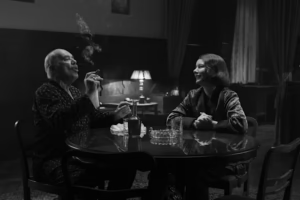 That’s the last time Erika talks to Klaus, and when tragedy strikes, she is devastated while her father sits stone-faced. Mann delivers speeches about the spiritual and moral future of Germany to audiences who want to claim his moral righteousness as their own. “They need us as an ornament,” says Erika. “But deep down, they hate him.” She confides that to U.S. correspondent Betty Knox, a former “jeep buddy” of hers during the war and, considering the intimate tension between them, maybe something more.
Erika’s romantic life is only hinted at, including an ugly encounter with a two-faced ex-husband and passing reference to her current spouse, the famously gay W.H. Auden. She’s persona non grata in a Manichean world that treats her as either a perverted commie or a Yankee poodle. “Let’s go home, papa,” she remarks. Her father’s jaded reply: “Where is that?”
The purgatorial father-daughter trip in Fatherland snakes through a flattened country of dead souls and restless ghosts, children’s choruses and men’s choirs singing nationalistic anthems, soviet propaganda ministers who want to discuss Mephistophelian dialectics and Voice of America radio stations blaring “Hold That Tiger.” Disorienting is putting it mildly. Mann repeats Goethe’s advice about perseverance: “Let us love what’s alive and mourn what is dead. And leave it behind.” Comfort and catharsis only come with a Bach chorale, in a climax of quietly breathtaking beauty. Seems like humanity might just be able to survive after all.
You May Also Like
-
 June 18, 2019
-
 August 21, 2018
-
 September 30, 2020
