‘The Knights of Guinevere’ Takes Us Into the Backrooms of Not-Quite-Disney
Glitch Studios brings a new nightmare drip for the kids
While its flagship The Amazing Digital Circus formally ended with a literally theatrical finale earlier this year, Glitch Studios is still going strong. Ahead of the holiday season and its big potential for merch sales, Glitch Studios has an opening for a weird, disturbing cartoon that appeals to teenagers despite (or perhaps because) its content not being at all child-appropriate. Over a year after the original half-hour pilot, The Knights of Guinevere finally has a second half-hour episode and a release schedule for the remaining ones to drop on YouTube.
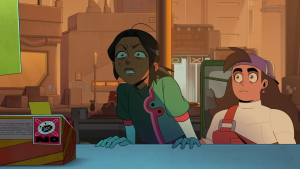
The Knights of Guinevere picks up right where it left off. On the world of Park Planet — a global-sized amusement park — aspiring robotics specialist Frankie and her roommate the ex-robotics specialist Andi ended the last episode only managing to narrowly avoid being obliterated by a building-sized mechanical monstrosity. The savior for these would-be knights? The Guinevere android they’re trying to refurbish. This particular princess seems more than capable of taking care of herself. Well, aside from the ongoing body horror of how she’s literally falling apart, and how her mental state keeps lapsing.
Much like other Glitch Studio joints, Knights of Guinevere avoids spelling out too much of its own backstory. This preserves some mystery but also, because of this slow drip model of a new episode every few months, the creative team does not want to waste precious screen time on exposition, they need to move the story forward. Glitch leaves it up to the fans to hype themselves up by capturing little details, and speculating about what it might mean for the plot. My favorite such catch is that “Park Planet” is a pun. It’s a planet that’s a theme park, yes, but it’s also literally owned by the Park family. Diversity without being too obvious about it.
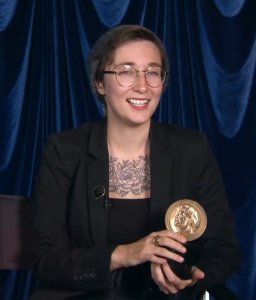
Not coincidentally, showrunner Dana Terrace is best known for The Owl House, an original fantasy show on the Disney Channel about witches and wizards which received regular plaudits for representation while integrating it naturally enough into the setting that it never felt overbearing, and consequently, was more likely to be attacked by reactionaries for promoting witchcraft than for being woke. Though intended for younger audiences, The Owl House resonated with broad audiences despite having no pre-existing branding to lean on. The Owl House also had a reputation for being notoriously queer, although according to Terrace, this does not appear to have been related to the show being canceled.
Rather, the core issue that Terrace faced with Disney executives was the opaque reasoning about what it means for something to be “Disney.” Circular logic has usually settled on whatever it is that Disney has done in the past. Consequently, the behemoth can easily stagnate, throwing away successes specifically for their originality.
Knights of Guinevere is in a messy, ugly place in that regard. Guinevere herself, as a malfunctioning android, appears to only be capable of communicating in canned phrases associated with the Guinevere archetype around which Park Planet revolves. One of the more intriguing revelations in the second episode is that Guinevere does appear to be capable of agency, she just can’t conceptualize her actions as anything except a recreation of the fantasy world embedded as a core part of her programming.
While the Disney metaphor is obvious, it’s also understated. Much like The Amazing Digital Circus and its own peculiar existentialist logic, Knights of Guinevere is ultimately less concerned with being a metaphor than it is with just being relatable. Frankie and Andi’s ultimate career goals are poorly defined. They are not simply altruists or tourists, they have ulterior motives. There is, in the long run, the pretense of a scheme to eventually sell the Guinevere android to somebody and buy maybe a small fleet of spaceships with the proceeds.
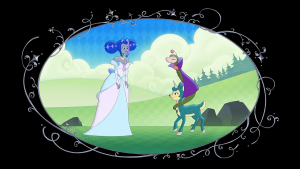
These practical aspects of the show are reminiscent of Stolen Kingdom — the documentary about the community of urban explorers of abandoned amusement parks — but not in the way you’d expect. Frankie is, after all, a garbage scavenger. That she found a Guinevere android is a huge opportunity. But, at every step of Frankie and Andi’s abortive quest to repair the Guinevere android, lurks the specter of the Park Planet. It quite literally controls everything about their lives. But it does this very poorly, haphazardly, and incompetently.
The antagonist of the second episode is just a crooked cop with his own machinations, and Frankie’s dialogue clearly implies this isn’t the first time she’s set one up for a fall, or had every reason to believe she could pull it off. The Park Planet overseers are more reminiscent of Caine from The Amazing Digital Circus than typical stock corporate villains, their incredible capabilities offset by an utter inability to think of anything halfway coherent to do with their awe-inspiring power.
Despite occupying a similar niche, The Knights of Guinevere and The Amazing Digital Circus are not similar in tone or style. They do, however, share a generational view of the concept of surveillance. Unlike Orwell’s Big Brother or Foucault’s panopticon, where obedience is a function of authority figures always watching us, Knights of Guinevere appreciates, as I suspect nearly every young person does these days, that just because we live in a surveillance state doesn’t mean that anyone’s actually bothering to look at the cameras.
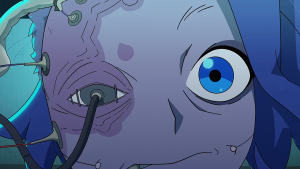
Indeed, as dystopias go, Park Planet seems to have dedicated most of its energy to setting up the cult of Guinevere. The very fact that Frankie and Andi are messing around with the black market of Park Planet’s underworld, an underworld that’s almost certainly been there longer than they have, suggests that corporate stopped paying serious attention to anything that’s been going on in the backrooms for quite some time now.
Frankie is the only character who seems to particularly like Guinevere, having a fond appreciation of the mythos and its relation to her childhood. But she’s openly treated as weird for this, even by Andi, and especially by other denizens of the underworld. Park Planet may be based around the idea that some people, somewhere, really love Guinevere, but the self-interested employees and scavengers of the backrooms have no particular reason to believe in the cult of Guinevere. Laid out like this, the criticism of Disney is rather unsubtle, and it’s to the credit of Knights of Guinevere that the script trusts the viewer to be able to make the thematic connection on their own without having to explicitly spell it out.
This is what Knights of Guinevere really understands about fandoms. Being able to decode the meaning of a text is a huge part of the fun, and I’m not surprised to see the same younger audience that loved The Amazing Digital Circus turn its nose up at more by-the-numbers fare to excitedly gush about the nightmare world of Knights of Guinevere. Of course, it’s very on-point depiction of a world which expects audiences to identify with corporate marketing strategies more than actual people is hardly something only youth can identify with.
You May Also Like
-

-
 November 28, 2022
-
 January 8, 2025