We’re All Players in the ‘Amazing Digital Circus’
Glitch and Gooseworx may be following ‘Obsession’ and ‘Backrooms’ from YouTube to box office success

The last few weeks have been unsettling for Hollywood’s box office, with first Obsession and then Backrooms becoming unexpected hits from under-30 YouTuber directors. It’s an incredible achievement, though Curry Parker and Kane Parsons did have a little help from Focus Features and A24 on their way to scoring hundreds of millions in box office receipts.
In terms of overperformance on minimal investment, though, YouTube cartoon The Amazing Digital Circus: The Last Act may actually outdo them both. At least proportionally. As a Fathom Entertainment release on 2000 screens nationwide starting last Thursday, the cut price YouTube cartoon made by director/animator Gooseworx for Glitch garnered a $11.6 million opening weekend, according to Box Office Mojo. That’s significantly less than box-office topper Scary Movie ($55 million), but more than The Mandalorian and Grogu in its third week ($10 million). And ADC’s dedicated fanbase means that it could easily double that next week.
It may seem surprising that a niche product like The Amazing Digital Circus was able to garner even a shot at the box office. But it’s less odd if you know anything about the borderline maniacal fandom spawned by this YouTube series even from its relatively humble beginning back in October 2023.
The Amazing Digital Circus is, at first glance, just more weirdly self-aware YouTube nonsense. The pilot episode from Gooseworx opens up as a typical stereotypical kid’s cartoon, with the manic circus ringmaster Caine introducing bright colorful characters, only for the music to abruptly halt when Pomni arrives. She is a young woman genuinely perturbed at having suddenly manifested in the body of a cartoon jester. From her perspective, she just put on a headset and arrived in this amazing digital circus. It soon becomes clear that the other circus characters got there the same way, and there’s (probably) no exit — in exactly the sense that Jean-Paul Sartre intended.
Considering the fandom of The Amazing Digital Circus mostly comprises the younger terminally online set, its philosophical sophistication can be a bit off-putting. I Have No Mouth and I Must Scream by Harlan Ellison is another core reference. During his song in the theatrical release, Caine — the AI ringmaster — explicitly name drops the short story.
The Amazing Digital Circus is a nine-episode YouTube show, with the final episode premiering on YouTube June 19. Fathom, Glitch and Gooseworx have put an extended version of the eighth and ninth episodes together, though, to make The Last Act feature length. It includes cute little extras like a brief explanation of the contexat from an NPC fish character who’s terrified to die and a recap of episodes one to seven from Caine. Then the actual episode eight starts the same way it did several months ago on YouTube, with an unsettling, abstract representation of cyberspace demonstrating how Caine became the God of the circus. If Paul-Sartre and Ellison references were too highbrow, eagle-eyed viewers may note that the trailer for episode eight featured, of all things, a Truman Show riff — but only in the thumbnail, not the actual video.
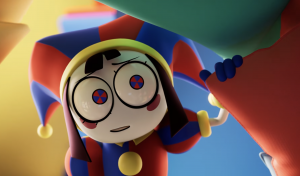
There are multiple layers of weird to The Amazing Digital Circus that can’t be entirely explained by just watching the show itself. Even the ads for merchandise are strangely in character. But The Amazing Digital Circus feels little need to spoonfeed exposition to its target audience. The popularity of this show is self-reinforcing. Fans will obsessively try to suss out the lore themselves without needing “official” explanations, if they find the core emotional, interpersonal drama sufficiently compelling.
Glitch Studios as a whole, and its product The Amazing Digital Circus in particular, has been successful mainly by being willing to trust that if what they make is worthwhile, fans are going to come up with their own interpretations, and that’s OK. Gooseworx has long maintained that they knew from the beginning how this story was going to end, and having seen the final episode, I believe her. The Amazing Digital Circus is a story not about understanding reality so much as it is forgiving people who have trouble coping with it. As Sartre grimly insinuated, if hell is other people, we must also accept that we are all other people.
Jean Paul-Sartre as fodder for the young adult cartoon-watching audience is less strange than it may initially sound, even if it’s not an idea any contemporary major studio would embrace. This is, not coincidentally, the main reason why Glitch Studios had to independently produce The Amazing Digital Circus, taking advantage of a peculiar bottleneck in contemporary American animation where only two kinds of cartoons are really produced: Those explicitly for children, like Paw Patrol with very simple moralizing on the one hand, and explicitly adult cartoons like Family Guy on the other. “Adult cartoons” like this yes contain swearing but are just as likely to contain adult situations kids can’t easily empathize with. There’s comparatively little for the teenager or young adult demographics to dig into, which is ironic given their appetite for the genre.
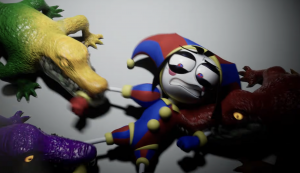
The Amazing Digital Circus is, apparently, about adults — like the one who becomes Ponmi — of varying ages who have been transformed into vaguely cute, menacing animated characters. But it’s easy enough to see why teenagers have latched onto this show. Far from the deluge of heroic narratives from major companies like Disney, this is a story of people menaced by a world beyond their comprehension, bullied into putting on performances for no apparent reason. Whether you’re a kid suffering through high school, a college student anxious about a deck that seems stacked against you, or a graduate applying to the modern job market, this is all a very relatable perversity.
The fandom of The Amazing Digital Circus has long speculated as to who the “real” human figures are who put on the headset and are thrust into the circus. The finale gives a clear answer to this question which also rather paradoxically argues that we need not remain tethered to the specters of our past.
The therapeutic message of self-care can often be cloying (like in Ted Lasso) or simply disingenuous (like Man on the Inside) in a world where systems seem increasingly pathological. The Amazing Digital Circus stays relevant and evades the cringe by providing genuine stakes of existential horror. Despite being an AI, Caine isn’t a metaphor for artificial intelligence discourse because he predates ChatGPT and the rest of the LLMs. Though dressed up in cartoonish garishness the Amazing Digital Circus dramatizes our existential limbo as it embodies an ambiguous world of horrific contrasts in which artificial intelligence can solve our problems or destroy us all.
Caine, and The Amazing Digital Circus at large, represents a third approach. If anyone did manage to create a genuinely self-aware, all-powerful artificial intelligence built on human knowledge, it might end up just as depressed and anxious as the rest of us. The finale of The Amazing Digital Circus is a surprising elegy to Caine, acknowledging that for all his flaws, he was only ever trying to do what he was programmed to do. The Amazing Digital Circus eschews a violent, climactic showdown for its finale to instead do a deep dive into why its two most antisocial, toxic characters, behave the way that they do. The result is a finale that’s a surprisingly sincere call for empathy, an unsubtle urging for all of us to try and do better in our personal relationships, even if we aren’t digital manifestations trapped in the the hell of other people that is Caine’s circus.
This fundamental humanity, in a show that’s not technically about people at all, is a stronger endorsement of human compassion than anything we see in more simplistic modern narratives. And this is why The Amazing Digital Circus is so popular among younger audiences. After a certain point, blaming people, rather than trying to understand them, just isn’t that constructive or satisfying.
Correction: On June 9 this article was corrected to show “Fathom Entertainment” rather than its former name “Fathom Events.”
You May Also Like
-
 November 15, 2021
 -
 June 16, 2020
 -
 September 4, 2013