
‘Chronovisor’ Presents an Intellectually Grounded Indiana Jones-Type Adventure
Jack Auen and Kevin Walker’s debut feature fashions a mesmerizing conspiracy thriller from academic research
When it comes to the Indiana Jones films, most people tend to remember the extravagant action set pieces and Harrison Ford’s star charisma. But one of the main reasons I’ve always gravitated toward that franchise over, say, Star Wars, is that all the movies in the series are, to varying degrees, celebrations of intellectual adventure. What is Indiana Jones if not an academic who has devoted his life to seeking knowledge — in his case, the knowledge that comes with discovering artifacts and what those discoveries reveal about humanity? If that meant, under the stewardship of Steven Spielberg and George Lucas, Jones had to, say, outrun a massive rolling rock or endure an underground rollercoaster to do so, even better.
But of course, Spielberg and Lucas were also paying tribute to 1930s and ’40s cliffhanger serials with Raiders of the Lost Ark and its successors so realism wasn’t exactly on their aesthetic menu. In the real world, one suspects most intellectual adventures like Indiana Jones’s would revolve around considerably more mundane plot turns: phone calls, requests for archival material, and lots of reading. Writers like Jorge Luis Borges and Umberto Eco made their reputations by spinning literary gold out of such pursuits. But it’s harder to imagine electrifying cinema coming from academic research.
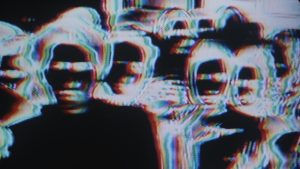
Enter Cosmic Salon, a filmmaking collective based in New York City. Two of its members, Jack Auen and Kevin Walker, have just written and directed their first feature, Chronovisor. After playing the film-festival circuit since its world premiere at Rotterdam in January, it begins a theatrical run at Film at Lincoln Center in New York City on Friday and will play elsewhere in the United States afterward. Among its many achievements, it finds genuinely thrilling ways to make academic research feel cinematic without compromising its cerebral nature. In other words, it plays like a more realistic, intellectually grounded Indiana Jones film.
And I do mean “intellectually grounded,” because, believe it or not, Chronovisor’s basic narrative has a factual basis. In 1972, Italian Catholic Benedictine priest Pellegrino Ernetti, best known for his research into Gregorian chants and archaic music, claimed he created a time machine he called a “chronovisor” capable of observing and recording past events. Among the events he captured was, most remarkably, the crucifixion of Jesus Christ — remarkable, at least, until an Italian journalist reported that the photographic evidence Father Ernetti provided was bogus. Despite the Vatican’s disavowal of the device, Ernetti maintained until he died in 1994 that the chronovisor was real. As of now, though, it has yet to be found, while rumors abound that the Vatican holds the time-travel-viewer.
Auen and Walker build their film around this stranger-than-fiction mystery. Béatrice Courte (first-time actor Anne Laure Sellier) is a Columbia University behavioral science professor who, while researching a monograph she’s working on, comes across an audiotape featuring Ernetti himself discussing his device, claiming that what he’s seen is, however unbelievable on the surface, grounded in the fundamentals of physics. From there, she becomes obsessed with finding the chronovisor for herself. She gleans much of what she learns about the device from long hours spent in libraries reading books, news, and magazine articles. She also sifts through a lot of video material, including a tampered videocassette that she rehabilitates with a screwdriver and Scotch tape. When it comes to contacting those who knew Ernetti, however — like Father François Brune and author Peter Krassa, both of whom published books about Ernetti’s device — she goes the extra mile, calling publishers and fabricating a posthumous award for his musicological achievements.
It’s one thing to see Béatrice make these phone calls and watch archival video; those are easy to parse visually. But when it comes to all the (analog) texts she reads, Auen and Walker hit upon a brilliant visual aid to make it as absorbing to us as to her. Since most of the words are in foreign languages — Italian, Portuguese, Latin, Greek, and more — the directors superimpose English translations onto the words. Furthermore, in some shots, they block out the rest of the surrounding text so the most important words stand out in stark relief.
Chronovisor is more than just an intellectual procedural, however. One of Ernetti’s selling points for his device is the idea that if the existence of Jesus Christ could be definitively proven, that could lend credence to Bible teachings and thereby help prove the existence of God Himself. By contrast, scientists seek to explain how things work in the world around them. And yet, in some ways, science and religion aren’t as far off as one may initially assume. Both fields could be said to present different pathways to the same goal: reckoning with the vastness of the universe. It’s just that for scientists, especially physicists, they put their faith in logic and reason instead of a higher power.
Auen and Walker’s film evokes that spiritual side through their filmmaking. Shooting on Super 16mm film, cinematographer Leo Zhang uses deliberately dim interior lighting to create a feeling of introspective contemplation, with the many library-set scenes especially feeling like being in a church. The use of selections from the three slow movements of Gustav Holst’s classic orchestral suite The Planets on the soundtrack cloaks the film in cosmic mystery. Even the bright white typeface of those superimposed English translations feels spiritual, particularly in the way they almost glow from the pages.
More subtly, the film is also a a character study, of the reclusive Courte who keeps emotions close to her vest. Sellier, the actor playing Courte, is herself a behavioral science professor in real life, adding to the film’s feeling of authenticity. Right from its opening scene, when she explains her research at length in a bar to a couple of colleagues who exude polite boredom, one gets the sense of a person who reserves her greatest passion for her work to an alienating degree. In a later scene, when a couple of other colleagues discuss ways to make their scientific subjects more accessible to their students, it’s Courte’s turn to radiate boredom, most likely thinking more about the chronovisor than about her students. Tellingly, only during the film’s many research scenes do Auen and Walker ramp up their technique, reflecting the introverted passion of its main character.
Without heading too far into spoiler territory, Chronovisor climaxes with an extended bit of experimental video art that could, in a certain light, be seen as disappointing, since it offers more questions than answers. But if you look at its blurry, degraded imagery carefully, one could also interpret it as the most logical ending, psychologically speaking: a supernatural transmission that acts as a mirror to the figure viewing it. Perhaps Courte’s all-consuming obsession with the chronovisor says as much, if not more, about herself as about the world it purports to merely observe and record.
You May Also Like
-
 January 20, 2020
 -
 May 25, 2022
 -
 January 22, 2020
