
Chloe Benjamin Follows Up ‘The Immortalists’ With ‘Under Story’
Loss drives the protagonists to Antarctica and an alternate universe
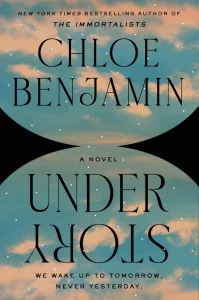
It’s been a long torturous road for 37-year-old Chloe Benjamin who is releasing her third novel after eight years of radio silence. Under Story is an astoundingly imaginative and immersive work of fiction that veers off any sort of traditional pathway and takes us all the way to a parallel universe.
Benjamin’s last novel had the fortune and subsequent burden of being both a huge bestseller and receiving broad literary acclaim. The Immortalists told the story of four siblings who visit a fortune teller during their childhood who informs each of them of the precise date of their deaths. The massive book tour that followed landed Benjamin in the hospital with severe migraines and has since struggled to find her balance.
Under Story centers on Laurel, who is a mycologist who studies fungi, and her hsuband Eli, who is a physicist. In a tragic accident that involves a split-second of negligence their 8-year-old son Silas is swept away by the current. It is an act for which Laurel cannot forgive herself; she had been the one watching Silas when he disappeared. Laurel and Eli’s marriage soon shatters. By chance a few years later, the couple meet up again at McMurdo research station in Antarctica where Eli has come to work as a physicist and Laurel has taken a job as a dishwasher seemingly in penance for losing her son. They both become entranced by the appearance of a strange visual disturbance at the station; an eerie pinkish light that speaks to some kind of otherness.
Eli and Laurel first hooked up in high school, and she remembers how they would lie in the grass and he would speak to her softly about his strange ideas about the universe. He was certain there was life elsewhere and spoke most enthusiastically about some sort of parallel universe attached to this one. He called it the “antiuniverse.” Now, it is Laurel who becomes convinced that the strange aura they keep seeing at McMurdo is the portal to another world he described to her long ago. She thinks if they could somehow make it through to the other side, they might arrive before their son’s death and this time prevent it from happening. In the hands of a less gifted writer, this story might fall flat; but it doesn’t; it soars. We are invested in this couple’s survival and their love story. There is almost a hallucinogenic quality to Benjamin’s prose that is both mystical and reality based. Their story taps into our own repressed desire to go back and change that one something we feel left us helpless. We become exhilarated at the prospect of their second chance.
Under Story
By Chloe Benjamin
G.P. Putnam’s Sons; 512 pages
Benjamin tells the story in an intimate third person that is so close to Laurel that it feels like a first-person narration. Laurel becomes the pivotal character — the one most determined to make things right. She recalls what a bold young man Eli was when she met him, going on and on about neutrinos and how they spun one way or the other and what this determined, and hopes she can convince him now to try to do this with her. It seems impossible; it is impossible by any rational standards, but she becomes convinced it’s not. They just must want it enough. She has trouble breathing at times just thinking about Silas; the chance to have him again overtakes her.
 Benjamin grasps how our early life becomes the template of all that follows. As hard as we try, we can’t really separate ourselves from our earliest beginnings. Laurel has always been obsessed by nature. She is the child of apple growers who always wondered about the roots beneath the apple trees and where they went. She would pester her mother to explain it to her. When she drew an apple tree in class she felt she was being deceptive because so much of what made the tree thrive was invisible to the human eye. Benjamin has her narrator explain to us how Laurel felt as a little girl: “Laurel’s first memories of soil — though at the time, she would have called it dirt — came from weeding in her mother’s garden.” When Laurel took walks with her mother, she would insist her mother identify for her everything they saw together, “Thistle, dandelion, chickweed: they trailed whole cities, tangled with life.” Benjamin paints snapshots of how this little girl obsessed with all the magic lying right around her; various rocks and pebbles and other riffraff; starts to become the person who will grow up to be invested in the art of discovery. Nature’s mysteries are boundless.
As an adult in Antarctica, Laurel still feels a childlike exhilaration thinking about its massive size; it is 40% larger than the whole of Europe. It makes up one tenth of the earth’s surface and holds 70% of the planet’s fresh water. But it doesn’t have Silas.
Benjamin never allows us to forget him, or the pain Laurel and Eli are forced to endure, an unspeakable howling hurt. Benjamin allows Laurel to find some sanctuary in “that pink dome in the sky” that people at McMurdo research station refer to as the Arc. But Laurel sees something else when she stares at the pink dome. It “calls up the rainbows Laurel saw as a child: bright half rings hung high as if conjured by invisible magicians… It seems to pulse, even to breathe. In her it sparks what science used to: a hungry, looming excitement.”
She becomes convinced this is the answer. Laurel convinces Eli to come with her, and they begin planning and training to make a huge dive beneath the dome that will cross some sort of abyss that will either swallow them or spit them out into a parallel Earth where time goes backwards and things work differently. It turns out this universe has its own laws; different from our own. People age backwards. Parents all watch their children die. Trees grow differently. People live for decades without meeting their parents. There is so much cruelty built into the normal life cycle, such dreadful loss. They meet all the people they knew from their own planet, but they are different somehow. Can they get home? Silas, whom they have found, is growing more helpless by the day forcing them to witness his demise in slow motion. What about their doubles? Where are they? Are they trying to get back to this planet? Did both couples cross over at the same time?
Benjamin often interrupts her own narrative with provocative digressions about the wonders of the cosmos. We learn it is 14 billion years old. There was darkness for the first 200 million years. Then stars appeared, and somehow our sun was lit. The Milky Way took shape. Small microbes morphed into animals and then plants, and foliage appeared under thick forests. Human beings came much later. But just as we feeling some relief at this eternal vastness, she reminds us of Eli and Laurel and their enduring love and disappearing child as if to suggest to us that all the miracles in the universe mean little to nothing if we lose those we love.
You May Also Like
-

-
 October 23, 2019
 -
 February 18, 2000
