
‘The Whisper Man’ Deserves this Review
Despite Michael Keaton, Robert de Niro and Michelle Monaghan, this film is already spoiled
The Whisper Man arrived on Netflix on August 28 with a reported $50 million budget, a star cast and the Russo brothers among its producers. Yes, those two Russo — Avengers — brothers. I imagine a substantial portion of that money went to bringing Robert De Niro, Adam Scott, Michelle Monaghan and Michael Keaton to the project, because the rest of the cast looks as if it was purchased on Temu. Monaghan, too sadly, looks like the Temu version of Michelle Monaghan. Faded, uncharismatic, without soul or life.
Yet, for reasons that surpass logic, science and every known human principle, The Whisper Man has become Netflix’s No. 1 movie in numerous countries, including Spain, where I currently live. This is why I have decided to give it a review full of spoilers, because honestly, that’s all it deserves.
Whether you know the ending, whether I tell you who the killer is, whether I explain every ridiculous plot twist or whether you watch it completely unaware, the experience remains exactly the same. You are going to spend two hours watching something so absurd, implausible, incoherent and fundamentally incomprehensible that knowing what happens in advance cannot possibly make it worse. If anything, knowing what is coming might actually make the experience slightly more bearable.
The Whisper Man ★ (1/5 stars)
Directed by: James Ashcroft
Written by: Ben Jacoby, Chase Palmer; based on the novel by Alex North
Starring: Robert De Niro, Michelle Monaghan, Adam Scott, Michael Keaton
Running time: 114 mins
The movie opens with an astonishingly cheap-looking drone shot over an empty field, where a group of police officers discovers a corpse. Among these searchers is detective Amanda Beck (Monaghan), but identifying her as the star of White Lotus and True Detective is surprisingly difficult because she looks like an actress wearing a police jacket, as if the casting department had simply found someone who vaguely fit the description. The whole sequence appears to be an attempt to recreate the atmosphere of True Detective Season One, except with the production value of a student film, and from there we meet Tom Kennedy (Scott), a widowed crime writer who moves with his young son Jake into the house where Tom’s late wife grew up.

Jake is traumatized by his mother’s death and has trouble going down the stairs because, as we later understand, he witnessed something terrible involving her and stairs. So naturally, Tom decides that this is the perfect house in which to raise his traumatized child. Jake also begins seeing the ghost of his dead mother.
The central mystery concerns a serial child murderer known as the Whisper Man, whose modus operandi is to stand outside children’s homes and whisper to them through the windows before abducting them. Except that he does not really whisper. He speaks in a deep, guttural voice that sounds suspiciously like Batman, which means that throughout the movie I kept waiting for Keaton, who plays the original Whisper Man, Frank Carter, to don his batcape and somehow rescue everyone from this disaster. He never does. Carter, of course, is already in prison, having been captured years earlier by retired detective Pete Willis (De Niro), while the new disappearances suggest that someone has revived the old killer’s methods.
Detective Beck therefore seeks out Willis for help but, in the typical cheap-thriller version of the hero’s journey, the retired detective initially refuses because apparently every movie of this kind requires an emotionally damaged man who must first be persuaded to return to the case. De Niro, meanwhile, looks so physically diminished and emotionally absent that I wanted to offer him some soup and suggest that perhaps we should take him somewhere quiet and comfortable. And because the screenplay apparently believes that revelations are the same thing as character development, we eventually discover that Willis is also Tom Kennedy’s estranged father, despite the fact that the two men have different surnames, which is apparently just one more mystery the movie expects us to simply accept.
Meanwhile, Jake sees a mysterious hand wearing a blue glove reaching through the mail slot and trying to grab him, except that Tom sees it too. So, this is not a case of the child imagining things or seeing some supernatural figure that adults cannot perceive; the father literally witnesses a strange gloved hand reaching through the door toward his son. And what does Tom do? He does not call the police, he does not leave the house, he does not barricade the doors or even appear particularly interested in determining who is trying to grab his child. He simply sends Jake to his room. Later, Tom discovers a man hiding in the basement, the man escapes, Tom chases him, falls down and watches the villain run away. At this point any rational human being might reasonably consider moving somewhere else for his own and his son’s safety. Not Tom. He stays in the house, because apparently the possibility of having his traumatized son abducted by a serial killer is not quite enough of a reason to change his address.
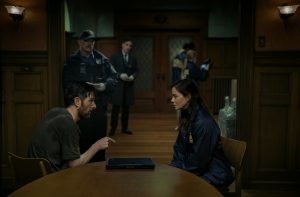
Eventually, of course, the new Whisper Man does kidnap Jake, and the movie transforms into a bargain-basement version of The Silence of the Lambs. Willis visits Carter in prison to seek information, turning Keaton into a kind of Hannibal Lecter without the cannibalism. Keaton, to his credit, seems to understand exactly what kind of movie he is in. His performance has the peculiar quality of a man who knows he has already been paid and has decided to enjoy himself anyway. Everyone else, meanwhile, appears to have been instructed simply to recite their lines. Nobody acts. They say words. There is no dramatic weight, no emotional texture, no sense that anyone involved is actually inhabiting a character, while New Zealander James Ashcroft’s direction is flat as a pancake and the editing sometimes looks as if the entire movie was cut quickly on a smartphone.
The film is based on Alex North’s novel. I have no idea how good the novel might be, but whatever happened between the source material and what eventually appeared on Netflix resulted in a movie in which the investigation itself becomes almost irrelevant because there is simply no reason for us to care about what is happening. Tom is obviously devastated by his son’s kidnapping and responds by drinking heavily, while Carter agrees to help only if his estranged family is brought to the prison so he can see his son, whom he has not seen in years. Again, we are apparently supposed to understand the emotional significance of all this, but the movie has done such a poor job establishing any emotional connection that the whole thing feels like people completing administrative tasks while pretending they are participating in a thriller.
For the denouement we discover, to no one’s surprise, the identity of the new Whisper Man, and the movie finally brings everyone together for the inevitable confrontation. Whisper Man II attacks Beck, repeatedly stabs Willis and is eventually captured after Jake is rescued. There is also a suspicious character who collects objects connected to serial killers, a subplot that seems to exist primarily because someone decided the movie needed one more suspicious person, as well as another police officer whose main function appears to be proving that Beck is not the only police officer employed in the entire town.
And then, when you think the suffering is finally over, the filmmakers find one last way to make the entire experience even more incoherent. Carter has spent all this time wanting to see his estranged son, who is now also in prison, and somehow a guard simply opens the cell door and allows them to meet. What happens next is one of those moments when you can almost hear the director and producers asking themselves how much further they can push an already broken story: Michael Keaton strangles his own son, and the movie ends.
This is perhaps what streaming cinema increasingly looks like: enormous amounts of money spent manufacturing two-hour capsules of attention, packaged around recognizable faces and algorithm-friendly premises. Netflix does not necessarily need these movies to be good; it needs people to click, and people click. Put De Niro, Monaghan, Scott and Keaton on a poster, let the algorithm push it into millions of homes, and sooner or later somebody is going to press play. For Netflix, the machine works. For the producers and actors, the checks clear. Somewhere in the process, however, the idea that a movie should actually be good becomes almost irrelevant.
Maybe this is the future: vast, expensive bags of cinematic hot air, produced to be consumed by an audience already trained to scroll, click and move on without paying much attention to the details, with the occasional genuine little gem appearing somewhere in the catalog to remind us that streaming platforms are still capable of making something worth watching. The Whisper Man is not that gem. It will remain in my memory for one reason only: I wrote this review. And frankly, that is more than the movie deserves.
You May Also Like
-

-

-
 February 28, 2020

Watched this movie and was completely baffled by how bad. No idea what they were thinking with this one. I hope people push back and don’t let this become the future of cinema as you say.
Thank you. I’m glad the review resonated. The more people say “this is not good enough,” the better chance we have of pushing back against this kind of lazy, expensive content.
Brilliantly written! If only this movie was as entertaining as your review.
Ha! That’s the nicest (and most depressing) compliment I’ve received in a while. Thank you, Kiki.
Your review has perfectly encapsulated my every thought about this movie, after watching it last night. And, truth be told, the only reason that I watched it is because several scenes were filmed in my office building (any police station related scene). I agree with every aspect you wrote; it was pretty painful. From further research that I’ve done, it sounds like the book was much better and the plot was potentially plausible. The screenplay did it no justice. I am not familiar with Michelle Monaghan’s prior acting, but totally agree with your assessment of her and the rest of the cast.
Thank you, Angela! So in a way, you and your office building are now part of the history of this terrible movie. That somehow makes it even more tragic.
To be fair, people watch movies while scrolling on their phones. Your point about an uncaring audience and an indifferent studio is poignant, if not incredibly sad.
Exactly. That’s the part that bothers me the most. We’ve trained ourselves (and the industry) to accept less. Thanks for putting it so clearly.
Your review of the Whisper Man is spot on! I want those 2 hours of my life back.
But, if I hadn’t watched it I would not have found your review, which made me lol.
So there’s that I guess. Thank you!
Thank you, Karen. I hope the review at least gave you back a few of the minutes you lost watching the movie.
I completely agree with your review. HOW is this number one on Netflix? When I have to read “an explanation of the ending,” after I watch a movie, it is really crazy. And I just got an email from Netflix that explained the entire movie! Great talent wasted.
Thank you, Carol. The fact that Netflix felt the need to email people an explanation of the movie is possibly the most damning review of all. Appreciate you reading.
Your description of Tom forcing Jake to live in a house that is clearly unsafe reminded me of The Housemaid (1960) and how one of its more baffling plot points is that the family lives in a multi-story house despite the fact that the daughter has polio. There is, of course, a metaphorical significance to this. Much like the titular housemaid, the house itself is symbolic of the family’s dedication to presenting themselves as genteel modernists without regard to whether it is particularly wise or practical for them to do so.
That probably wasn’t what The Whisper Man was trying to do, though, if I had to guess.
Nice one, William. I only wish the director had actually considered the possibility of giving the film some metaphorical depth. There really isn’t any—and that’s a shame, considering the novel, which I eventually read and actually liked.
The book creates a genuinely terrifying, claustrophobic psychological build-up within those walls. The film, unfortunately, destroys pretty much all of that atmosphere through a series of baffling creative choices, narrative stumbles, and what feels like commercial haste.
So perhaps the house could have been a metaphor. The problem is that the film never gives us a reason to believe it is one.