
John Malkovich, Werner Herzog, and Danny Boyle Show Up Big in Italy
Actors and directors bring the goods to the Venice Film Festival 2026
“Why am I wearing this?!?” said director Danny Boyle, hurling translation headphones off his ears after realizing he was the only one speaking. The excitable Brit auteur was at the press conference for the Venice Film festival’s opening night selection Ink, the director’s exhilaratingly overheated take on the Swinging-Sixties origins of Rupert Murdoch’s tabloid sensation The Sun. He couldn’t wait to start talking about his new film, even before any questions were piped through his headgear.
No matter — Boyle was more than happy to launch into a breathless monologue as soon as he sat down. “You say to everybody you’re making a film called Ink. This isn’t a film about tattoos!” he said. “You make a film like this for not a lot of money. It’s about Britain, it’s about Fleet Street. No one knows what Fleet Street is anymore!”
Fleet Street was, in fact, both the location and the mythic identity of the British national newspaper industry. More than a dozen papers famously nestled cheek-by-jowl in office buildings along that short London thoroughfare — bookended by the courts of justice on one end and St. Paul’s Cathedral on the other. “The Law and God,” said Ink screenwriter James Graham. “And then, between them, the news.”
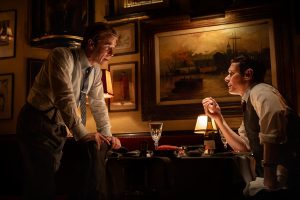
The Oscar-winning Boyle, best known for adrenaline-pumping, thrill-ride dramas like Trainspotting and Slumdog Millionaire, might seem an odd choice for a movie about newspapers. But he was smitten with Graham’s 2017 underdog play about how Murdoch (Guy Pearce) hired brilliant but stymied editor Larry Lamb (Jack O’Connell) to revolutionize a failing outlet like The Sun by pumping it full of low-brow journalism that readers secretly relished, upending patriarchal norms of propriety and arguably trampling on any responsible notions of morality itself.
In the 12-month process, the sleepy broadsheet Sun transformed into the tabloid-turbocharged “super, soaraway Sun” — and became the highest-selling newspaper in the world. It was also, in Boyle’s view, the Big Bang that begat our current online chaos of fake news, addictive clickbait, and weaponized social media outrage.
“It’s all set in the period of 1969,” explained Boyle. “But we feel like we updated it to make a connection to the modern world. I mean, that’s a pretty exciting palette for a director to work with. You know, so you can get up every morning and feel like you’ve got a great day of work to do. And then you get invited to the Venice Film Festival,” he said. And then added with a chuckle: “For a film about tattoos!”
Oscar buzz started immediately after the Ink screening, especially for Boyle’s muscular direction, Graham’s wickedly sharp script, and devilish performances from O’Connell and Pearce. But the awards chatter got even more deafening after the following night’s premiere for Martin McDonagh’s hilariously bleak Wild Horse Nine.
A meditation on the guilt-wracked consequences of a ruthlessly amoral career, the caustic comedy follows two CIA operatives stationed in 1973 Chile who are also unlikely best friends: loose cannon Chris Carlisle (John Malkovich) and jaded professional Lee Chesterfield (Sam Rockwell). Taking an unlikely two-week break from planning the assassination of democratically elected left-wing president Salvador Allende, the pair fly to Rapa Nui, more famously known as Easter Island, on a trip with ulterior motives.
“I was killing people before you were born,” Carlisle says blithely to Chesterfield on the flight. “I’ve killed people in countries you can’t even spell.” His loose-lipped, fuck-it attitude makes more sense once the film reveals that Carlisle has a terminal illness. And at that point, Wild Horse Nine becomes a perfect showcase for Malkovich’s virtuosic performance: tender, regretful, defiant, devastated, strident, cruel and, ultimately, heroic.

“You can already start writing your acceptance speech for the Oscars,” said a Swedish reporter at the press conference, after the room exploded with applause for Malkovich. “How do you feel about that? Finally getting the Oscar you deserve after such a long and prestigious career?”
Ever the pro, Malkovich dodged with expert tact. “I’ve had really spectacular collaborations with directors, writers, and actors,” he said. “I never feel in competition with any of them, because generally I love what they do. For me, it’s a very nice thing. But the nicest thing is that the film gets attention.”
Getting attention for its oddball premise was iconoclastic director Werner Herzog’s wildly eccentric character study Bucking Fastard, in which real-life sisters Kate and Rooney Mara star as Jeannie and Joannie Holbrooke, siblings who dress, walk, and act exactly alike. In a hypnotic surreal twist, they even talk in almost perfect sync. When the two sisters fall into a torrid physical relationship with next-door-neighbor Gareth (Orlando Bloom), they do it together. And when Gareth jilts them, they both wreak a fiery revenge in unison that gets them a restraining order.
This obsessive mirroring, seemingly a superficial gimmick, is Herzog’s opportunity to explore more profound ideas about identity, desire, and companionship, in a story that feels more like a magical fable. “We did existential rehearsals with the two sisters,” said Herzog at the press conference. “But they were so good instantly, that after five days we stopped. I had complete confidence in them.”
“At first, it was very daunting,” Rooney said. “But we found pretty quickly that having a lifetime together there was an unspoken world between us that we didn’t have to create at all.”
Kate agreed. “Once we figured out the rhythm of our speaking in unison, it almost felt like a song,” she explained. “We had this unspoken rhythm together. It happened quite naturally.”
Set in Ireland, the movie starts in Killarney, moves to Dublin, and eventually ends up in a fictional countryside defined by a peculiar mountain range of various caves. It’s there that the sisters strangely convince themselves that their only way to find true love is to mine their way deeper into the caves.
The location is actually in Slovenia, where the caves are more than 20 kilometers in size. “The caves were co-writers of the film,” said Herzog. “It is the landscape of the soul. A landscape of imagination. There’s nothing realistic about it. And that’s the beauty of it. It is poetry.”
You May Also Like
-
 July 12, 2022
 -
 May 17, 2019
 -
 November 30, 2020
