
For Whom Is America the ‘Chosen Land’?
Matthew Sutton looks at the Christian roots and legacy of the United States project
Is America a Christian country? The answer depends upon whom you ask. For some, it’s an emphatic no, and any expression of religion in public life is an attempt to breach Jefferson’s “wall of separation” between church and state — the democratic, secular ideals embedded in the Constitution to allow both religion and government to function without undue influence from one another, not to mention to avoid the murderous wars of religion which were not so distant from the time of the nation’s founding.
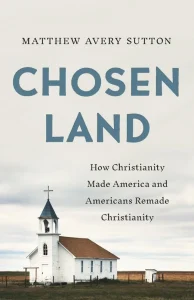
Chosen Land: How Christianity Made America and Americans Remade Christianity
By Matthew Sutton
Basic Books; 656 pages
For others, it’s an emphatic yes, to the point where many, like the pseudo-historians David Barton and his son Tim, falsely claim that the Founding Fathers overwhelmingly believed and practiced a version of Christianity that looks suspiciously like their own — that is, white, evangelical, and “Biblical” somehow.
The real answer of course is more complicated and more interesting. As Matthew Sutton argues in Chosen Land: How Christianity Made America and Americans remade Christianity, the religion — or more specifically, competing forms of Protestantism — has been the “dominant engine of American political and cultural life, shaping law, policy, popular entertainment, and ideals of gender, race, and nationhood. To ignore its power is to misunderstand American history — and America itself.”
 Well, no one alive today is capable of ignoring its power, in particular the Christian nationalism infecting the highest offices of the American republic, bringing violence and fear to those who oppose it, at home and abroad. But we might forgive a little straw man-building in such an exhaustive and innovative work.
Sutton teaches history at Washington State University, and he is also the author of several books on Christianity in America. His expertise is very much in evidence in Chosen Land, as he takes the reader from the “Christian invasions” of the British and Spanish Empires, through the centuries to the “decisive” role of the Christian right in our current government, from the Oval Office to the Supreme Court.
In between, Sutton supplies a briskly written chronological summary of the major sects and controversies from the colonial era through the centuries to our present, tumultuous moment. While he provides space for other versions — in particular Black churches and the growing influence of American Catholics — this is pretty much a book about White Protestants, since, let’s face it, no other group comes close in terms of influence and power, Christian or otherwise.
But even here it can get tangled, because there are so many sects in the U.S. There’s a big difference between Mormons and Methodists. For clarity’s sake, Sutton provides a framework: broadly speaking, American Protestantism flowed in “four distinctive American streams”:
First, the conservatives — not necessarily the Bible-toting, 2A-obsessed Christians of our day, but those who “sought to conserve the historic Christians faith as they understood it,” such as the Lutherans or Episcopalians of the nineteenth century.
Second, the revivalist stream, which perhaps reached its peak of influence in Billy Graham. But it started earlier than you might think, with the open-air prayer meetings of George Whitefield, who traveled through colonial America preaching an immediate, emotive version of the faith.
Third, the liberals, or those striving for a faith that could encompass reason and science, which included Deists like Jefferson through to the “twentieth century leaders of mainline denominations.”
And finally, the liberationists, the Black, Latin, indigenous, and immigrant faith leaders who served (and serve) as a reminder of the distance between the promises of the Constitution and the cruel realities of American life.
It can be helpful for the reader to keep these streams in mind as Sutton moves through the decades and centuries — if I do have a criticism of this briskly written and informative book, it’s that it has a kind of relentless comprehensiveness that precludes too much analysis. There’s a lot of what and not a lot of why, which makes it probably best consumed in smaller doses, as opposed inhaled in a few days, say, to use a completely random example, if you’re a writer on deadline.
I’d also add there isn’t much about what Americans get from religion in positive ways — the charity, moderation, and community that is just as much a part of American Christianity as Bible-thumping.
That’s not to be dismissive. I’ve been reading and writing about religion in America for ages, and I still learned a lot from this book — about the founders and the fundamentalists, the Quakers and the Shakers, the millennialists and the mainline Protestants — the fascinating, clamorous, and even, on occasion, inspiring story of the religion that continues to leave its deep imprint on American life.
You May Also Like
-
 April 15, 1997
 -
 January 20, 2021
 -
 February 24, 2021
