Houston, We Have Engagement!
Netflix streams Artmeis II as a NASA reality show
In a world indoctrinated by the religion of likes and shares, four astronauts — Reid Wiseman, Christina Koch, Jeremy Hansen and Victor Glover have become the influencers of the moment. Unlike Neil Armstrong and Buzz Aldrin, no one will remember their feats, no “giant step for mankind” seared on the public consciousness. This galactic mission needed drama, madness, and speeches about leadership and love… after all, that’s what drives social media and the stratospheric fuel that powers Netflix.
NASA’s Artemis II mission launched on April 1, 2026, with a mission — not literal, but certainly functional — of, settle down Trekkies, boldly going where no one had gone before. That is: to satisfy Pink Floyd fans and explore the super-mysterious Dark Side of the Moon before firing back a payload of data. Earthlings would soon have photos, and answers to all those who claim that extraterrestrial bases and the Illuminati are there, or whatever else Joe Rogan has said on his podcast.
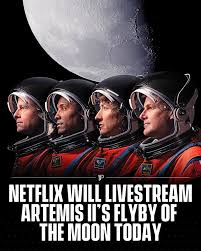 It was billed as the great adventure of our era, but it was overshadowed and undermined by the less glorious adventures of American rockets nearer to home, in the Middle East. Nevertheless it was a return to seriousness, science, American achievement, and the magnificence of space travel which has become, more recently, just another mundane Elon Musk appendage through SpaceX the embarrassing parody of Blue Origin: Jeff Bezos and Pedro Almodóvar present “Women on the Verge of a Nervous Breakdown” starring Lauren Sánchez, Katy Perry, Gayle King, Aisha Bowe, Amanda Nguyen, and Kerianne Flyn.
Spring ‘26 is time for a good old-fashioned space voyage, to take us back when people actually cared about humanity’s potential to conquer the stars. During the winter, your social media feed was all doom, gloom, death, cold, and what has more protein: four eggs or tuna with avocado. But NASA understood that the real appeal wasn’t in politics, daily life, or discussing organic compounds, rocks, or craters. Instead, let’s tell the personal stories of the astronauts in this edition of The Real World: Journey Around the Moon.
So let’s fuel the algorithm… These are your spacefluencers!
Fun n’ Drama
The Artemis II mission is no longer a scientific milestone, but a desperate pilot [sic] for a series no one asked for. We have a commander who doesn’t deliver reports, but rather rehearsed monologues with the cadence of a 2000s medical drama, and a crew more concerned with the engagement of their Instagram stories than with the orbital trajectory.
Technical absurdity is disguised as a plot twist: the broken toilet isn’t an engineering failure, it’s the scatological gag necessary to humanize these spacesuit-wearing influencers, a scene written by the writers of The Big Bang Theory — Howard Wolowitz actually designed a toilet for the Space Station — looking for an easy punchline with canned laughter in the background.
NASA forgot to sell “the small step” and instead used this as a brand relaunch campaign. And for that, they assembled a cast of stereotypes and tropes that never fail:

Reid Wiseman (in the role of the Melodramatic Commander); the leader who justifies his vulnerability with a tough personal history — widower, single father. He’s in charge of the monologues that will make you cry, but so relatable. Despite his outward toughness, he has to deal with enormous problems like his malfunctioning Microsoft Outlook — haven’t we all been there? Come on, empathy! Because you can be the Commander of a spaceship… but that Outlook… God!
Taking the best from Amy Farrah Fowler, we have Christina Koch (The “Space Plumber” / The Viral Star): She’s the one who takes the best selfies while saving everyone from a clogged toilet and a possible alien attack… And obviously, she’ll have the funny one-liner to boost NASA’s engagement, because she’s charismatic, an unstoppable rising star [sic].
Victor Glover, the Philosopher who breathes soul into quotable 15-second speeches; he’s the one who unites the team — and humanity — with messages of love and brotherhood. He’s the cool guy (without knowing he’s cool), undoubtedly a Leonard Hofstadter, the one you feel you can talk to and he’ll understand you.
This wouldn’t be appealing without an ever-optimistic character who seems like he doesn’t belong in the group — he’s a foreigner, Canadian, but he’s the one who will always put a smile on your face… Jeremy Hansen Raj Koothrappali — the new guy who starts out as filler but quickly gains followers and becomes fundamental because he represents us, the audience; he’s the bridge between the narrative of the others and the link with the audience.
NASA’s strategy has been impeccable: focus on personal stories and eliminate interviews with astrophysicists, technical jargon types.
Space used to be the poetic “magnificent desolation” depicted by Aldrin. But this current event is just another backdrop for personal branding, which has encountered fierce competition and needs to fight to survive. The solution? The platform beyond Earth’s orbit, ready for the era of “space influencers.” The humanization of the stars has arrived, and it’s been a resounding success. This inevitably shrinks the universe and gives it a warm, homey feel. What has this trip to the Moon left us with? A clogged $26 million toilet, Outlook showing its eternal flaws… a viral monologue, selfies, and lots of interaction.
Houston, we have no problem. We have the ultimate reality show.
You May Also Like
-
 March 24, 2022
 -
 January 10, 2019
 -
 August 8, 2018