
With Noir City, Black is Back
New events across the continent celebrate the enduring appeal of the shadowy genre
film noir
/film ˈnwär/
noun 1. a style or genre of cinematographic film marked by a mood of pessimism, fatalism, and menace. The term was originally applied (by a group of French critics) to American thriller or detective films made in the period 1944–54 and to the work of directors such as Orson Welles, Fritz Lang, and Billy Wilder.
I spent the chilly months of this past winter wrapped up in watching film noirs (thanks, Internet Archive!). My parents being film aficionados, I’d already seen a number of the classics — Double Indemnity, The Postman Always Rings Twice, The Asphalt Jungle — and now I discovered a bunch of new treats. Like Suddenly (a psychopathic Frank Sinatra as a presidential assassin), The Big Clock (Charles Laughton kills one of his many girlfriends, then tries to frame someone else for the crime), Scarlet Street (an unhappily married Edward G. Robinson meets a dame in Greenwich Village — and that’s no place to encounter a decent young woman).
Beyond the usual pleasures of film noir — the shadowy settings, the femme fatales, the complex capers, the innuendo laden dialogue — there was something else in these films that I found especially reassuring. No matter how charismatic the villain, you know the bad guys are always going to get caught. Those doing wrong will always be held accountable. In these turbulent times, it was a relief to see someone actually facing the consequences of their own actions. It was the cinematic equivalent of comfort food.
Still, I was startled to hear Eddie “The Czar of Noir” Muller use that very phrase introducing the first night of the Film Noir Foundation’s 23rd annual Noir City film festival when it played Seattle in February. Muller created the Noir City series, whose success led to the creation of the Film Noir Foundation — dedicated to film restoration — of which he is also the president. Hence Czar.
He’d had more than a few film buffs recently telling him that they were finding the rigid moral framework of film noirs to be “just the comfort food” they needed at a time that the rest of the country seemed to be falling apart. And that’s why they were so excited to escape reality in partaking of this year’s Noir City offerings. Unlike real life, it’s a chance to see someone getting their just desserts. Such a comfort!
And there’s no shortage of bad guys willing — even eager! — to take the fall in Noir City’s slate of film fare. Such as Martin Blair (Dan Duryea) in Black Angel, a down- on- his- luck pianist who’s a suspect in a murder case. He eventually realizes he really was the killer, having forgotten the murder in an alcoholic blackout. Though another man’s already been convicted of the crime, Duryea steps up to the plate and confesses, even though he knows that means it’ll be him walking into the gas chamber. Now, that’s a man!
Or Kent Smith in Nora Prentiss, playing yet another unhappily married man (a common theme in noirs), who falls for a nightclub singer, and, in a complicated (and admittedly implausible) turn of events, prefers to stay silent and be convicted of a murder he didn’t commit, rather than come forward with the truth. He too will take that long walk to the gas chamber. What is it they say about pride coming before a fall?
The flip side of characters paying for crime is that the audiences get to be titillated with all sorts of shenanigans (adultery, drug use, and random violence, to name a few), before the hammer drops and the perpetrator pays the price. As Muller explained to World Literature Today, the lure of noir is the stark juxtaposition of crime and punishment — and the resulting schadenfreude on the part of the viewer: “A noir story is about people who know what they’re doing is wrong, and they do it anyway. And, typically, there’s hell to pay. We love watching them break the law; we love watching them reap the consequences.”
Muller also prefers using a thematic approach in putting together his series, which he finds “offers more variety in a festival program than doing it museum-style, which is to focus on a particular artist. I don’t feature one director, actor, or cinematographer… a festival needs to have a broader menu, a more eclectic selection of films.” This year’s series subtitle, “Face the Music!” drops a clue that the films are all set in the entertainment industry.
The musical mood? It’s jazz, baby. “Jazz is America’s greatest contribution to the twentieth century,” Muller has explained, “and mixing it up with film noir is a perfect way to showcase the music for a younger generation. The stories may be dark and depressing, but the music always soars.”
After sitting through all those nightclub scenes, you’ll undoubtedly want to down a shot and light up a cigarette yourself while Nat wails on the horn.
Noir City enjoyed events in Oakland and Seattle in early 2026, but has now moved to its original home in Hollywood for April 10-12 (dates are scheduled for other cities as well.
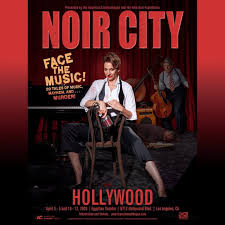 This year’s series offers the usual a cornucopia of well-known classics and lesser-known fare. In that first category, you can’t go wrong with Frank Sinatra’s stunning performance as a struggling musician/drug addict in The Man With the Golden Arm (though a true noirish ending would’ve stuck to the novel, in which Sinatra’s character commits suicide). And then there’s the pleasure of watching Lauren Bacall teach Humphrey Bogart how to whistle in To Have and Have Not — no one worried about their 25-year age gap between the stars back in those days.
And Sweet Smell of Success has a veritable rogue’s gallery on display, a crew of conniving characters who are so sleazy you’ll want to take a shower afterwards. (My favorite line in the film comes from Burt Lancaster, playing a newspaper columnist, dispatching press agent Tony Curtis’ character with the classic wisecrack : “I’d hate to take a bite out of you — you’re a cookie full of arsenic.”). True noir repartee. Throughout the series, you’ll find other snappy lines dropped into the films like gems waiting to be discovered. “I had to see you,” Catherine Bennett tells Dan Duryea in Black Angel. “Why?” he responds. “Because I had a wife who needed killing and you had a husband who took care of it?” Or an unrepentant James Cagney, thrown into jail on an attempted murder rap in Love Me or Leave Me: “Tell ‘em you seen me in the pokey and I looked great! Tell ‘em I like it! Makes me feel like a kid again!”
The rarer stuff includes star turns for Sammy Davis Jr. and Kirk Douglas in, respectively, A Man Called Adam and Young Man With a Horn. In the former, Davis is a trumpet player struggling with racism, alcoholism, and a temper that’s always getting him in trouble. Though receiving mixed reviews on its release in 1966, it’s worth seeing for its look at the jazz club scene of the era, rarely depicted on film, not to mention the strong performances by Davis, a young Cecily Tyson, and musical appearances by Louis Armstrong and Mel Tormé (Davis’ trumpet playing is dubbed by noted trumpet player Nat Adderley).
Douglas gets a happier ending in Young Man With a Horn, playing a character based on cornetist Bix Beiderbecke (though Beiderbecke’s own life ended in rather more disarray). It’s the least noir-ish of the films, as no crime is ever committed. Douglas is simply so dedicated to his craft he has blind spots; he falls for the wrong woman (a subtly Sapphic Lauren Bacall), overlooking the right one (an ever-understanding Doris Day), and, wracked with guilt when his musical mentor dies, spirals down into the bottle. There’s still a swinging score, with Douglas’ trumpet dubbed by Big Band player Harry James.
And could there actually be noir films — in color? Noir City thinks so. And it turns out the vibrant color of 1950s film stock gives color noirs a lurid sense of unreality (though the curl of cigarette smoke will always look better in black and white), as you see in two especially intriguing, and today largely forgotten, films. Love Me or Leave Me is a 1955 biopic of also largely forgotten singer Ruth Etting, starring Doris Day. Before disappearing into a string of rom-coms with co-star Rock Hudson, Day delivered a powerhouse performance in this film, as a singer enduring the abuse of her megalomaniac husband/manager, played by James Cagney, who, in his own frenzied performance, does everything but froth at the mouth.
In between the bouts of physical violence, coercive control, and murder attempts, Day somehow finds the time to perform a bevy of classic songs, including “You Made Me Love You” and “Everybody Love My Baby (But My Baby Loves Nobody But Me).” She even finds it in her heart to have some sympathy for Cagney (don’t worry, he’s still headed for prison, though maybe not the gas chamber).
Then there’s Pete Kelly’s Blues, directed by and starring Jack Webb, who knew more about jazz than he ever knew about police work (his record collection numbered in the thousands). Just check out this cast: in addition to Webb, you’ve got Janet Leigh, Edmond O’Brien, Peggy Lee, Lee Marvin, a cameo by Ella Fitzgerald, and a blink-and-you’ll-miss-it spot by Jayne Mansfield as a cigarette girl. Webb runs a jazz band during the Prohibition era, whose members are forced to give up their earnings to mob boss O’Brien; Lee shines as a singer lost to booze who eventually suffers a breakdown and ends up in an asylum. It’s a world of watered-down alcohol, fist fights, betrayals and murder. And yet, as Sgt. Joe Friday (Webb’s trademark character that he played as Dragnet moved from radio to television over four decades) himself might have observed, the good guys always come out ahead.
Does that sentiment seem like a fantasy? Perhaps so. Especially if you’ve been looking at any front page headlines recently. But film noir is a realm of (mostly) black and white that still leaves room for a little nuance.
Sure the bad guys are alluring. Of course those dames and dolls have appeal. Enjoy them. But never forget who’ll be on top at the end. The dice are loaded. The deck is stacked. As Tony Curtis puts it in Sweet Smell of Success: “The cat’s in the bag — and the bag’s in the river.”
You May Also Like
-
 January 9, 2024
 -
 December 19, 2018
 -
 July 22, 2019
