
‘Spider Noir’ Is the Strangest Spider-Man Yet
Nicolas Cage does his best Humphrey Bogart as a webslinger who’s also a hardboiled 1930s private eye
The Lord answered my prayers and delivered unto me an eight-hour Amazon Prime miniseries featuring Nicolas Cage as Spider-Man but also as a 1930’s private eye who’s kind of a cross between Humphrey Bogart and Jimmy Stewart. At least that’s what I thought I wanted out of life. It turns out that Spider Noir, a live-action spinoff of the Into the Spider-Verse animated films, is about half of what I wanted, but when it delivers the goods, it really delivers the goods.
Cage plays Ben Reilly, see, he’s a terminally broke, alcoholic private eye in an alternate universe where it’s always Depression Era New York, see. But he’s no ordinary gumshoe. While liberating a prison camp in France during World War I, he stumbled upon a hideous experiment that German scientists were conducting on American POWs, blending their DNA with all sorts of deadly creatures, snakes, bugs, and the like, giving them hideous mutations and powers. In a terrifying flashback, we see a half-spider, half man roar up from his bunk and bite Reilly on the arm, a very horror-movie way to re-enact Peter Parker getting bitten by the radioactive spider in the best-known Spider-Man story.
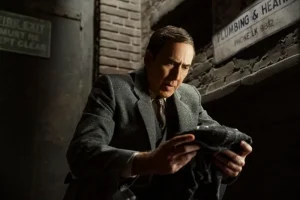
Already, the series makes a key mistake. Like Patty Jenkins’s Wonder Woman movie, Spider Noir doesn’t have the courage of its convictions to set its superhero shenanigans during and post-World War II, which was, after all, the height of the noir era. But with bad narrative choices comes narrative responsibility, so the 1930s is what we get. The conceit in Spider Noir, is that Reilly, now imbued with all sorts of spider-powers, like shooting silk webs out of his wrists, sticking to walls, and only having half a human skeleton, “learns how to be human” again by watching the films of Edward G. Robinson and James Cagney, which gives Nicolas Cage every excuse in the book to talk exactly like them.
Cage is our most committed screen actor, never unafraid to take the most ridiculous material to its absolute peak. And his performance as Reilly, and Reilly’s superhero alterego “The Spider,” is far and away the most compelling reason to watch the show. He’s very compelling, as well as incredibly hilarious and often quite moving, and for that reason alone I found it almost impossible to stop watching Spider Noir.
The show takes some visual risks as well. You have two choices of how to watch it on Amazon Prime, either in black and white or in “True Hue” color, with an exaggerated full-tone hyper palette. I chose black and white the whole way through, because that’s how you’re supposed to watch noir, but occasionally toggled over to the color side, and it did stun, almost like eating a rich slice of cake.
When Spider Noir works, it leans heavily into the noir tropes, at times feeling like a classic Bogie movie, with its rain slicked streets and smoke-filled jazz nightclubs. At its very best, it resembles a Sam Fuller joint like Pickup on South Street or, in one memorable late-season episode set in a haunted laboratory, like Fuller’s terrifying insane-asylum movie Shock Corridor.
However–and it’s a big however–Spider Noir is nearly eight hours long, and it has the plot of maybe a three-hour show. There are endless scenes of henchmen bursting into a room and saying “the boss wants to see you,” and then the boss sees whoever the boss wants to see, usually Cage, they have a drink, exchange a couple of quips, and then the boss has seen them until the next episode, when the boss wants to see them again. There’s always another knock at the door, and someone always wants to talk, which is a lazy screenwriting trick because they don’t have enough action to portray.
The main “boss” in question is a mobster named Silvermane, played effectively by Brendan Gleeson, who never makes a mistake as an actor, which is good, because he essentially has to perform the same scene over and over again, and drinks enough whiskey to euthanize a horse. Also quite good are Lamorne Morris, who plays Reilly/The Spider’s friend, a newspaper reporter named Robbie Robertson (canon from the original Spider-Man comics), and Karen Rodriguez, who pops off a bunch of good one-liners as Reilly’s secretary Janet, who might just be a better P.I. than he is. Even though their characters mostly serve as extra people for henchmen to walk in on, Morris and Rodriguez are welcome sidekick presences.
You can’t really say the same thing about Li Jun Li, who plays the show’s femme fatale, a cabaret singer named Kat Hardy, the show’s obvious analogue to Spider-Man’s Felicia Hardy, The Black Cat. The entire show revolves around several major characters, including Cage, being utterly in love with Cat Hardy. Li is quite beautiful, and wears some fabulous Art Deco-style outfits, but she gives a flat performance with all the magnetism of a soggy loaf of bread, and mostly exists in rooms where people want to see her and deliver expository dialogue.
There are also analogues to several classic Spidey villains, including The Lizard, Electro, and, in scene after scene, Flint Marko (the Sandman), who, played by Jack Huston, glowers and clenches his sandy fist, but mostly in service of lines like “the boss wants to see you.” I wanted more supervillains, less “hey bub.” For a Spider-Man show, Spider Noir gives about 40 percent too little Spider-Man.
But when Cage cooks, he really cooks, and his Ben Reilly/The Spider is one of the TV year’s most original creations. The show leaves things wide open for season two. I’m expecting henchmen to knock at my door any minute now to tell me that the boss wants me to watch it.
You May Also Like
-
 June 2, 2023
 -
 December 13, 2018
 -
 October 27, 2022
