
Is ‘Widow’s Bay’ the best Stephen King adaptation not actually based on his work?
Apple’s creepy comedy benefits from excellent showrunners
Tom Loftis (Matthew Rhys), the mayor of an island a few dozen miles off the New England coast, has a big problem and it’s only going to get worse. In the Apple+ show Widow’s Bay, named for the town Loftis tries, badly, to manage it takes Loftis a while to accept that the town is cursed.
Bad things happen, like, all the time. Evil spirits abound. People disappear at sea. And it’s getting worse — whatever has been plaguing Widow’s Bay for centuries is coming back around with a vengeance.
Loftis is skeptical. He thinks the townspeople are loony and superstitious. But it only takes a few episodes of truly scary (yet also somehow hilarious) events to rattle the mayor enough to start taking action.
That’s Apple’s new horror/comedy in a nutshell, but it doesn’t explain why Widow’s Bay works so well, or at least has worked well for the first half of a 10-episode first season that concludes in June. The reception so far has been rhapsodic from both critics and randos on social media who’ve been combing the streaming series for freeze-frame Easter eggs like it’s the second coming of Lost.
Widow’s Bay is good. Very, very good in a way that few shows that dip into horror are ever able to accomplish. That’s partly due to strong writing, led by creator Katie Dippold, a Parks and Recreation writer who also penned the two best Melissa McCarthy movies (Heat, Spy), as well as the woman-led Ghostbusters reboot and, ok, fine, a misfired Haunted Mansion movie for Disney.
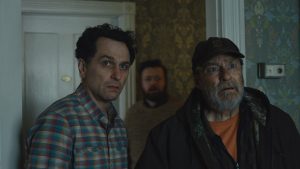
The writing on the show is sharp and funny, but it’s never winking or self-conscious, and it doesn’t lean too hard into the island’s mysteries, at least not at first. It focuses instead in the first few episodes on individual scary stories that affect Loftis directly which helps us get to know his character and those who work around him (two casting ringers there: Emmy winner Jeff Hiller from Somebody, Somewhere and legendary character actress Dale Dickey).
The show can turn on a dime from ridiculously over the top to observant about the mundane, to creepy, and then to dread-inducing. As important as the writing is the tone, and that’s the other half of the equation that works so well: Hiro Murai, so instrumental in walking the same type of tightrope on FX’s Atlanta (see also: the Murai-directed Teddy Perkins episode) is key to getting the formula right here.
Together as writer and director, Dippold and Murai land three excellent episodes to start the series that each feel like part of a top-notch anthology series. Stephen Root, Kevin Carroll and Toby Huss help flesh out the superb cast, while Kate O’Flynn, an English actress who’s been excellent in a lot of shows you probably haven’t seen, steals the show in a standout fourth episode that gives her mousy outcast character Patricia the spotlight.
In that episode, which focuses on a party-hosting book that takes hold of Patricia, we briefly see a novel by horror author Stephen King. That’s no accident. The show, like Netflix’s Stranger Things, is deeply infused with the type of narratives that drive King’s work. The small-town New England setting. The supernatural forces seeping into everyday life. A main character who can’t believe what’s happening to him, but who but really should.
Widow’s Bay has plenty of other influences, of course. It’s been compared to Jaws, Twin Peaks and horror films like John Carpenter’s The Fog and Halloween. But it’s King’s work, and particularly his underappreciated humor and sense of the absurd, that feels most akin to what’s going on in the early episodes of Widow’s Bay.
A show about King’s universe was already attempted: it was called Castle Rock and was well-regarded, but only lasted two seasons. The other recent King series, It: Welcome to Derry, have done quite well albeit with more overt blood and gore and will probably run for a half dozen seasons.
My only worry about Widow’s Bay is that its excellent start will go off the rails the way HBO’s 2020 horror series Lovecraft Country did, or that it will try too hard to explain away the town’s secrets instead of just leaning into the scares and the laughs.
Widow’s Bay works a lot better focusing on the set-piece scares and jolts of its individual scary stories and its assortment of intriguing townspeople; it doesn’t need to wrap everything up in a tidy bow. The worst part of Stephen King novels are typically the endings.
You May Also Like
-
 December 3, 2018
 -
 January 17, 2020
 -
 July 25, 2025
