
From a Lie to an Undeniably Cool Truth
The Complete History of Saturday Night Fever
It started with a lie. Writer Nik Cohn penned a piece for New York Magazine, “Tribal Rights of the New Saturday Night,” about an 18-year-old Brooklynite, “Vincent” and his aimless friends. “Vincent” worked in a paint store during the week but lived to disco dance on the weekends. Cohn passed the story off as fact, but it was pure fiction, inspired by the gangs from his youth in Ireland. Regardless, Stigwood read it, understood the narrative appeal and saw a movie, as well as a vehicle for both John Travolta, then a television star on Welcome Back Cotter, and the Bee Gees, whom he managed.
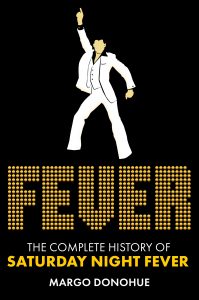
Fever: The Complete History of Saturday Night Fever
By Margo Donohue
Citadel Press; 272 pages
Forty eight years ago, Saturday Night Fever, a gritty coming-of-age story with a sensational soundtrack, hit theaters and transcended the screen, becoming a cultural phenomenon. SNF was a box office mega-hit, going on to make 237 million dollars. Everyone west of Moscow was struttin’ to Stayin’ Alive. SNF’s disco soundtrack, which relied heavily on the Bee Gees, was the best-selling record of all time, until Michael Jackson’s Thriller came along.
However, at the time, a movie starring Travolta, featuring Bee Gees music, was far from a sure thing. No one knew if the man who played the lovable goof “Vinnie Barbarino” in a fading sitcom would have movie appeal as a leading man, and many considered the Bee Gees, along with disco itself, passé. With SNF nearing its fiftieth anniversary, it’s this leap of cultural faith that Margo Donohue assesses in her new Fever: The Complete History of Saturday Night Fever, which is a straight-forward account about the making of the classic film.
Donohue interviewed many of the film’s major players, including Director John Badham and actors Joseph Cali (Joey), Bruce Ornstein (Gus), Paul Pape (Double J.) and Donna Pescow (Annette), among others. John Travolta, who played the film’s lead, Tony Manero, and his co-star, Karen Lynn Gorney (Stephanie Mangano) did not participate. Neither, for more obvious reasons, did the man who synthesized all the elements and willed it to happen: Australian impresario Robert Stigwood passed away in 2016. Donohue interviewed Stigwood’s nephew, Ron Stigwood, who worked as an assistant on the film.
To fill in the gaps for these key missing components, Donohue utilizes previous interviews, either from print or documentaries, of which there have been several including VH1 and A&E documentaries Saturday Night Fever – The Inside Story (2010) – YouTube. And, more recently, HBO delivered an excellent documentary about Stigwood, Mr. Saturday Night. Ultimately, Donohue goes deeper than any of these aforementioned projects, delivering a fun, informative read about a relatively low budget film – about $3.5 million – which defied the doubters and still holds up today.
Before Badham was brought on, Stigwood tapped John G. Avildsen, who was coming off Rocky, to direct. But Avildsen and Stigwood butted heads over the film’s tone. While Avildsen was leaning towards light and uplifting, Stigwood demanded down and dirty. Avildsen was canned.
Screenwriter Norman Wexler, known for penning Serpico (1973) delivered a dark screenplay, with profanity, a rape, and a suicide. Wexler is probably the most enigmatic character in the SNF saga. He was diagnosed with bipolar disorder and was arrested for threatening to shoot President Richard Nixon in 1972. Wexler passed away in 1999, but Donohue interviewed his daughter, Erica, who says that her father was inspired to write SNF because it showed that individuals could overcome their circumstances and change their lives.
In late 1976, with shooting scheduled to begin in mere months, Stigwood was alarmed: Travolta was overweight. Stigwood put a plan in place to lean Travolta up. He went through rigorous training with Deney Terrio, later famous as host of the long-running TV show Dance Fever, and then Jimmy Gambina, Rocky’s diminutive cornerman Mike who actually trained Sylvester Stallone for Rocky in real life. Gambina, who Donohue interviewed, made Travolta run six miles a day and put him through an exhaustive calisthenics regimen. Once Travolta was fit, choreographer Lester Wilson put in countless hours teaching him the dance movies. Donohue spends significant time deciphering who did what for Travolta’s physique, as well as his on-screen dancing. She also discusses Gorney’s stiffness, and how she needed much support for the dance sequences, including a dance double.
As Travolta boogied for the cameras, he was grieving heavily. During filming, his girlfriend, Diana Hyland, passed away. Somehow, Travolta soldiered on and succeeded in owning the dance floor and making a mostly unlikable character palatable, perhaps even likable. Meanwhile, Badham, who was romantically involved with Gorney during filming, encouraged Travolta and his castmates to experiment with their acting choices and improvise. Some of the film’s best scenes were a result of this freedom. When Mr. Manero smacks his son at the dinner table, Travolta’s request that his father refrain from touching his well-coiffed hair was an improvisation.
Shrewdly, Stigwood got the SNF soundtrack out a month before the film’s release to create word of mouth. His rationale: if they love the songs, they’ll see the flick. When SNF was released in December 1977, it won over audiences all over the world, mainstreamed disco and turned Travolta into a superstar. Without his captivating performance, even with the great music and screenplay, who knows if SNF becomes a phenomenon. It also spawned a belated and forgettable but lucrative sequel, Staying Alive (1983), and a somewhat successful stage show, both of which Donohue covers in some detail.
Ultimately, Stigwood, the maestro of the SNF saga, created a blueprint for utilizing a movie’s soundtrack to sell movie tickets and vice versa. After SNF, he repeated his success with Travolta in Grease in 1978. Other filmmakers took notice of Stigwood’s formula, spawning Flashdance, Top Gun, Footloose, Dirty Dancing and more in the next decade. As for the film that inspired them, SNF was inducted into the Library of Congress in 2010 for being “culturally, historically, or aesthetically significant.” Indeed, almost 50 years after its release, Saturday Night Fever is stayin’ very much alive.
You May Also Like
-
 December 4, 2018
 -
 July 6, 2020
 -
 August 25, 2022
