
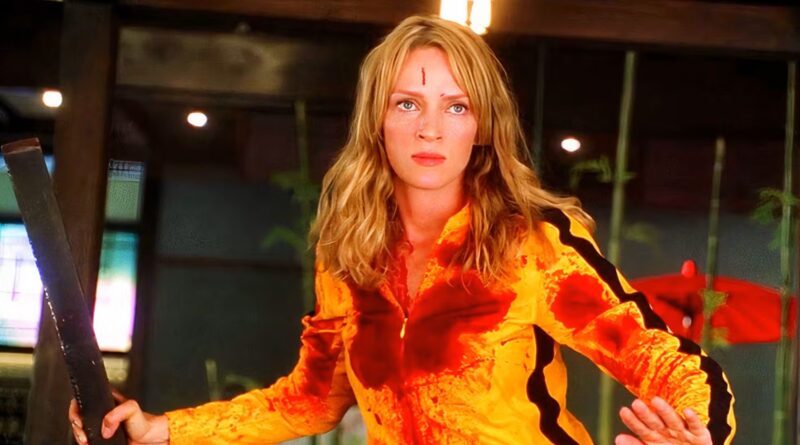
The ‘Kill Bill’ Killers Continue To Cut Deep
Revisiting Tarantino’s iconic ensemble — from Uma Thurman’s vengeful Bride on down the pantheon
With the official release of the much-talked-about but rarely seen Kill Bill: The Whole Bloody Affair, Quentin Tarantino’s punishingly giddy odyssey of relentless homicidal revenge (famously refracted through the fawning film fanatic’s kaleidoscope of grindhouse b-movie influences) is now one vicious marathon movie. Before his moral depravity became public, former Miramax honcho Harvey Weinstein notoriously bifurcated the epic into Kill Bill Vol. 1 and Kill Bill Vol. 2, released respectively in October 2003 and April 2004. The compromise allowed QT to avoid cutting anything from his opus while giving Weinstein the chance to milk two box office bonanzas from Tarantino’s loyal fans.
Kill Bill: The Whole Bloody Affair
★★★ (3/5 stars)
Directed by: Quentin Tarantino
Written by: Quentin Tarantino
Starring: Uma Thurman, Lucy Liu, Vivica A. Fox, Michael Madsen, Daryl Hannah, David Carradine, Sonny Chiba, Julie Dreyfus, Chiaki Kuriyama, Gordon Liu, Michael Parks
Running time: 275 mins
Doubled up or fused into one, the gory story — an East-meets-West remix tribute to Kung Fu flicks, spaghetti westerns, Japanese anime, Yakuza films, and even Italian giallo horror—is still a fitfully dazzling experience. A few truly astonishing set pieces boast Yeun Woo-ping’s virtuosic fight choreography, Sally Menke’s whip-smart editing, sumptuous cinematography from Robert Richardson, and some of the most thrillingly eclectic music in cinema. (All hail the G.O.A.T. of all needle drops, Tomoyasu Hotei’s “Battle Without Honor Or Humanity,” which originated in another film and quickly became the indisputable anthem for Kill Bill.)
 But those classic moments are strung together with indulgent transitional scenes larded with eyeroll-worthy dialogue in service of florid exposition. There’s a seesaw energy to the film’s pacing, at times admirably tight and then risibly flabby. Do we really need Elle Driver’s Wikipedia recitations about snake venom? Or Bill’s Seinfeldian monologue about Superman? “How long does this shit take to go into effect?” Kiddo yells while Bill pontificates. Amen, sister.
Then again, all the incredible world-building is just as rich and playfully menacing as ever. Like the Deadly Viper Assassination Squad, with its lineup of stone-cold killers Vernita Green aka Jeannie Bell aka Copperhead (Vivica A. Fox); Elle Driver aka California Mountain Snake (Daryl Hannah); O-Ren Ishii aka Cottonmouth (Lucy Liu); and, of course, Beatrix Kiddo aka Black Mamba aka Arlene Machiavelli aka the Bride (Uma Thurman). The only male among the squad is Budd aka Sidewinder (Michael Madsen), aside, of course, from their leader, his much older titular brother Bill aka Snake Charmer (David Carradine). All of them are lethal, especially since they’re outfitted with Japanese steel — namely the katana samurai swords hand-crafted in Okinawa by the legendary Hattori Hanzō (Sonny Chiba).
Kiddo wants to kill Bill because Bill and his squad almost nearly killed her, along with her fiancé and their close friends, at the chapel where she was about to be wed. Miraculously the shotgun-wedding bride — secretly pregnant with Bill’s child — survived the massacre. But after awaking from a 4-year coma and finding herself with a flat belly, she wants revenge on Bill and her former co-workers for taking away not only her matrimonial life but her maternal one as well. And over the course of four and a half hours, she makes it her mission to hunt them all down and kill every single one — leaving Bill for last.
 The Whole Bloody Affair rectifies a major flaw in Vol. 1 and Vol. 2, namely the major spoiler that ends the first movie and serves as a de facto cliffhanger for the second. It’s a betrayal of the original script and the film’s original structure, and the new version’s climax packs an emotional punch that it never had before. It also lengthens the animated origin story for O-Ren Ishii in a way that doesn’t add much to the story — like we need more convincing that O-Ren is the most ruthless killer in the batch.
Kill Bill boasts career-defining work from Thurman and Liu, both of whom bring such intense commitment to their roles, both physically and emotionally, that their characters have become culturally indelible. But damned if they still don’t feel like admirably independent woman. It’s a tragedy how tragic their stories really feel.
The hindsight of two decades — and the distance from Tarantino’s apex of hipster cool in the millennial cultural zeitgeist — further clarifies this faux-feminist action film for what it’s always been: a coldly misogynistic ride that uses its girl-power pandering as cover for a merciless array of male-on-female violence, cruelty, and contempt. Even the masterfully crafted fight scenes between women come off as catty cat fights. In this universe, you’re either a nobly suffering goddess or a psycho bitch.
Seeing a woman smash in her rapist’s head doesn’t negate the fact that she still gets raped. Watching an 11-year-old disembowel the pedophile mob boss she just seduced isn’t so much empowering as it is deeply traumatic and depressing. Older men in positions of power are constantly either talking down to or romantically flirting with the opposite sex — or both. One guy works at an all-nude titty bar called the My Oh My Club; a minor character who’s an octogenarian father figure runs a Mexican brothel and slices women’s mouths lengthwise if they get out of line.
Tarantino’s defenders would say that these are strong women navigating a cesspool of bad dudes. But the handful of nice guys here feel like chumps, while all the other men act with an impunity shimmering with the imprimatur of cool. Meanwhile, the women are all defined by their relationships with men — specifically Bill. This poseur product of lady empowerment doesn’t even pass the Bechtel Test!
The film’s newly conjoined re-edit doesn’t change its essential nature, which is aggressively slick, undeniably corny, occasionally inspired and deeply self-satisfied. Kill Bill remains what it’s always been: a geeky fanboy’s vision of sexy girls kicking ass.
You May Also Like
-
 December 6, 2019
 -
 December 12, 2022
 -
 December 5, 2023
