
Why ‘The Rise of the Red Hot Chili Peppers’ is More Moving Than You’d Expect
Friendship, fame, and fatality are part of the band’s origin story
You don’t have to be a Red Hot Chili Peppers fan to be moved by this account of three friends finding their way in the world together. But lovers of the band will hold this account of the band’s early years close to their hearts.
Directed by Ben Feldman in his feature-length debut, the Netflix original doc The Rise of the Red Hot Chili Peppers: Our Brother, Hillel lives up to both parts of its title, detailing the origins and evolution of the band and delivering bandmates Anthony Kiedis and Flea’s heartfelt tribute to founding RHCP guitarist Hillel Slovak, who left this world in 1988 just as the band’s labors were really beginning to bear fruit.
The Rise of the Red Hot Chili Peppers: Our Brother, Hillel ★★★★ (4/5 stars)
Directed by: Ben Feldman
Running time: 95 mins
The story is built around extensive interviews with the band and with those who were close to them in their early phase. Flea and Kiedis (who, in his current mustachioed phase, is starting to look disconcertingly like Sparks’ Ron Mael) are completely unguarded and forthcoming about the highs and lows of spending their youthful lives with Slovak. Flea verges on tears at various points as he recalls both their connection and the loss of it. Early on, Slovak is quoted as saying, “Time is a factor against me,” as if he could foresee the short window he would have in which to make his mark on the world.

Flea and Anthony recall how they met as students at Fairfax High in L.A., bonding immediately and irreversibly. Flea wanted to be a jazz trumpeter at the time. “I thought rock music was for dumb people,” he confesses. They were both outsiders from broken homes where dysfunction and violence were the norm. Kiedis the extrovert and Flea (then Michael) the introvert, they were feral kids who fell into shoplifting, vandalism, and getting high.
But they sensed some kind of purpose for the first time when they first encountered fellow Fairfax student Slovak, whose cover band Anthem (which also included future RHCP drummer Jack Irons) was playing a school talent show. The Flea/Kiedis duo quickly turned into a trio of offbeat BFFs who would literally do Three Stooges-influenced skits together, listen to records, and inspire each other. Flea recalls learning to love rock and being influenced by the artistic soul of Haifa-born Slovak, whose grandparents escaped the Nazis by fleeing to Israel. Slovak was constantly painting, drawing, and journaling as well as playing.
Throughout the doc, the commentary of Flea, Kiedis, and Irons makes it clear that there’s a lot more to these guys than the often deliberately cartoonish image they’ve established over the years. As they peel back the layers of their inner lives, we learn that even as teens they were already much more sophisticated than you might guess, despite their wild ways.
At Slovak’s urging, Flea learned bass to join Hillel’s band. After graduating in 1980, the three friends were living low and hard in the underbelly of L.A., and drugs were soon added to the menu. It was a dizzying time to be young in that town, with the hardcore, metal, and New Wave scenes exploding, and the future Peppers flung themselves into all of it with gusto.
The result was a rapid musical evolution as Anthem shifted from hard rock to New Wave, cut their long hair, and renamed themselves What Is This. Around this time, Kiedis — not yet a performer — heard Grandmaster Flash’s “The Message” and was inspired to start writing lyrics.
Gary Allen is revealed as a crucial catalyst in the RHCP origin story. A gay, Black singer/performance artist, he was another outlier who became a part of the guys’ found family and pointed the way to new avenues of artistic expression. In his interview, he explains how he urged Kiedis, Flea, Slovak, and Irons to start a new band to open a December 1982 gig for him. All these decades later, he still sounds shocked recalling the results, which were immediately explosive and resulted in the new band (duly dubbed The Red Hot Chili Peppers by Allen for the intensity of their performance) quickly becoming darlings of the L.A. underground.
More of the facts surrounding the band’s trajectory from that point have made it into the lore of the RHCP. But in addition to the interviews, the tale is told with snatches of Slovak’s journals and his original artwork, and loads of fascinating photos and footage.
Writer/musician Addie Brik, who was Slovak’s girlfriend, contributes some of the most touching reminiscences outside of the band members. George Clinton, who produced the band’s second album, Freaky Styley, is every bit as colorful in his recollections as you would imagine. And when the reams of candid photos and videos bring us along on the wild ride of those album sessions, Clinton captures the band’s over-the-top energy, exclaiming, “We had to tape the headphones to their heads so they didn’t throw them off.”
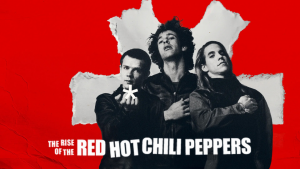 Along the way, we see images of the janky little L.A. studio where the band cut their first demo for $250 in May 1983. We watch one of their earliest live TV appearances and catch Flea and Kiedis engaging in some bizarre, hilarious ad hoc schtick with show host Alan Thicke. And as both the band’s profile and their drug use are on the rise, photos and performance footage show us the fever pitch that was their everyday norm and the toll that their excesses were taking on them, especially Slovak, who was quietly crumbling from inside.
Musing on the source of the inner pain that drove Slovak to drugs, Flea says, “The same thing that drove him to be as creative as he was hurt him too, and he was carrying it with him all the time.” It would eventually kill him, but ultimately, this isn’t a film about that tragic loss. In the main, it’s about how even the outcasts who feel the most unloved can find family, inspiration, and acceptance in each other and use that love to fuel their journey to bigger things.
You May Also Like
-
 November 28, 2022
 -
 September 22, 2023
 -
 February 8, 2019
