
Was Peter Asher Pop Music’s Zelig or Svengali? ‘Everywhere Man’ Offers Answers
The documentary follows Asher from Swingin’ London to laid-back L.A… and beyond.
Tucked deep into this account of artist/producer/manager Peter Asher’s meteoric music career is a fleeting image that says it all. It’s just a still photo that’s only onscreen for a second; blink and you might miss it. It’s an outtake from the cover photo session for James Taylor’s milestone 1970 album, Sweet Baby James. Anyone even passingly familiar with the ubiquitous, era-defining, multi-Platinum record will immediately recognize Taylor’s blue-shirted, lank-haired look. But instead of focusing on the singer, the photo has a wider POV, revealing Taylor’s guru Asher sitting right next to him and looking as integral to the proceedings as the camera itself.
It’s a concise, wordless way of expressing Everywhere Man’s central theme: There are multiple patches of pop culture tapestry that either wouldn’t have happened without Asher or would have been drastically different. Between his 60s stardom as half of Peter & Gordon and his status as star-making manager and producer from the ‘70s onward, the Dan Geller/Dayna Goldfine-directed doc has a lot to tell.
Peter Asher: Everywhere Man★★★★ (4/5 stars)
Directed by: Dan Geller, Dayna Goldfine
Running time: 118 mins
In recent years, Asher, now 81, has been doing some telling of his own by touring with a show where he sings some of his old tunes and shares stories from across his career. The film smartly latches onto excerpts from those storytelling segments to advance the narrative throughout, alongside bespoke interviews with Asher and a parade of high-rolling cohorts, including Lyle Lovett, Eric Idle, Twiggy, Carole King, Natalie Merchant, Steve Martin, Linda Ronstadt, James Taylor, and more.
Archival commentary stitched throughout the doc bring Robin Williams, Paul McCartney, and others into the mix.
One of the first revelations is that Asher’s showbiz years began even before Peter & Gordon, when he and his sisters, Clare and Jane, were a trio of redheaded child actors in the 1950s, working together and separately. Their parents were impressive in their own right — dad was the doctor who identified Munchausen’s Syndrome, and mom was a classical oboist whose adult students included Beatles producer George Martin.
Unlike Asher, sister Jane kept acting into adulthood, and her notoriety led to her meeting Paul McCartney and starting up a relationship serious enough that Macca moved into the spare room in the Asher family’s London home. All these decades later, the excitement in Asher’s voice is still infectious when he recalls being the first on the planet to hear “I Want to Hold Your Hand” immediately after Paul and John wrote it on the piano in the Asher’s basement.
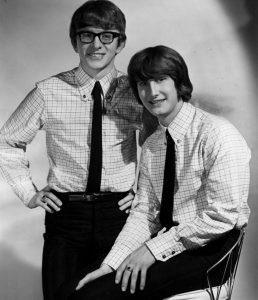
By this time, Peter and schoolmate Gordon Waller had started their singing partnership. Asher maximized his proximity to the world-shaking songwriting team by snapping up one of their castoffs, “A World Without Love,” and we’re briefly privy to McCartney’s original demo for the tune. Long story short, the 1964 single made Peter & Gordon No. 1 around the world and placed them forevermore in the pantheon of mid ‘60s British Invasion pop. Something of an odd couple, Peter was the geeky little Austin Powers-looking intellectual, and Gordon was the tall, swaggering bad boy of the duo.
Partly due to their differences, the duo only stuck together till 1968, but they made enough of a splash to enjoy the full pop-star experience, as we see in the documentary through footage of them deplaning in America, met by a Beatlemania-esque mob of fans; and the prerequisite Ed Sullivan Show appearance. One of the doc’s funniest moments is Asher’s description (accompanied by photos) of a U.S. gig at the 1964 World’s Fair, where a moat separated them from the audience but did not dissuade the teen girls from swimming excitedly towards their idols.
One of Everywhere Man’s most vivid segments uses dazzling archival film and photos (and Asher and company’s recollections) to conjure up the excitement of the Swingin’ London/Carnaby St. Scene that was Asher’s world during his post-Peter & Gordon run as A&R man at The Beatles’ Apple label and co-founder of the Indica bookshop and art gallery, underground hubs of the era. Indica has its place in pop history as the spot where John met Yoko and where Marianne Faithfull met Mick Jagger (the latter entirely on account of Asher). Another LOL moment arrives when a present-day Asher revisits the old Indica site and inadvertently bumps into a guided Swingin’ London tour group who immediately recognize him.
The film then follows Asher through his third and most renowned act, as he relocates to L.A. at the start of the ‘70s and almost unintentionally finds his way into production and management. It was here that he truly found himself, out from under the Beatles’ shadow and helping to forge a whole new scene. As the man who discovered James Taylor at Apple and then helped him become the center of the early ‘70s singer/songwriter movement, Asher was a prime architect of that era’s L.A. sound, as explored in the bulk of the doc’s final third.
 Besides producing and managing both Taylor and Linda Ronstadt, Asher assembled the cabal of session hotshots who basically became the new Wrecking Crew, including guitarists Danny “Kootch” Kortchmar, Waddy Wachtel, drummer Russ Kunkel, and bassist Lee Sklar. Initially known as The Section and eventually celebrated in their own 2023 documentary, Immediate Family, they were on seemingly every folk-rock album out of L.A. in the 70s, and they literally came together in Asher’s living room. Summing up Asher’s influence on the period, Taylor notes, “He was responsible for a different kind of recording beginning to happen in L.A.”
But for all that, one comes away with a picture of Asher as an unassuming enabler in the best sense, whose greatest gift was knowing when to get out of the way and let things happen. Looking back on the blockbuster albums he made with Ronstadt, he says, “Whatever masterstroke genius idea I had, it was mostly, ‘Let’s listen to what Linda has to say.’” As if in response, a moment that speaks volumes is the GRAMMY awards clip where Ronstadt’s entire acceptance speech is, “I’d especially like to thank Peter Asher. Thank you.”
From there, Asher’s hit list grew so furiously that the film doesn’t even try keeping up. Diana Ross, Cher, Neil Diamond, Elton John, Bonnie Raitt, Ringo Starr, Billy Joel, Randy Newman, Robin Williams, and 10,000 Maniacs made up only a portion of his clientele. Ultimately, Everywhere Man is an immersive portrait of someone who worked himself into the center of too many cultural flashpoints for it to have been a fluke.
You May Also Like
-
 July 13, 2023
 -
 November 28, 2022
 -
 July 14, 2021
