
The Real Scandal Is the Whitewashing of ‘The Odyssey’
Where are the Greek actors for a Greek epic?
“All Odyssey, all the time,” is how my friend described the news coverage of Christopher Nolan’s The Odyssey . The film grossed over $100 million on its opening weekend and, since its release on July 17, has box office takings of almost $400 million. With an all-star cast including Anne Hathaway, Matt Damon, and Tom Holland, among many others, Nolan’s adaptation of Homer’s 2,400-year-old epic has become a cultural event of the summer, another notch under Nolan’s belt. Yet, alongside the tested Hollywood trick of adapting a classic for the big screen, Nolan’s Odyssey falls into another tradition of Western cinema: Whitewashing.

Though many conservative voices led by Elon Musk have complained of Zendaya’s casting as the goddess Athena, and Lupita Nyong’o as Helen of Troy, Nolan’s far more egregious error lies in casting white, non-Greek actors as Ancient Greeks. Conservative voices complain about the presence of people of color in a film set in a time period as they claim it to be unrealistic, when, indeed, ancient Greek society featured plenty of people of color. Anyone with a map can see that Africa is just across the Mediterranean from Greece. The fact that the complaints about “authenticity” do not include complaints about a lack of Greek actors is telling, as it shows the real interest lies not in historical accuracy, but in excluding people of color.
Hollywood has a long history of whitewashing history and myth alike, often casting white Americans actors in Middle Eastern and otherwise non-white roles. In the 1950s and 1960s, The Ten Commandments, (1956), Ben-Hur, (1959) The King of Kings, (1961), and The Greatest Story Ever Told (1965) had white American actors of non-Greek descent playing Ancient Greeks. Meanwhile, Hercules (1958) and Jason and the Argonauts had people of non-Jewish descent playing Ancient Jews.
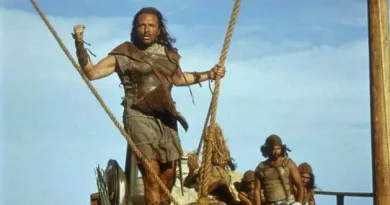
In more recent years, Wolfgang Petersen’s Troy had Brad Pitt playing Achilles, the Ancient Greek; Mel Gibson’s The Passion of the Christ had largely American and Italian actors portraying Jews from the first century; Darren Aronofsky’s Noah had American, non-Middle Eastern actors playing human beings from before the Biblical Flood in a region Biblical scholars argue is the modern-day Middle East; and Ridley Scott’s Exodus: Gods and Kings had, again, mainly white, American actors portraying Egyptians and Israelites alike. The same year Exodus came out, two films featuring Heracles released, Brett Ratner’s Hercules and Renny Harlin’s The Legend of Hercules, both featuring Americans of non-Greek descent playing Heracles.

The notion of an “Ancient Greek” is a murky one, as the inhabitants of Ancient Greece would have thought of themselves as Athenians, Spartans and Thebans before thinking of themselves as “Greeks.” To what extent today’s Greeks resemble the Ancient Greeks is a matter of no small historical debate, as are the similar question of Ancient Egyptians vs. modern-day Egyptians, Ancient Celts vs. modern-day Irish, or Israelites and Jews.
Yet, Odysseus is undoubtedly the most famous Greek hero of all time, given how often the Odyssey has been retold and retranslated again and again. As such, it would make some sense, for the sake of genuine historical accuracy and respect for Greek culture, to cast a Greek or a Greek-American in at the very least the leading role. Damon is lovely, but he’s as Greek as a cream soda.
Hollywood has no shortage of talented Greek actors; indeed, it has no shortage of talented actors of any ethnicity, existing in one of the most diverse countries in the world. Theo James, Hugh Jackman, Nicholas Galitzine, and Zoe Kazan are just a few highly talented Americans of Greek descent Nolan could have called. There is a Greek restaurant called Good Neighbor Restaurant a five-minute drive from Universal Studios. Nolan could have gotten one of the owner’s sons to play Telemachus, and it would have been more “authentic” than Holland.
It’s contested because it matters what we think it natural, normal, real. Popular views of Greek history are already severely skewed, even Greek statues are whitewashed. While most people’s perception of Ancient Greek statues is one of the pearly-white museum pieces found in the Met and the Louvre, historians agree that Ancient Greek marble statues would have been coated in bright, vibrant paints. The Royal Society of Chemistry says that “On many temples and buildings in Ancient Greece there were many sculptures with much detail. If the sculptures were white the detail would have been indistinct. Color, and the contrasts of color, would allow people looking up at the sculptures to determine the detail.” This is something that is noticeably lacking from Nolan’s Odyssey, where any background statues are as dull and bland as the film’s palette.
When Hollywood whitewashes history, everyone loses. The Greek and Greek-American actors who could otherwise benefit from the big credit are ignored. Audiences come away from films with misconceptions of history. Greeks and Greek-Americans are confronted with a false version of one of their most iconic narratives.
Hollywood’s view of the world is so often one in which lily-white men with pearly-white teeth save the day, where nobody has skin browner than a light tan — even after spending ten years at war and ten years at sea. Perhaps there is a Black woman to buttress the protagonist; but otherwise, most of Christopher Nolan’s Odyssey falls into this box, transforming a quintessentially Greek narrative into an American one, devoid of the tradition that makes the original story fantastic, and, indeed — epic.
You May Also Like
-
 January 2, 2025
 -
 July 16, 2026
 -
 November 7, 2022