
‘The Odyssey’ Is the Most Christopher Nolan Film Yet
A star-studded epic brings Homer to the 21st century
“Ten years on this fucking beach. Let’s go home,” hisses a grim Odysseus (Matt Damon). The storied Greek hero never sounded earthier than in Christopher Nolan’s The Odyssey, a Hollywood colossus of a Classics adaptation that swaps dactylic-hexameter poetry for straight talk and mostly jettisons incarnate Gods for the divine clarity of 70mm IMAX film. Why whip up a computer-generated Olympus when the natural world is so full of spectacular majesty?

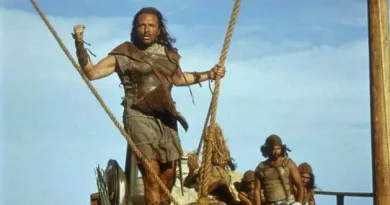
This ancient sword-and-sandals epic feels so real because the film’s blockbuster $250 million budget allowed the production to embrace on-location practical effects: men feasting in torch-lit banquet halls, guards patrolling sun-bleached stone fortresses, massive wooden vessels groaning with soldiers, an all-star cast thrust into the raging seas and onto jagged islands, wearing regal robes and cupping beggar’s bowls. In his devotion to in-camera verisimilitude, enhanced with such immersive large-format celluloid cinematography, Nolan makes plain the punishing dimensions of the wayward warrior’s twenty-year journey: a full decade on the bloody shores of Troy, followed by another one spent sailing in vain towards the faded bosom of his faraway kingdom, Ithaca.
Heroic is too limited a word to describe the Oscar-winning filmmaker’s herculean feat of translating this 3,000-year-old text into a visual feast for 21st century moviegoers. Homer’s (ever-contested) credit as author is not prominent, and for good reason. In restructuring and reshaping the saga’s famously scrambled narrative, Nolan’s dense but surprisingly fleet-footed screenplay claims a respectful ownership over the material, streamlining it into a bracing cautionary tale about how war-fueled barbarism hastened the end of Bronze Age civilizations.
The Odyssey ★★★★ (4/5 stars)
Directed by: Christopher Nolan
Written by: Christopher Nolan
Starring: Matt Damon, Tom Holland, Anne Hathaway, Robert Pattinson, Lupita Nyong’o, Samantha Morton, Zendaya, Charlize Theron
Running time: 173 mins
In this telling, Odysseus suffers from the trauma he experienced during the Trojan War, epitomized by his brilliantly cynical gambit of turning a gifted wooden horse into a vehicle for destruction. That social and cultural betrayal — a peace offering full of brutality — shattered xenia, the sacred notion of hospitality otherwise known as Zeus’ Law. In other words: treat others as you would be treated. “We broke the fragile bonds between men,” mourns Odysseus, himself a man who brazenly defies the Gods and repeatedly suffers the consequences.
Gods, incidentally, are on everyone’s lips, but never really in corporeal form, even to those sailing on Poseidon’s seas and under Zeus’ skies. The few who do reveal themselves in Nolan’s Odyssey are just the goddesses — all terrestrial in their manifestations and mostly lacking in any mystical glamour. Only Odysseus ever gets to see Athena (Zendaya), and then in fleeting hallucinations. “You have Athena’s eyes” is the closest tip-off we’re given that she otherwise walks among other mortal men (unlike the poem, where she shows up early and often, shape-shifting from human disguises to animal ones).
Odysseus and his men do encounter, with terrifying consequences, the witch-goddess Circe (a brilliant Samantha Morton, wily and vengeful). And the only other visible immortal is Calypso (ageless beauty Charlize Theron), seen solely by a castaway Odysseus, where, on her deserted island Ogygia, she acts more as his therapist than his renowned seven-year lover. Conflating the Land of the Lotus-Eaters, Nolan here makes Calypso the one who feeds Odysseus the narcotic as a sort of ketamine micro-dosing that helps soothe his ravaged conscience.

It’s telling that the supreme beings who do appear are all female, since this Odyssey is otherwise driven and riven by the passions and follies of mortal men who are strong in action but weak in conscience. The worldly-wise goddesses give the best insights into these soldiers — especially Circe, who, in a chilling scene of stomach-churning surrealism, turns Odysseus’ crew into pigs. “This is who they are,” Circe says with a steely serenity. “Know your own men!” And, after Odysseus persuades her to restore their humanity, she calmly relents, cooing to them: “Back into your disguises, back into your disguises.”
If The Odyssey has an Achilles’ heel, it’s Nolan’s valiant but anemic depiction of women (never a strong aspect of his work or of the sausage-fest source material anyway). His erasure of Odysseus’ famous philandering seems to be an attempt to make Odysseus’ romantic fidelity to long-suffering wife Penelope (Anne Hathaway) more noble. But their relationship never feels fully convincing, mainly because the charming Hathaway — ever a princess, never a queen — is one of Hollywood’s most enduringly lightweight actresses. Her theater-kid pathos doesn’t give Penelope the regal melancholy she needs.
Joining her in the underwritten caucus is Lupita Nyong’o, who plays dual roles as Penelope’s cousin Helen as well as Helen’s sister Clytemnestra. Both parts feel more like cameos, since both sisters are so crucial to this story yet have no depth beyond their respective function as the instigator of the Trojan War and the avenging wife of filicidal husband Agamemnon (Benny Safdie, barely revealed).
Boosting Penelope’s frisson, and giving Hathaway her meatiest moments, is Robert Pattinson as sneaky suitor Antinous, one of the hundred men who have invaded her palace, violating her hospitality while they devour her provisions. They demand that she acknowledge Odysseus’ death and make one of them king by marrying her favorite. And Antinous is the closest to wooing her with his deceitful smooth talk. Pattinson plays a worthy villain, mixing in all colors of duplicity, cruelty, regret, and even admiration.

His Antinous makes for a juicy adversary, especially for Odysseus’ 20-year-old son Telemachus (ever-boyish Tom Holland), an eager but untested prince eager to take his father’s throne. His shining moment in the source material is at the climax, when he joins his returned father in wreaking justice on all the greedy suitors. Strangely, Nolan reduces Telemachus’ star turn to a meek assist as he stands by watching his dad otherwise dominate the room in a chaotic sequence that feels like unusually messy climax for such a well-considered film.
But who watches The Odyssey for the palace intrigue anyway? Tuck in for the fantastical, including Polyphemus the Cyclops (Bill Irwin) and his wildly grotesque face — nose askew, single pupil nestled within a vertical eyelid. Or the giant Laestrygonians, who here eschew man eating for a ton of ass kicking in a fight that feels like a Middle Earth outtake from The Lord of the Rings. Most spellbinding is Odysseus’ trip to the black-sanded wasteland of Hades, where blood from a sacrificial lamb conjures the unearthed bodies of soldiers killed at Troy — including Sinon (Elliot Page), who wails in despair over how Odysseus’ deceits and half-truths manipulated him and his fellow soldiers. “Honor your men,” he moans to his haunted king.
Survivor guilt defines Odysseus, as does regret for all his mistakes. The siren song he hears, lashed to his ship’s mast while his crew stuffs wax in their ears, is the one about all the promises he failed to keep. “The thing you most want,” they tell him, “is the thing you already had but lost.”
The Odyssey is self-aware enough to have its characters listening to and discussing the various stories about Odysseus’ military triumphs. Rapper Travis Scott is the first voice heard in the film, in a nod to the rhythmic text’s oral beginnings. And Odysseus himself is constantly narrating events from his past. The stories in this film are told, retold, referred to, tweaked, refined, distorted – everything is subjective, except the cold hard fact of a society in decline.
Though studded with stunning scenes and veined throughout with ferocious intelligence, The Odyssey doesn’t quite qualify as Nolan’s best movie. But it is the most Christopher Nolan movie, in a career so devoted to protagonists struggling to make sense of the pain that time has inflicted on them, and so committed to plots that double as obsessive meditations on temporal shifts. Nolan here is tackling the defining piece of literature that combines the Greek concept of homecoming (nostos) with the longing (algos) it naturally conjures. His cinema of nostalgia finds its root in this formative ur-text, which might just be the cinematic siren call that his fans — and many others — will find irresistible.
You May Also Like
-
 January 2, 2025
 -
 November 6, 2018
 -
 April 16, 2021
