
‘Gang War: Bandidos’ Paints a Portrait of Danish Bikers at War
What happens when a country wants to outlaw a group of brothers?
I grew up around motorcycle culture. My old man was riding bikes long before I was on the scene. And, to put it lightly, the dude has seen some shit. I’ve met a lot of guys who wear vests with club patches affixed on them in my day. So when someone talks that shit about biker culture and its effects on the culture at large, I can say I know what I’m talking about. To “The Country Club” I have never been. To “The Swap Meet”? Plenty.
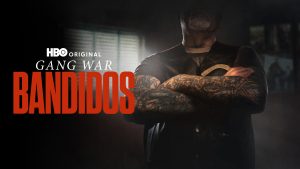
Recently, I got hooked on a HBO Max documentary series about, of all things, some serious stuff going down in Danish biker gangs. The Bandidos is a Texas club I’ve seen plenty while living down in Austin but this is not about the long history of the club over here. Gang War: Bandidos examines the rise of the Bandidos Motorcycle Club in Denmark, where the Texas-born outlaw motorcycle organization became embroiled in one of Europe’s most violent biker conflicts.
The Bandidos are a real motorcycle club and the stories featured actually took place, unlike the scripted events of motorcycle drama Sons of Anarchy. No one is model good-looking and there are no beautiful babes whose leather-clad man may be a little rough around the edges, but he’s a good man at heart. No, friends and freakazoids, the series is a real look into the life of some guys who live and die for their club, in the realest sense.
The series offers a perspective rarely afforded to filmmakers documenting outlaw motorcycle clubs. In this six-part Danish documentary series, director Mads Hedegaard’s work is bolstered by extraordinary access to club leadership, including interviews with European Bandidos president Michael Rosenvold, known as “Kokken,” before his death in 2024.
Through archival footage, interviews, and rare access into the club, the docuseries goes as far as the Bandidos are willing to allow cameras to see how their rankings, rules, and controversies move. In terms of Europe, Danes have always run the club, only after Kokken’s death did a Frenchman, his number two get the job. That meant the Danish group was in charge of how far they would speak to the filmmakers and, as a result, many of the club’s leadership sat down for the cameras to speak about their experiences with both the law and other clubs.
The first episode centers on the club’s decades-long battle with the Hells Angels and the government’s effort to dismantle the organization entirely. Historically, the Bandidos and the Hell’s Angels had a long-standing feud resulting in killings, enough that the two groups had to organize a formal truce. I mean, at one point, someone fired a machine gun and grenade at one another.
I don’t know what it is about the Nordic dudes, but these guys go ten toes down. If you look up the sordid history of the heavy metal subgenre Black Metal, the gnarliness of the Bandidos case shouldn’t surprise you. (The Black Metal dudes were burning down churches and killing one another — go read the classic book Lords of Chaos to learn more about these lovable guys in leather jackets and spikes.)
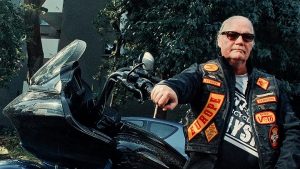
The gist of Gang War is simple: Denmark is considering banning the club. The issue is whether you can prove that the actions of men dedicated to living that “1%” lifestyle — 1% meaning they live as outlaws against the normies — are culpable as actions of the whole club. That’s a hard equation to make, considering the vast majority of club members are dudes with regular jobs who like to get up to some hijinks but aren’t really trying to do hard time.
What’s interesting, paradigm-wise, is that this isn’t a show about cartoon criminals. It’s a nuts-and-bolts look at how the history of something can infect its present and future. Knowing plenty of bikers throughout my life — having been around choppers, Harleys, Indians — I understand the call to the road. Since Marlon Brando threw his leg over a bike in The Wild One in 1953, there has been a complicated legacy — for better or worse — of what surrounds that bad boy image and how society understands what it means to be a “biker.”
Gang War doesn’t shy away from the grim details — death, shootings, grenades being thrown — but it does ask how these things affect guys who just want to be in a brotherhood with one another. The access granted to the filmmaking team was a brilliant chess move by Kokken before his death. By facing the allegations against his club head-on, Rosenvold peeled back the onion as far as admitting some members have checkered pasts, that things have gone wrong in the club’s history, and that the journey hasn’t always been an easy ride but, at the heart of the series, is the proposition that the club is not organized crime, despite the Danish state’s evidence.
They wanted to show, in the best way possible, that they were not actually what spurious public opinions thought they were. Clubs NEVER speak about their rules, so Kokken allowing the public even a peek inside was a big deal. The distrust of journalists among the clubs is real considering someone is always trying for that “gotcha” exposé. Allowing leadership to speak and take a middle-of-the-road stance on individual action puts them in a different place than deny, deny, deny — which is what most would do.
 If a club has a history of violence stretching back decades, can the organization ever separate itself from that history, or is the history the organization? You know your guys are screwing up. You love this thing you’re a part of. For a lot of these men, the club is their identity. So how do you compartmentalize that as a leader? Kokken and the leadership recognized transparency as mandatory for survival. A biker doesn’t live in a vacuum, but they do see everything through a hyper-specific lens. In this case, they had to make the call: sit with these reporters and make a deal with the devil to save their own skin. Otherwise, that deal would potentially be with Denmark’s version of the State’s Attorney.
For the true crime junkie, it’s a great series. For those who want to see the human side of a complicated social relationship with something you adore, it’s even better. Don’t let the leather vests scare you away. This is certainly better than the cornball soap opera bullshit that was Sons of Anarchy.
You May Also Like
-
 December 27, 2018
 -
 January 11, 2020
 -
 April 9, 2024
