‘The Yahoo Boys’ and the Clumsy Art of the Romance Scam
A new book on the teen scammers of Nigeria gets to the humans, but not the politics
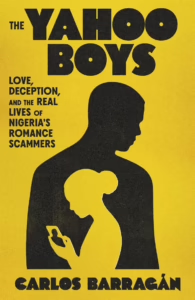
From the outset, Carlos Barragan is quite open and explicit about why he wrote a novel about a romance scam. His mother, a successful dentist, fell victim to one. Somebody from Nigeria somehow convinced her that they were in a serious romantic relationship despite the fact that this relationship was entirely online and constantly devolved into excuses for why she had to send him money. Barragan, who better understands online fraud than his mother, struggles to understand how this otherwise intelligent woman could be taken in by such an obvious scam. The Yahoo Boys is his attempt to find an answer. Although he fails to find his mother’s scammer specifically — a task Barragan openly admits was probably completely impossible — for the most part he succeeds in finding the yahoo boys.
The Yahoo Boys
By Carlos Barragan
Farrar, Strous, and Giroux; 304 pages
Barragan’s main flaw in this book is his lack of interest in domestic Nigerian politics. I can’t exactly fault him for that given the subject of his interviews. The four titular yahoo boys that he profiles in depth are for all practical intents and purposes random Nigerian teenagers who stumbled upon a successful get-rich-quick scheme. Barragan’s narrative is at its strongest when he’s emphasizing just how alien the existence of the yahoo boys is relative to their victims. Any of the people they’re scamming might as well be from outer space as far as they’re concerned. They understand, on an abstract level, that they are manipulating real people with real lives, and in their most compelling moments, even convince Barragan that they have real remorse. Yet Barragan is inevitably forced to admit that none of the yahoo boys seem to want to stop scamming just because they met a person (like Barragan) who was negatively affected by their line of work.
How the yahoo boys can maintain such a self-evidently sociopathic position isn’t addressed as well in The Yahoo Boys as it could have been. The political angle to appreciate is that these scams exist because the American dollar is worth roughly one hundred times as much as the Nigerian naira. As incredible as this sounds from the American perspective, even a single twenty dollar gift card represents an outrageous payday for a yahoo boy. Barragan even explains how, flush off their first successful scam, yahoo boys will just blindly spread their ill-gotten gains all over their local neighborhood. On one end, it’s bad that they’re running a scam. Although on the other end, it’s almost reassuring that the yahoo boys are a Robin Hood-esque institution, taking money from the West and redistributing it to the Global South.
 Barragan, to his credit, recognizes the obviousness of this narrative and tries to engage the subject, but only in the specific context of his informants, the yahoo boys. The trouble with this approach is that the political realities behind the economic conditions which make the scam practical are simply beyond their grasp. They don’t know enough about how the world economy works. And this has less to do with their being Nigerian, or even from poor backgrounds, as it does with the fact that the entire premise of being a yahoo boy is that it’s a job you can learn how to do without an apprenticeship or a formal education. You don’t even really need fluent English language skills. You get better at that naturally the more scams you try to run, and the flaws can be endearing. It makes the scammer seem more human.
That’s my interpretation more than it is Barragan’s. While he does, in the later stages of the book, mention Artificial Intelligence, it’s obviously not his focus. The references to it are cursory and vague, with Barragan implying that the technology could potentially replace the yahoo boys without being quite confident enough to say so outright. But bear in mind, this is the last chapter or two after ten where he has emphasized, repeatedly, that while he went into this investigation expecting to find some sort of elaborate criminal enterprise, he was shocked time and again the extent to which yahoo boys are literally just dumb teenagers. They also seem to have more in common with their victims than even Barragan wants to admit, lacking any real concept of financial planning. Though it is entirely possible that the process of finding interviewees was self-selecting and only the more ignorant yahoo boys were even willing to talk. When Barragan talks to the most sophisticated of the scammers he interviews, he isn’t able to go in-depth, because she (yes, there are yahoo girls too) spends most of their interview time telling a vaguely sad story that has far more to do with her alleged sex work than the yahoo scams. If my tone seems overly cruel and dismissive, that’s the cynicism of a couple hundred pages of crocodile tears.
Despite this constant stream of unreliable self-pity from his sources, Barragan’s sense of perspective is excellent. He makes the yahoo boys more sympathetic than is probably warranted and it pays off, providing a sharply different angle to the story than what we generally see in media today. The narrative regarding online romance scams has, since the moment Barragan successfully pitched this book idea, moved on to pig butchering scams which are distinct from what the yahoo boys do in that (allegedly) the scammers are working for criminal organizations at gunpoint, so as fellow victims, we don’t need to think too much about their psychology. John Oliver did an episode about them. If that’s too mainstream, the newspaper comic Mary Worth also did a recent story about “pig butchering” scams.

Despite the dramatic names, there’s not much difference between a yahoo boy scam and a pig butchering scam on the victims’ end. Barragan’s sympathy is appropriately with the victims on their spectrum of the loneliness epidemic. The story of one victim who was somehow convinced that her yahoo boy was pro wrestler Cecil Rhodes is instructive in a lot of ways. For a sufficiently lonely person, even the self-awareness to realize how stupid the story is when described to a third party is facing an uphill battle against a fantasy that genuinely makes them happy.
For all his efforts, though, Barragan’s lack of political consciousness can’t really convincingly answer the question of why it is appealing to Nigerian youth to become yahoo boys. Once again, the main reason for this is his unreliable sources. The yahoo boys lie: by definition, professionally. It’s literally their job to be very good liars. It barely even qualifies as a twist when by the later chapters, Barragan realizes that much of the empathy he has applied to his informants is misplaced. They might feel some genuine guilt about the apparent damage of their actions, but at the end of the day, no one keeps at the yahoo boy lifestyle unless they need money.
Ironically, this is a fundamental application of the idea that there is no ethical consumption under capitalism. Barragan just can’t quite get to that analogy, or properly explain how the way we see work in the Developed World is not that different from how yahoo boys take their daily life as a given with no real way of conceptualizing a version of Nigeria that doesn’t suck. The main appeal of being a yahoo boy is the huge payout. Learning an actual trade, by comparison, is harder work for comparatively little reward.
The Yahoo Boys was tricky to write, it seems, and is tricky to review because it is a book about interviewing inveterate and professional liars. I entirely believe Barragan’s narrative about what and how he learned about the yahoo boys. I also believe his interviews with them are accurate, to the extent he could reasonably verify their information. He is also — though just barely — self-aware enough about their unreliability not to take the claims of the yahoo boys at face value. An incident near the end of the book where Barragan observes that he himself was clearly scammed, has a sort of dry irony in that it demonstrates how Barragan was weaving a narrative in terms of risk versus reward, much like the yahoo boys do, and despite losing that dice roll, didn’t come out all that badly. After all, he got a good story, and published it in this book.
The yahoo boys have comparatively simple ambitions. Get an American to steal gift cards from Walmart, and the yahoo boy becomes a local big shot, if only for a moment. The yahoo boys are many things, but they certainly don’t seem to be lonely. They don’t even seem all that dangerous. One of Barragan’s most telling postscripts is that despite the yahoo boys seeming to be fairly awful people, he always felt perfectly safe hanging out with them.
You May Also Like
-
 April 1, 1996
 -
 July 23, 2019
 -
 April 29, 2020