What Was Alfred Hitchcock’s Secret?
New book argues that the famed director’s casting is given short thrift
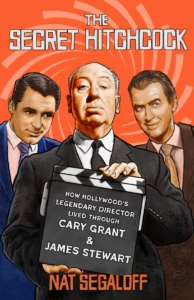
Alfred Hitchcock is widely considered a master of modern film technique, and for good reason. His methods of building suspense persist in films, decades after his death. In his new book The Secret Hitchcock Nat Segaloff provides an argument that Hitchcock’s work shouldn’t be seen as an auteur’s vision executed with masterful, innovative technique, but rather as brilliant opportunism. According to Segaloff, Hitchcock made use of the tools of circumstance, and the two most significant of those tools were Cary Grant and James Stewart.
The Secret Hitchcock: How Hollywood’s Legendary Director Lived through Cary Grant and James Stewart
Nat Segaloff
University Press of Kentucky; 221 pages
Because Grant and Stewart were A-list actors in their own right, they generally warrant biographical depictions as much as Hitchcock. Their collaborations are often noted by journalists and scholars less as a combined story and more as a different story. Segaloff’s jumping off point is one such note: a relatively brief exchange between Francois Truffaut and Hitchcock in their landmark 1962 interview, where Truffaut briefly notes that Grant and Stewart might seem interchangeable in Hitchcock’s films but are actually quite different in terms of what they can actually accomplish, to which Hitchcock agrees.

Segaloff follows this with a depiction of Grant and Stewart, not in terms of their relative merits as performers, but what they represented as abstract concepts in the public imagination. Grant is the impossibly handsome man. While that might not seem like an especially remarkable observation, the irony of this fact is key in understanding Suspicion (1941), a movie which is quite literally about Joan Fontaine suspecting, for good reason, that her husband Grant is a despicable person willing to stoop to murder to meet his goals but mostly succeeding in ignoring those suspicions because her husband is Cary Grant.
This is what good casting can accomplish and why it tends to be an underappreciated art in Hollywood today. The Secret Hitchcock is full of what-might-have-been speculation that always comes down on the side of that, whether for technical contractual reasons, it’s probably for the better that Grant and Stewart didn’t collaborate with Hitchcock as often as they might have wanted to, because their mere presence complicates how we read the plausibility of their actions. Grant’s particular version of sinister in Suspicion works because it’s precisely thanks to that charm that his character can get away with actions that, as Segaloff notes, are often implausible in celluloid — not least because in the original novel, without Grant’s charisma muddying the waters, Fontaine’s character comes off as an idiot. But with Grant as her leading man, Fontaine’s complex credulity led to her being the surprise winner for the Oscars that year.
 Grant can play many parts, but never stupid or naive. He’s a man whose very specific brand of Hollywood charisma makes him seem in control even when the script makes him vulnerable. Segaloff’s discussion of Rope (1948) as a possible Grant collaboration underscores how for all his range, this limits Grant in certain circumstances. The whole point of the movie, and the play on which it’s based, is that the professor accidentally turns his students into murderers. While Grant is certainly charming enough to persuade people to do all sorts of things, he is not plausible showing that level of naivete.
This is where Stewart comes in — as an alternate casting tool. He better encapsulates the kind of paranoia that comes from a person who isn’t sure what they’re doing and can be shaken by new information. Certainly, this is the case for Vertigo (1958), a film that is widely lauded yet also infamous for its often outrageous implausibilities that its lead detective character seems incapable of noticing. Just as Stewart himself embodied nuance, as an actor famous for coming back from World War II a highly decorated pilot and hero despite his unequivocal humility. Stewart the actor could show ambivalence, uncertainty.
Segaloff does not suggest that other “tools” could not have worked, just that the films that resulted would have been quite different. Take The Man Who Knew Too Much (1956) which is specifically spotlighted in the Truffaut interview. Stewart’s everyman character forges an emotional connection with the viewer, whereas since it’s so hard to see Grant in over his head, the picture might have had to accommodate some humor to make it square. North by Northwest (1959) provides another good example of how Stewart and Grant were not interchangeable. Try to imagine Stewart do modern spy caper nonsense at Mount Rushmore and you will struggle. Grant can get away with that because he’s Cary Grant, whose aura lets him get away with anything even when he’s playing an alleged everyman.
Segaloff doesn’t even back away from the master of suspense himself, openly describing several of Hitchcock’s films, even among the profiled ones, as stinkers. As a mostly straight adaptation of a stage play, Rope‘s main screen gimmick was that it was filmed in such a way that it could seamlessly transition between reels, a technical achievement Hitchcock worked hard to do that’s virtually impossible to even notice unless you’re specifically looking for it. That Hitchcock even did The Man Who Knew Too Much (1956) at all is a tad redundant once you notice, as Segaloff does, that Hitchcock also did The Man Who Knew Too Much (1934). Hitchcock was motivated to do every film he finished, but there’s clear disappointment in Segaloff’s tone as he discussed Family Plot (1976) as a bridge too far as self-parody.
By the conclusion, when Segaloff is recounting the story of Hitchcock’s last proposed film, The Short Night, it’s immediately intuitive why Hitchcock said he was never going to finish the film just because it wasn’t necessary. Hitchcock himself had just become too predictable at this point. There was no way he could warp remixed ideas in a way the audience could understand because that very warping had become too closely associated with him. In a weird way, Hitchcock actually ages better the farther in the past he gets because we start to forget what it even means for a story to be an Alfred Hitchcock story, with reactions that can’t be focus groups because it might take years or decades for it to really sink in for the viewer what he was even trying to do. Fortunately, having the exact context of who Grant and Stewart were and how their careers intersected with the Hitchcock brand only serves to enhance that experience for those not already aware.
You May Also Like
-
 November 21, 2022
-
 June 5, 2025
-
 February 9, 2023