
‘Wicker’ Provides a Rom-Com Interlaced With Substance
Olivia Colman and Alexander Skarsgård tentpole this offbeat drama from Alex Huston Fischer and Eleanor Wilson
Sex-starved wives. Brides with tight matrimonial chokers. Grooms sporting ceremonial carrot-penises for the goats to bite off. And a six-foot-four wicker man who happily hammers his outcast wife’s thatched roof when he’s not happily hammering her vagina. (Watch out for splinters!) If the brothers Grimm had ever written comic eroticism, the randy result would have looked a lot like Wicker.
Filmmakers Alex Huston Fischer and Eleanor Wilson have breathed cinematic life into Ursula Wills’ wise, witty short story “The Wicker Husband,” a prickly parable set in magical medieval times about a small-minded community and its crafty comeuppance all refracted through the lens of some very horny villagers. At times, it plays like a Penthouse Forum letter penned by Old Mother Hubbard.
Wicker ★★★★ (4/5 stars)
Directed by: Alex Huston Fischer and Eleanor Wilson
Written by: Alex Huston Fischer and Eleanor Wilson
Starring: Olivia Colman, Alexander Skarsgård, Elizabeth Debicki, Marli Siu, Nadhaan Rizwan, Richard E. Grant, Peter Dinklage
Running time: 105 mins
After suffering one too many verbal jabs at her pungently piscatorial spinsterhood, an ostracized Fisherwoman (Olivia Colman) asks the kindly local Basket Weaver (Peter Dinklage), himself a recluse, to make her a husband. And so he crafts a Wicker Husband (Alexander Skarsgård), a chestnut-brown man made of willow who delivers conjugal bliss and matrimonial joy. And it drives the narrow-minded, tradition-bound, suffocatingly patriarchal villagers crazy.
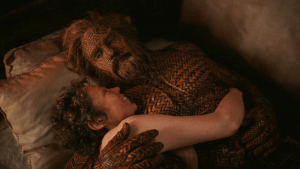
“Mother Nature provides, I merely augment,” says the mysterious Basket Weaver, whose ethereal ecological connections give him unearthly abilities to create human simulacra. But his conjured stud of woody sinew has upset the balance of village life, carefully cultivated and tightly controlled by the Tailor’s Wife (Elizabeth Debicki). Her courtly demeanor and soft-spoken ways mask poisonous asides fortifying outdated traditions that keep the whole town in line—especially the dim-witted men. “It’s important to manage your husband,” she confides to her younger cousins and sister.
The Fisherwoman has no need for such nagging, since her timber knight is the very model of a physically strong, emotionally gentle, and exceptionally devoted spouse. He was, after all, literally made for her. And their marital bliss (not to mention the piercing noise of their nocturnal lovemaking) is a dire threat to the ability of the Tailor’s Wife to keep everyone in line. So the gossipy shrew starts a whisper campaign, sowing doubt about the Wicker Husband’s fidelity. As one character says: “It is easier to believe the bad than the good.” Those flames are easy to fan anyway, since the woody hunk has been fueling sexual fantasies among all the women—including the Tailor’s Wife herself.
Fischer and Wilson are cheeky filmmakers, lacing their story with wry jokes and gallows humor to complement the village’s piss-stained facades. One running gag involves the town’s Doctor (Richard E. Grant), a delightfully overconfident louse whose patients almost invariably die from his blithe malpractice. And, like any good fairy tale, Wicker takes its fanciful premise to logical extremes, in a climax that reveals how eagerly the locals indulge in their own craven acts and venal urges. One person sinks into alcohol-fueled madness. Another makes such a breathtaking declaration that the self-own confessional all but destroys her life.
Wicker is not just a feminist fable about fuckable furniture, but an eccentric story about love at its simplest and most profound: selfless, full of sacrifice and trust—and, most of all, faith. Paper-thin propriety is no match for the uncomplicated clarity of true devotion. “I promise to love you,” says the Fisherwoman. “My love needs no promises,” replies the Wicker Husband. This romance is tightly woven indeed.
You May Also Like
-
 August 7, 2025
-
 June 25, 2019
-
 September 11, 2025
