
‘The Brutalist’ Truth About AI
Controversy over Oscar nominee’s sound enhancement is just the beginning
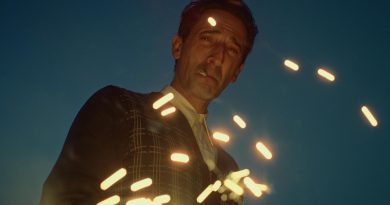
In The Brutalist Adrien Brody has the role of László Tóth, a Hungarian-born Jewish Holocaust survivor. Felicity Jones plays his wife, Erzsébet Tóth.
The Brutalist received 10 Academy Award nominations, including Best Picture, Best Actor for Brody and Best Supporting Actress for Jones.
Yet the movie is exceedingly controversial, not because of its subject matter or performances, but because of what seems to be everybody’s favorite subject: Artificial Intelligence.
Director Brady Corbet used AI to enhance the pronunciation of some of the words in the Hungarian dialogue. The Respeecher AI tool adjusted Brody’s and Jones’ Hungarian exchanges to make them sound more authentic to Hungarian speakers.
It is interesting to note that Brody’s mother is Hungarian.
Corbet also deployed AI the pre-production stages of the film to create images of the Brutalist architecture designed by Brody’s character. However, he used humans to draw the visuals that we see in the film.
Brody and Jones both reportedly agreed to the enhancements of their speech.
Film editor Dávid Jancsó, a native Hungarian speaker, helped coach the actors. His rationale for the Respeecher was to make their speeches even better.
They call it “voice cloning” technology. It analyzes and processes the recording of a speaker and generates a synthetic voice that sounds like the original—but different.
In the case of “The Brutalist” the difference is in the vowels other letters in the Hungarian language.
This is not the first time a director has used Respeecher in a movie. Robert Zemeckis deployed it in Here, “de-aging” Tom Hanks’ voice.
They also used it to enhance the singing of Karla Sofía Gascón in Emilia Pérez, which received 13 Oscar nominations, including Best Picture and Best Actress (Gascón).
Copyright developments
The U.S. Copyright Office has more than a passing interest in the development and application of AI in productions.
It has recently released “Copyright and Artificial Intelligence; Part 2: Copyrightability.”
Shira Perlmutter, Register of Copyrights and Director of the U.S. Copyright Office, said: “After considering the extensive public comments and the current state of technological development, our conclusions turn on the centrality of human creativity to copyright.
“Where that creativity is expressed through the use of AI systems, it continues to enjoy protection. Extending protection to material whose expressive elements are determined by a machine, however, would undermine rather than further the constitutional goals of copyright.”
In other words, human participation is key to whether they can grant something copyright protection.
If AI is a tool to assist creation, that’s OK. As the report puts it: “Neither the use of AI as an assistive tool nor the incorporation of AI-generated content into a larger copyrightable work affects the availability of copyright protection for the work as a whole.”
If AI generates the creation on its own, that doesn’t pass: No court has recognized copyright in material created by non-humans, and those that have spoken on this issue have rejected the possibility. In two well-known cases, the Ninth Circuit held that copyright did not protect text purportedly ‘authored by non-human spiritual beings’ and photographs that a monkey captured with a camera.
That’s right: AI, ghosts and monkeys.
They dedicated Part 1 of the Register of Copyrights report to “Digital Replicas.”
The 2023 SAG-AFTRA contracts comprehensively cover Digital Replicas, so that section of the report doesn’t add much to the SAG-AFTRA verbiage.
It covers both an actor’s likeness and voice.
Whether filmmakers use plain-old CGI or up-to-date AI to create a replica, the actor must agree for its use. More importantly, “You have the right to be paid when your digital replica is being used.”
SAG-AFTRA has gone further when it comes to AI and voice.
At the end of last October it signed an agreement with Ethovox, which positions itself as “The only premium voice service created by actors and empowered by AI.” Involving actors apparently provides validation.
Essentially, SAG-AFTRA and Ethovox agree that Ethovox will respect the SAG-AFTRA contract regarding an actor’s voice.
SAG-AFTRA National Executive Director & Chief Negotiator Duncan Crabtree-Ireland said in the context of that agreement: “Not everyone will want to work with an A.I. company, and that’s understandable. But for those who intend to utilize the opportunities A.I. offers, it’s important that agreements require companies to secure informed consent, and provide fair compensation. Without informed consent and fair compensation, this new era will become a ‘Wild West’ of A.I. misuse and exploitation.”
But back to “The Brutalist” controversy.
First, recognize that there was consent by the actors, so that’s not a problem.
Second, think of how we make movies: with technology. Everything from the cameras to the lights. Oh, and while on the subject of sound, let’s not forget the microphones. Should we expect actors to declaim in all scenes as though they are standing on a stage?
And none of this happens without electricity.
As viewers of 2019’s The Current War will remember, Thomas Edison claimed that direct current (DC) was dangerous compared with his preferred alternating current (AC). He electrocuted animals—dogs, cats, and even an elephant—to prove it. Apparently no monkeys were harmed.
The scary part for Hollywood is that people will soon be able to make whole movies on an NVDIA-powered rack in some college dorm room, sans actors, directors, musicians, writers, camera operators, and set builders. AI will soon not be optional.
You May Also Like
-
 July 6, 2020
 -
 January 9, 2024
 -
 January 4, 2025
