
‘The Pervert’s Guide to Utopias’ Preaches Radical Pessimism at the End of the World
In Venice, Sophie Fiennes’ third collaboration with Zizek sees the 77-year-old at his most political — and earnest
Following the end credits of The Pervert’s Guide to Ideology (2012), British filmmaker Sophie Fiennes and Slovenian cultural theorist Slavoj Zizek treat viewers to what may be the greatest stinger of all time. Reenacting Titanic’s infamous floating door scene, Zizek shivers in the gelid blue water of the night, uttering with his final breath, “I may be freezing to death, but you cannot get rid of me. All the ice in the world cannot kill a true idea.” He then sinks, a la Leo, into the ocean, but not before shoving a defiant fist in the air. The struggle lives on.
Fourteen years later, there’s not a whole lot of ice left. In The Pervert’s Guide to Utopias, Fiennes and Zizek grapple with ecological collapse and other apocalyptic prospects, using their winning formula of expertly reconstructed movie sets and psychoanalytically informed film criticism. The pair’s third, culminating collaboration begins with a “spoiler warning” that sets the tone for the rest of the 133-minute runtime: “This is a film about the end of the world.”
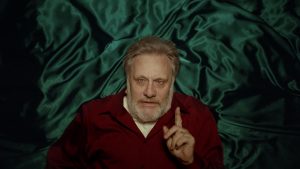
Like its predecessors, The Pervert’s Guide to Utopias offers a smorgasbord of ideas about human nature and culture through an eclectic filmography that includes Apocalypse Now, V for Vendetta, Blade Runner, The Prestige, and Sullivan’s Travels, to dip just a toe. What sets it apart from the rest is its tone, which is disarmingly earnest, even activist. Between film analyses, Zizek profiles current affairs, beginning with Congolese warlords selling multinational corporations the precious metals we use to power our phones. In a discussion on human genetic enhancement, he warns that class differences may soon be transformed into biological differences, fulfilling the worst of our sci-fi nightmares. Elsewhere, he responds to a supercut of inane Trump clips by calling the U.S. president “an authoritarian without authority.”
Zizek later brings Swedish climate activist Greta Thunberg into the conversation, airing her tearjerking 2019 “How Dare You” speech to challenge Plato’s notion that evil is borne of ignorance. Confronting global leaders for stalling on greenhouse gas reductions, Thunberg thunders, “If you really understood the situation and still kept on failing to act, then you would be evil, and that I refuse to believe.” Zizek claims that on the contrary, evil is born of knowledge, which provides us with an excuse not to act. Today, it takes the banal form of “I know, I know, don’t bother me.”
The Pervert’s Guide to Utopias★★★★(4/5 stars)
Directed by: Sophie Fiennes
Written by: Slavoj Zizek, Sophie Fiennes
Starring: Slavoj Zizek
Running time: 133 mins
What emotional compensation do we receive for such an attitude? In the case of fossil fuel executives, perhaps it’s as simple as self-serving blitheness. But how about for the rest of us? Apathy is often a defense mechanism for despair: If we pretend not to care, maybe we won’t feel so bad. In arguably the most compelling segment of the film, Zizek unpacks Lars Von Trier’s Melancholia, inaugurating melancholy as the prevailing feeling of the modern West. He describes it as a sort-of anhedonia, where nothing is missed and nothing is desired.
What fascinates Zizek about the film is its protagonist Justine (Kirsten Dunst), a depressive bride-to-be. In contrast to those around her, who cling to normalcy as an asteroid hurtles toward Earth, she is unable to function, even at her own wedding. But as the impending collision becomes too obvious to deny, she paradoxically starts to come alive. When the moment of impact nears, she constructs a “magic cave” of flimsy sticks to console her nephew in a purely symbolic act Zizek regards as among the most poetic in cinema. Justine is fully aware that what she’s doing will not save her loved ones, but does it anyway to preserve their spirit. For Zizek, this is the proper orientation toward crisis: to “take on danger with a cold distance knowing we may not be able to survive the catastrophe.”
Ever the pessimist, Zizek nonetheless emphasizes that our situation is much more open than we think. For him, the future and the past are not fixed but waiting to be made and remade. Beyond possibility, he asserts the concept of multiple necessities: that as seemingly necessary as the end of the world is, it is equally necessary to prevent it. But Zizek takes pains to distance himself from hope, declaring at the film’s Venice premiere that it only serves as an alibi for those who don’t want to act now. Instead, in a signature dialectical inversion, he instructs that “the only optimism possible is no hope.” So hold up your fist as it’s submerged by the rising tides — if you’re going to drown either way, you might as well.
You May Also Like
-
 February 19, 2019
 -
 April 25, 2019
 -
 December 11, 2019

What was in the now private video?