
Hell: A Guided Tour
Virginia Roberts Guiffre’s harrowing memoir describes the sleazy, brutal underworld of sex trafficking and the vicious predators who reigned there
It’s rough justice for the former Prince Andrew, whose brother King Charles III has unceremoniously stripped him of his royal title and expelled him from Buckingham Palace as the world of British royalty reels from allegations that the playboy prince fraternized with the late Jeffrey Epstein and sexually abused a teen under Epstein’s auspices. From now on, the accused will be known as Andrew Mountbatten Windsor, not as a prince, though of course he denies the charges and might yet contest them.
The legal process may well play out for years, but for some, the only evidence to carry weight here is the first-person account of Virginia Roberts Giuffre, who took her own life on April 25 and whose memoir Nobody’s Girl has just hit shelves. Her story is a tragedy, on par with the worst accounts heard during the Harvey Weinstein trials.
Nobody’s Girl: A Memoir of Surviving Abuse and Fighting for Justice
By Virginia Roberts Giuffre
Knopf; 409 pages
As the book makes clear, Prince Andrew was far from the first predator Giuffre ran into as a teen dependent on adults. This is hardly a pleasant read, yet it feels like a necessary one. For those brave enough to hear her out, Giuffre provides significant perspective. Anyone who attended an elite private college and then went on to some fancy job perhaps in publishing or finance, yet who still fancies they had a tough life or were a victim of “the patriarchy” or some other form of institutionalized injustice, should sit down and read Nobody’s Girl.
You think you’ve seen the world’s rough edges? This book will adjust your understanding of terms such as oppressed and marginalized. It will show you the meaning of a hard life. Giuffre describes having grown up dirt-poor in a Florida county just down the road from the opulence and wealth of Palm Beach and Mar-a-Lago. Her parents treated her like an accident and a mouth to feed. We hear about how, when she got her first period while playing with other kids at a party and came to her mother in alarm, her mom reacted with sneering contempt. Without so much as setting down the beer she was holding, Giuffre’s mom handed her a hygienic product and told her, “Figure it out.” But the mom almost comes off as decent in comparison with the father, who, at the tenderest of ages — well before most people begin to have much sense of their sexuality — subjected Giuffre to horrific abuse as she took baths. Her father then “lent her out” to a friend who was just as vile.
 Through her father, who did menial jobs at Donald Trump’s Mar-a-Lago estate, Giuffre got a job that she hoped might be the ticket to a halfway decent career. The job was as a locker room attendant at Mar-a-Lago, which sounds anodyne enough. But, in Giuffre’s telling, that position soon made her a target of predators.
We learn how Ghislaine Maxwell, the well-spoken, highly-educated daughter of the late British media magnate Robert Maxwell, spotted Giuffre walking on the Mar-a-Lago grounds while she was riding in a limo and told her driver to follow the hapless girl. Minutes later, Maxwell approached Giuffre near the locker rooms and asked whether the teen had ever considered working as a massage therapist.
Giuffre did not quite know what to make of Maxwell, but money talks. She ended up accompanying Maxwell on a ride to the Palm Beach waterfront mansion of one Jeffrey Epstein, who, to Giuffre’s shock, lay naked on his belly on a massage table. Giuffre’s description of what happened next is one of the most searing passages in any memoir. Masseuse? Nothing Maxwell had told Giuffre was even close to the truth. Here was the first encounter in an ordeal spanning many years, during which Epstein constantly took advantage of Giuffre’s youth and innocence for his own pleasure — and the pleasures of powerful men in his orbit. More accounts follow, and they do not get any easier to read.
The world of sex-trafficking may never have been evoked before with quite the level of lurid detail that Giuffre brings to the table here. Turning out this book, with the help of a collaborator, Amy Wallace, was an act of bravery for which the late author deserves our sympathy and thanks. While the professionalism of the writing may be partly or largely attribute to Wallace, the raw truths are Guiffre’s alone.
What people should not do is view the tragedy through one or another partisan lens. Sadly, such a mistake seems likely given that Maxwell scoped the 16-year-old Giuffre on the grounds of Mar-a-Lago. So, then — some will say — didn’t Trump kind of facilitate all the abuse followed? Weren’t he and his empire a magnet for the scummiest type of person? But such a reading would be shortsighted. Maxwell and Epstein, Giuffre reminds us, boasted of their ties with powerful Democrats and of having attended a dinner at Bill Clinton’s White House. They were drawn to important and influential people — and to an opulent lifestyle where they could provide quick services for acquaintances smitten with lovely girls, extending their social influence ever further — not to Trump per se.
Epstein was clearly a sick man, yet Maxwell stands out as an archvillain of this tale. Let’s not forget that, according to the author, Maxwell did far more than make introductions. She threatened Giuffre with dire consequences if the young woman failed to please Epstein and others. Needing money and experiencing, by her own admission, a bit of Stockholm Syndrome, which makes impressionable captives feel a weird temporary bond with their captors, Giuffre fell in line and did what Maxwell, Epstein, and others demanded, becoming a fixture of Epstein’s jet-setting lifestyle. She traveled widely with Epstein and Maxwell and spent time at his grand digs across from the Frick on the Upper East Side and at Maxwell’s London townhouse.
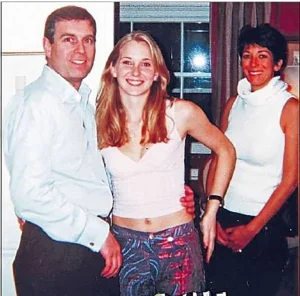
It was at the latter that she had her first run-in with then-Prince Andrew one day in March 2001, a moment captured in a photo — included in the book — that Epstein took with her disposable camera of Giuffre, Maxwell, and the young monarch standing together smiling. When Maxwell told the prince to guess the girl’s age, he correctly answered “17,” helped, we learn, by the proximity of Giuffre’s age to that of his own daughters.
As soon becomes clear, the charms and urbanity of the prince were a mist hiding predatory traits, although here, as elsewhere, Maxwell pulled the strings with coercion and threats. When they were out on the town, Maxwell allegedly told Giuffre, “When we get home, you are to do for him what you do for Jeffrey.” For her attentions to the prince that night, Epstein gave Giuffre $15,000, but it did not make her feel much better. She would soon run into the prince again at Epstein’s place in Manhattan. More trauma followed, and more still.
No doubt we are closer to the beginning of this controversy than the end of it. Tragically, the thing that militates against any politicization of the scandal is also one of its most disturbing facts: namely, the sheer number and variety of people implicated. Thousands of girls victims of wealthy businessmen of all nations and political leanings, liberals and conservatives, powerful Democrats and Republicans. So far, though, only a handful — notably, Epstein; Maxwell; the former British ambassador to the U.S., Peter Mandelson, whom Prime Minister Keir Starmer recently fired; and now the former Prince Andrew — have faced serious consequences.
The tragedy of this courageous, wrenching account is that Giuffre is not around to receive our thanks or those of victims of sexual trafficking and abuse who may now feel emboldened to come forward and tell their stories, secure in the knowledge that the public does have an interest in hearing the truth and holding predators to account. For her part, Giuffre is in a place where the predators can never touch her. She is truly nobody’s girl.
You May Also Like
-
 April 7, 2020
 -
 October 12, 2020
 -
 October 17, 2023
