
Will America Find Japan’s Bestselling Novelist Through ‘Stray Dogs’?
A new translation of Osamu Dazai’s ‘Justice with a Smile’ is part of a wave of his work appearing in the West
The great Japanese author Osamu Dazai was at the height of his fame when he and his mistress drowned themselves in a Tokyo canal in 1948. Dazai had made at least four other attempts to kill himself before he ultimately succeeded. He left behind an impressive body of literary work spanning over a decade; But his two most iconic novels, and the first to be translated into English, remain his later novels, No Longer Human and The Setting Sun, twin tales that tell of stories of depression, isolation, and trauma in a modern, Westernized Japan.
Though No Longer Human was one of the highest-selling Japanese novels of all time, Dazai remained fairly unknown outside of Japan, outside of a select few translations of his most iconic works by the legendary Japanophile Donald Keene.
That changed in 2012, when the mangaka Kafka Asagiri launched his hit manga series (since adapted into an anime) Bungo Stray Dogs. Every protagonist and antagonist in Bungo Stray Dogs takes their name from a famous author; their corresponding superpower takes their name from one of the real-life author’s most famous works. Asagiri did this partially to encourage Japanese youth to read more classic authors, from F. Scott Fitzgerald to Edgar Allan Poe to Dazai himself.
In the manga, Dazai is one of Bungo Stray Dogs’ protagonists, characterized by his attractiveness, humorous personality, and his obsession with suicide. Bungo Stray Dogs has since become a huge hit, selling over 16 million copies in print and launching an ongoing anime series with five seasons.
In the intervening years, Dazai has seen a major resurgence in Japan and a nascency in the West, borne by his universal themes of human isolation and depression in the face of modernity. At the height of Dazai’s recent resurgent fame, as many as 150,000 copies of No Longer Human were being sold per year. His vibe resonates strongly with Gen Z and Gen Alpha, born and raised on screens and thrust into an increasingly hostile job market and an increasingly hostile world.
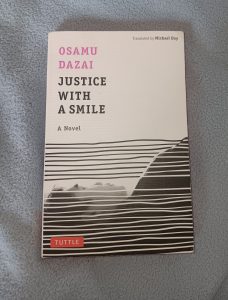 It is for that reason that Tuttle Publishing has begun translating some of Dazai’s lesser-known works, hoping to capitalize on that resurgence. Justice with a Smile is one of many of Dazai’s books published by Tuttle Publishing in recent years, alongside The Final Years, The Real Osamu Dazai, and new translations of Dazai’s classics No Longer Human and The Setting Sun in manga form. Justice with a Smile was first published in Japan in 1942 by Kinjo Publishing; however, it was only officially translated into English and published in summer 2026.
Dazai frequently and largely wrote autofiction in which he essentially retold true events that happened to him, sometimes with a sheen of drama or with the occasional detail or name change. This autofiction was not confined to his own life — he would often retell others’ stories. The Setting Sun, for example, is based on the diaries of one of Dazai’s mistresses. Justice with a Smile is similarly based on someone else’s diary, that of Yasuhisa Tsutsumi, a prominent Kabuki actor in Japan during Dazai’s heyday. Yasuhisa’s older brother, Shigehisa Tsutsumi was one of Dazai’s disciples and he provided the diary which provided the foundation for the work.
Justice with a Smile tells the story of Susumu Serikawa in the 1930s, who is sixteen when he decides to start keeping a diary. The book is written as a series of diary entries, beginning with Susumu’s last year in middle school and following his path through early college, before deciding to drop out to become an actor. Along the way, he deals with his sister’s marital troubles, his inability to decide what he wants to do with his life, and his brother’s increasing desire for alcohol.
Despite’s Dazai’s tendency to draw characters in his own image, Susumu is quite distinct from the perennially depressed author and — spoiler alert, the novel does have a happy ending (in stark contrast to Dazai’s life story). Translator Michael Day told me that the novel shows “a new facet of an incredibly talented and shockingly under-translated literary giant and I’m very proud to have played a part in bringing it into English.”
Although Susumu is vitally different from Dazai, the novel showcases the themes of angst that were so central to Dazai’s life and works. In our discussion of the book, Day reflected that, “I am used to thorny, twisty texts made of obtuse, strangely shaped parts that you have to scalpel apart precisely and stick back together with custom-formula adhesive. I like working on stuff like that, literature that plays games with language and your mind.” He added, “By contrast, this text is reasonably straightforward, but there are lots of things that are straightforward but not simple.”
Susumu is a testament to the fact that teenagers never change. The thing that drew Dazai to Yasuhisa’s diary in the first place is its tempestuous quality. Dazai would later say of the diary that “Throughout the notebook, in a deliberately chaotic style — laced with frequent exclamation marks and question marks — [Yasuhisa] had written, in a fierce yet humorous tone, tirades against his school and teachers, taunts directed at his friends, lamentations of self-loathing, and heartfelt yearnings for the future. There was a raw, poignant quality — something only a boy around sixteen could have written. Like magma that had not yet solidified into rock, it flowed between the lines, red, hot, and sparks flying.”
Justice with a Smile
By Osamu Dazai, trans. Michael Day
Tuttle Publishing; 160 pages
Susumu is tempestuous. On one occasion he announces his hopes for his sister’s marriage’s success; he subsequently moans, “Oh, no! I’m sounding like an adult.” He flakes on social engagements on a whim. He hates school. “None of these jackasses have ever taught me anything,” he writes of his middle school teachers. While in middle school, Susumu looks forward to higher education but, as soon as he gets there, he writes, “I’m disenchanted with university life.” He then looks forward to joining an acting school but when he gets there, he says of it, “There wasn’t even any sense of life, real life or any kind.” One moment he is feeling particularly self-satisfied. The next, he writes, “Susumu Serikawa, you are so stupid!” One moment he is looking forward to his career as a famous movie star; The next he is contemplating suicide over his concern about his test scores.
Suicide is a recurring theme in Justice with a Smile. His suicide attempts proved to be a rich source of material for Dazai — Japanese Wikipedia even has a separate page titled “Osamu Dazai and Suicide,” with a handy table explaining which of Dazai’s suicide attempt inspired which of his stories. “I want to die,” was one of Dazai’s favorite catchphrases which he was quick to fall back on when confronted with the slightest inconvenience, starting in middle school. Suicide always exists as a reasonable way out in Susumu’s mind, his Japanese traditionalism overriding his Christian morals. “I want to die,” is Susumu’s chief thought after his schoolteacher humiliates him. When finding himself disenchanted with the theater, he immediately writes, “Suicide. This morning I sat and calmly contemplated killing myself… Acting was the only reason I had to stay alive.”
Strangely, though Yasuhisa Tsustsumi’s diary was laden with references to Karl Marx and his philosophy, Dazai chose to substitute Jesus Christ for Marx. Dazai lived his whole life fascinated by Christianity, despite never formally converting. From his earliest works to his last, his writing contains numerous references to Christ and the Bible. Susumu’s Christianity forms much of his moral backbone; like many Christians Susumu looks down on his family members, abuses his teachers, and lets others down, while he is also additionally quick to relent and repent of his actions and try to make amends.
The translation is solid, as has been the case with many of Dazai’s latest works that have been translated. True, the language is rather modern; phrases such as “Dumpster fire,” “Bro,” and “BS” abound. The novel is also more profane than Dazai’s previous works, with four-letter-words sprinkled intermittently throughout. “I chose deliberately to throw in some Gen Z and millennial slang,” says Day, admitting that, “There has been a range of feedback about that choice. I wanted the translation to be as distinctive and even button-pushing as the original.”
Day went on to tell me that “The main challenge was getting the tone right. Dazai writes in fully modern Japanese and it isn’t at all difficult to determine what he’s trying to say. The directness of the tone in a way simplified things, but the crucial matter was making the English translation sound as fresh in 2026 as the Japanese did in 1942.”
Peeking out from the alienation and suicidal ideation there is an overarching thread of hope and the possibility of a better future for Susumu and his family. In the end, Dazai gives us a happy story that he himself would never enjoy. Justice with a Smile shows that not all was doom and gloom for the depressed author — there were cracks of light between his darknesses, and a just smile for all his frowns.
You May Also Like
-
 April 15, 1997
 -
 January 20, 2021
 -
 March 28, 2021