Carla Baratta: The BFG Interview
The Venezuelan model turned star of ‘One Hundred Years of Solitude’ talks Macondo
One Hundred Years of Solitude, the series that filled Netflix screens with immaculate doses of the Colombian Nobel Prize winner Gabriel García Márquez, has marked an audiovisual milestone in Latin American cinema. The production not only paid homage to the mythical novel, but earned the series a place of its own as a new reference for that legendary town called Macondo.
One of the most memorable and contradictory characters in the book is Fernanda del Carpio: a rigid, deeply religious aristocrat from the highlands who arrives in Macondo as an outsider and spends the rest of her life trying — and failing — to impose order, piety and social hierarchy on a family and a town that refuse to submit to either. Raised on the illusion of lost nobility, she is among the novel’s most complex and enduring figures, becoming both its most tragic prisoner and its most relentless jailer.
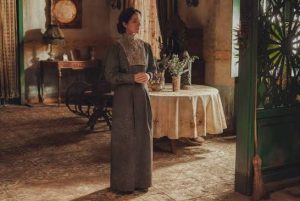
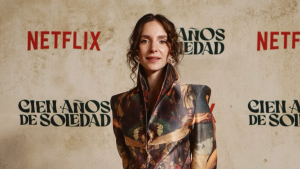
Three actresses brought Fernanda to life in the series: the Colombian-South African actress Laura Taylor in her youth; the Venezuelan Carla Baratta in her adulthood and prime; and the Colombian Margarita Rosa de Francisco as the older woman.
Venezuelan Carla Baratta may be more widely known for the Sons of Anarchy spin-off Mayans M.C., where she played Luisa “Adelita” Espina, the moral and tragic heart of the series — a maternal guerrilla leader who fights against the system that destroyed her, only to be finally consumed by it.
If that was already a multi-layered performance that Baratta solidly mastered, the new challenge of stepping into Fernanda del Carpio’s shoes — walking with her stretched, almost impostor-royal gait — meant navigating waters far deeper than those of a simple character. It meant rowing into the greatness of a book that was never just a book.
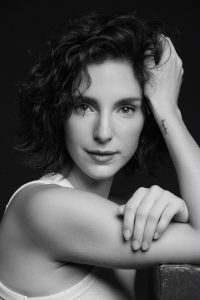
Baratta — also a model and visual artist, and currently lives in Madrid — is sharpening her focus toward her next projects. She took a moment to reflect with Book and Film Globe on the odyssey of being part of One Hundred Years of Solitude.
BFG: Fernanda can be deeply irritating: her religious fanaticism, her obsession with appearances, her rigidity and her refusal to accept the world around her. And yet García Márquez also makes her a deeply tragic figure. When you first approached her, how did you reconcile the part of Fernanda that you might instinctively reject with the woman you ultimately had to inhabit? What part of yourself did you have to put aside — or even erase — in order to become her?
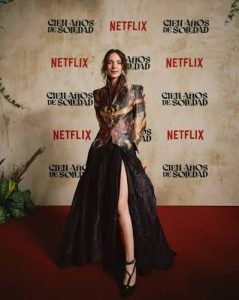
Carla Baratta: Personally it was a huge challenge. I had to find the humanity and approach her from a place of empathy with such a complex character. I don’t know if there was a reconciliation, but there was definitely a process of understanding where she came from so that I could believe that her actions were the result of that past.
Fernanda is played by three actresses across different stages of her life: Laura Taylor, you, and Margarita Rosa de Francisco. There is a remarkable continuity between the three performances. Did you and Laura ever talk about Fernanda? Was there a conscious handoff between you, or did each of you have to discover the character independently?
Yes, of course! I had the opportunity not only to talk with Laura and study her movements, but also to watch her on set. What she did was wonderful — she left me such fertile ground to work from, and I was able to deliver a Fernanda who was completely lost in her own world. And Margarita did a precious job taking her back to that innocence of madness that comes from not belonging.
One of the extraordinary things about the series is how faithfully García Márquez’s prose seems to have travelled from the page to the screen — not only in the dialogue, but in the monologues and in the very language of the characters. At a time when so much contemporary screenwriting seems increasingly afraid of language, what does it mean for an actor to inhabit writing as rich and alive as García Márquez’s? What does it feel like to have the words of perhaps the most emblematic writer in the history of Latin American literature literally coming out of your mouth?
Spectacular. As an actress who loves literature, it was an honor to be the voice of such beautiful words and such beautiful images. In my opinion, the screenplay work is impeccable.
Fernanda arrives in Macondo as an outsider, a cachaca from Bogotá, while you entered the production as a Venezuelan actress working inside an overwhelmingly Colombian creative environment. Did that experience of being an outsider give you a different way into Fernanda?
I never felt like a stranger or a foreigner. I’m from the border with Colombia and I’ve always felt a strong affinity with their customs and their people. But I’ve lived in more than four countries, and that definitely helped me understand the feeling of always being an immigrant in a house that never quite becomes yours.
Was there a moment during the preparation, rehearsal or shooting when you suddenly thought: I have her. I am Fernanda now. Was there a particular scene, gesture, costume, line or moment when the character finally clicked into place for you?
The moment when director Laura Mora told me she was in love with my interpretation of Fernanda — with the gestures and the absurdity of her postures. I was doing it without knowing if it was registering or if it made sense, and when she said that, it gave me the green light to fully surrender to that journey.
At what point did Macondo stop feeling like a set and start feeling like a place you actually inhabited? Was there a moment when the physical world around you changed the way you were performing Fernanda?
From the very first moment I set foot in the Buendía house. The magic was real. And adding the costumes and the atmosphere… it was like traveling through time.
What was an ordinary day inside that world actually like? I am curious about the things the audience will never see: where you ate, what you talked about between takes, the jokes, the waiting, the friendships, the little rituals that made this enormous production feel like a community.
The schedules were crazy. I would leave the hotel at 4 a.m. and sometimes not get back until 8 p.m. The atmosphere was beautiful — we ate with all the departments in a huge tent, and they took really good care of us. Jokes were part of everyday life, and the camaraderie among the entire crew was fundamental. There was always someone who would make you laugh or offer you a little coffee.
A production like this brings together actors, writers, directors, cinematographers, production designers, costume and makeup departments and an enormous technical crew. From inside that process, how much did those different creative departments actually interact with the actors? Did you ever find yourself talking directly with the writers or designers about Fernanda, or did most of that communication happen through the directors?
There were departments with which we had closer communication. With the makeup and costume departments we had a very close relationship — we could ask questions and give opinions. The same with production and direction. I was very respectful regarding the script and there was never any need to ask for changes.
Laura Mora and Carlos Moreno directed the second part. Do they have different approaches to filmmaking? How did each of them create the atmosphere on set? Were they directors who liked to explore a scene through many takes, or did they tend to know quickly when they had what they wanted? And how did that working rhythm affect you as an actress?
Both directors are wonderful artists and human beings. Although they have very different ways of directing and running a set, their energy and creativity follow a very parallel line, and that brought the actors a coherence in the performances that wouldn’t have existed if we’d had two directors with opposing approaches.
There is a moment when Fernanda finally explodes, and, from a male perspective, it almost feels like the worst nightmare imaginable: watching the woman you love reach a point of anger so overwhelming that you have no idea what to do or how to respond. The scene feels as though it has been building methodically, scene after scene, until the pressure finally breaks. Given the importance of Fernanda’s outburst in the novel, what was it like to perform that moment? It appears to have been filmed almost as a single uninterrupted take, with an enormous amount of dialogue and a continuous crescendo of emotion. How many times did you have to perform it, and what did that scene require from you as an actress?
Haha, I loved that scene. I enjoyed it enormously. It was a big challenge — memory-wise, emotionally, and technically — because, as you say, it was practically a single take (we only cut at the end when we went into the kitchen)… We didn’t do it as many times as one might think. It was episode 7 and by then we were all so in sync that it flowed wonderfully.
Before you ever imagined playing Fernanda, what did One Hundred Years of Solitude mean to you personally? As a Venezuelan, did García Márquez’s world feel Colombian, Latin American, or somehow your own?
Of course! It’s my father’s favorite book. It was always there like a relic in the library of our house.
You have now lived inside a character from one of the most important novels in the Spanish language and inside one of the most ambitious productions ever made in Latin America. Has this experience changed your understanding of what you are capable of as an actress?
It made me fall even more in love with this profession. And it gave me the foundation to keep believing in the power of dreams and of magic.
What are you hungry to play now? After spending so much time with a character as demanding, contradictory and enormous as Fernanda, is there a kind of role — or perhaps a kind of actress you want to become — that you feel ready to pursue now?
I would love to go back to comedy. That’s where I started as a child in theater. But right now I’m focused on writing (creating stories) while the next dream project comes along. I wouldn’t want to do just anything — it has to be something very, very special.
Do you remember the last day of filming? Not the official wrap, but the human moment when everyone understood that Macondo was ending. What is the one thing from that day you think you will still remember 20 years from now?
I remember the day Úrsula died. All the production car drivers (there were hundreds of them) turned on their lights and made a path for her while honking their horns. That scene will always remain in my memory like a treasure.
From one Venezuelan in forced exile to another Venezuelan who has travelled the world carrying her talent with her: what do you think connects those of us who were born in Venezuela, Colombia and across the Caribbean? What do you think makes us so unmistakably who we are?
I think that for us, fear is something else. We’re not scared of the same things as the rest of the world. We’re scared of injustice, of sadness, of loneliness. And I believe that’s where the magic comes from — from the humanity and kindness with which we see life and with which we are raised. From our grandmothers and grandfathers.
You May Also Like
-

-
 September 11, 2026
 -
 April 29, 2026