
There’s No Need for Monster Logic in ‘Resident Evil’
Zach Cregger reboots the iconic horror series and revels in its visceral pageantry
“What the fuck?!?” is the most accurate line of dialogue in horrormeister Zach Cregger’s Resident Evil, a viciously fun low-brow adaptation of the beloved and long-enduring first-person shooter game from Capcom. His protagonist Bryan (Austin Abrams), a medical courier tasked with a rush-job delivery to the secretly-infected urban hellscape Raccoon City, mutters those words repeatedly with every new eye-popping encounter. And wiser words were never spoken.
Resident Evil ★★★★ (4/5 stars)
Directed by: Zach Cregger
Written by: Zach Cregger, Shay Hatten,
Starring: Austin Abrams, Zach Cherry, Kali Reis, Paul Walter Hauser
Running time: 95 mins
That WTF zinger has been a mantra for other unfortunate souls in Cregger’s previous movies, too — but Bryan virtually chants it here as he keeps encountering mutant monstrosities both mind-bending and stomach-churning. A dog whose head peels open to reveal life-choking tendrils? A morbidly obese naked man in a sewer whose chest explodes with rabid rats? A sobbing little girl whose foot has become strands of tentacles? It’s barf-bag existentialism, queasy and hilarious and absolutely terrifying.

Writer-director Zach Cregger has been redefining modern horror with methodical efficiency, after wowing audiences with his 2022 what’s-in-the-basement debut Barbarian and elevating the genre to Oscar-winning prestige with the missing-children shocker Weapons. Now, as a gun-for-hire to revivify the left-for-dead zombie franchise Resident Evil, Cregger has made his third thriller-chiller in four years.
This Resident Evil is technically the eighth installment (and second reboot) in the feature-film franchise that began in 2002, which itself was adapted from Capcom’s wildly popular video game series (numbering a dozen sequels, spin-offs, and remakes dating back 30 years). The creative mind behind six of those films was Paul W.S. Anderson, whose amped-up futuristic sci-fi action takes were always big on bombastic mayhem.
Cregger is comparatively more of a lo-fi auteur, framing his intense shocks with slow-burn long takes, ominous nocturnal surroundings and spare soundtracks. Despite the storied source material and its world-rupturing visions of a fast-spreading super-virus that turns its victims into rampaging homicidal meat puppets, this Resident Evil feels like a more modest affair — and, with its POV first-person explorations of empty buildings and abandoned streets, even at times seems more faithful to its video game origins.
Don’t expect Weapons-level multi-narrative sophistication here. If anything, Resident Evil feels like a stripped-down exercise in minimalist storytelling. For much of the film, Bryan is the only character on screen; at the climax, he shares a room with just a handful of others. And scenes progress with simple-minded momentum: Bryan accidentally hits a woman on a snowy stretch of desolate road. He gets stopped by a cop, which leads to an overturned police car and a zombie on the prowl. Bryan flees to a farmhouse, where the residents have already become infected. And that propels him back onto the road, where he’s picked up and taken to Raccoon City — to deliver the courier bag that he now learns contains a serum that could reverse this disease.
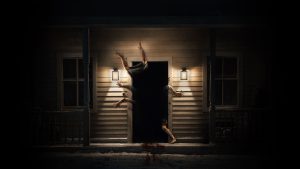
Once the film makes it to the big city, though, Resident Evil loses its glint of originality and becomes more of a (literally) leveling-up procedural, as Bryan has to ascend to the 27th floor of the morally dubious Umbrella Corporation to deliver his package. One route he takes involves an elevator, which gradually disintegrates section by section because one of the mutants overhead apparently vomits up acid — though they seem mostly docile otherwise. That guy looks almost normal compared with the multi-limb flywheel chasing him relentlessly: a nightmarish concoction that slowly grows larger as it collects dead bodies along the way, almost like a Grim Reaper dust bunny.
Why does one person have tentacles and another have destructive puke? And why is this tumbling corpse ball so fixated on hunting down Bryan? Do the monsters have any internal logic or rules of behavior? Not knowing why makes it seem like Cregger didn’t know himself, or (frankly) didn’t care. Resident Evil works better the less you question its logic and succumb to its visceral pageantry, right down to a blood-soaked maternity ward full of fleshy crimson bags hanging from the ceiling where dozens of cradled babies have slithering arms and deformed craniums.
Maybe Cregger had the good sense not to make Resident Evil anything more than a raucous good time, the kind of gonzo ride that Sam Raimi made early in his career as a showcase for his directing chops — and, not least of all, to display his comedic takes on horrifying material. Because, in its bleak climax, the film joyfully subverts any expectation of a hero’s journey. And it does that mainly because this is fundamentally a first-person shooter experience. As Bryan himself says, after upgrading from a handgun to a shotgun to an assault weapon and taking out a slew of zombies with a single shot: “Yeah! Video games! Yeah!”
You May Also Like
-
 July 22, 2022
 -
 October 9, 2019
 -
 May 29, 2024
