
Netflix’s ‘One Hundred Years of Solitude’ Is a Cinematic Miracle
Magical Macondo comes to life even as Colombia suffers tragedy
One Hundred Years of Solitude returns to Netflix with a devastating second season: a triumph of visual arts and literary storytelling over the current mediocrity of Hollywood. And in the middle of a doomscrolling culture, where Nolan’s insipid, soulless The Odyssey is conquering the world; where a Spider-Man whose flat, sadly stupid plot — recycling its already recycled story — is praised by critics; and where the industry’s great revitalizing phenomenon, Obsession, amounts to little more than a bundle of scenes ripped from TikTok, witnessing the grand cinematic spectacle presented by this second season, in the most glorious, poetic, impeccable way, feels like an act of absolute and vehement rebellion. An act of courage and, above all, of respect and love for the glorious experience of putting a mythical and unique story on screen — not merely to be enjoyed, but to be felt, lived, experienced.
Three years ago, I showed not only skepticism but total rejection toward the profane idea of adapting the book I hated so much, written by that Colombian Nobel Prize winner whose magical realism condemned future generations of Latin American storytellers to the repetition of fantastical little-town fables, and I firmly took my stand against Netflix. Two years later, when One Hundred Years of Solitude debuted on Netflix in 2025, I not only had to swallow every single one of my words, I even reconciled with the book. And today, after watching the first seven episodes of the second season — released by Netflix on August 5, with a final episode still to come on August 26 — I have laughed and cried, my skin has crawled, and I have ended up applauding what is, without a doubt, one of the most impressive achievements in the history of Latin American cinema. Does this sound bombastic? Absolutely. Does it do justice to what I have seen on screen? Absolutely.
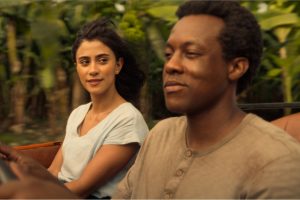
And Netflix — together with production company Dynamo — has delivered seven colossal one-hour episodes that, taken individually, reach a cinematic standard rarely, if ever, achieved by Latin American cinema. The first season of One Hundred Years of Solitude — received with skepticism by critics and audiences alike — started slowly. Very slowly. The first episodes felt like trying to push an elephant across the Sahara, only to eventually find an oasis. It presented a visual spectacle, sprinkled with magic — which, in the end, wasn’t that much magic — and characters leaping from the pages of the immortal novel to ascend into the heavens of streaming.
And so, the foundation of Macondo was told: the town that José Arcadio Buendía — dreamer, leader, and patriarch of an entire universe — and his wife and cousin, that colossal force of nature named Úrsula Iguarán, built from mud and cane at the edge of a river of clean water. It was a season that went in crescendo, just as Macondo itself grew, through challenges, wars, suffering, and celebration. And with four generations of Buendías breathing in the Caribbean heat, the first season ended as something very difficult to surpass. But boy, was it surpassed.
In this continuation, the cards have changed. There is no slow beginning. There are no elephants to drag. There is effort, attention, and dedication required, yes. That is what this series demands from its audience, which is a kick in the ass to the industry’s current dynamic, which asks you to keep track of Easter eggs, read “things you need to know before watching…,” scour Reddit for clues about what you are about to see, stripping away that old, visceral sensation of surrendering yourself to a movie or series and allowing yourself to be surprised. From the very first episode, “The Armistice,” director Laura Mora — responsible for five of the seven episodes, as well as the grand, feature-length finale on August 26 — delivers a masterclass that fuses camera work, production design, and music to inject us into the open veins of a Macondo suffocated by the stench of death brought by war.
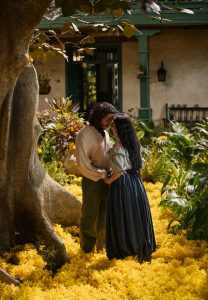
José Arcadio Buendía and
Susana Morales as Úrsula
Iguarán ; Courtesy Netflix.
Mora’s great achievement is maintaining an effective rhythm despite the complications of the story, and blending “magical realism” with a visual approach that does not trigger that instinctive rejection or reveal the hand of special effects. There is, as with all good drama, an exception — in the fourth episode “ThereHad Come an Innocent Train,” Remedios the Beauty ascends to the heavens, carried away by a powerful wind while hanging freshly washed sheets out to dry. And well, the truth is: there was no way to make that believable. The series moves like a heavy machine. This is far from a good binge. Here, it is good to breathe, to let what you have seen settle in your mind before continuing with the great journey of Macondo’s growth and eventual downfall.
But direction can be masterful, and if the actors don’t provide enough flesh, the result is helpless, empty. Yet, the cast of One Hundred Years of Solitude match the production’s technical achievements. The performances of Claudio Cataño, as Colonel Aureliano Buendía, and Marleyda Soto, as Úrsula Iguarán, who from the earliest episodes — as in much of the previous season — carry the weight of the series on their shoulders, deserve not only recognition but awards at galas packed with Hollywood stars. These two deserve to be named national heroes of Colombia.
Here, you don’t see actors or actresses: you see Aureliano, you see Úrsula. You see them, feel them, suffer with them, criticize them, accompany them… and bid them farewell. The episode depicting Colonel Aureliano Buendía’s death — on October 11, my birthday, thanks, Gabo — drags you into a memorable goodbye. And Úrsula, in her passage into the afterlife, leaves us with the stillness of an indomitable woman who was the bastion of a lineage and whose retirement is deserved. These are moments of high cinema.
To this pair we can add Laura Taylor and Carla Baratta, playing Fernanda del Carpio as a teenager and an adult, respectively. Beautiful, rigid, and pathologically puritanical, Fernanda steals an episode with the most colossal temper tantrum I have ever seen. Indeed, it may be the platonic ideal of a man imagining his wife exploding over something.

Julián Román who plays Fernanda’s husband, Aureliano Segundo, also takes on the role of Aureliano’s twin, José Arcadio Segundo. Román devours the screen with the brothers’ duality: the warrior against the dreamer. Ángela Cano and Licinia Alzate luminously, profoundly portray Petra Cotes — Aureliano’s true love — at different stages of her life. The list goes on and on, as members of the Buendía family enter and leave a world that shines before eventually becoming dull and drowned in darkness.
And Macondo grows. It modernizes with the arrival of the railroad, which fulfills its founder’s dreams but with development also brings destruction. The establishment of the banana company and the domination of the “American empire” mark Macondo’s extinction. And there is one scene. One scene that sells the entire series: the Banana Massacre. More than three thousand striking workers seeking to establish a union are gunned down. The solemnity, honor, and humanity with which the director tears open the entrails of the conflict between the cruelest violence — all inspired by a very real tragedy that occurred in Colombia in 1928 — and the helplessness of the humble, of those who have no voice to protect them… What we see here, the staging, has nothing to envy Schindler’s List. This stands on its own merits as an achievement of contemporary artistic creation.
A great flood lasting four years plunges us into the torment of the protagonists. Everything beautifully and brutally photographed. Here we see the big canvas. It is not only the Buendía lineage that is condemned but Latin America writ large. The magic of our grandmothers’ stories struggles against our conflicted realities. One Hundred Years of Solitude moves towards the end of the second — and final — season with one last breath of hope. After a cruel flood has washed everything away, can we start anew with the closing chapter of an epic where speaking with the dead has been as ordinary as screwing your aunt, when Aureliano Babilonia confronts us with the manuscripts of the old gypsy Melquíades and the lineages finally come to an end.
A Colombian woman once told me that one could live and die without ever having seen this series, but that no one could live and die without having read One Hundred Years of Solitude. After this second season, I have to correct her, the spirit of Gabriel García Márquez also lives and breathes through Mora’s miraculous Macondo.
You May Also Like
-
-
 February 5, 2025
 -
 April 14, 2026

Gracias por este artículo Carlos, me trago mis palabras también. Me encantó y conmovió porque también traduce mi sentir. Acertado como siempre mi estimado!!!!
Gracias a ti y a la Colombia maravillosa que representas. Ese país de colores y misterios; de magia y lucha eterna.
A beautiful cinematic portrayal of 100 Years.