
It’s Not Far From the Thousand Year Reich to ‘The Infinite State,’ But Gabriel Is New
Richard Swan’s new novel follows a new democracy setting up in the shadow of an oppressive interstellar empire
I feel about science-fiction dictatorships much as Leo Tolstoy felt about happy families: they’re all alike. What distinguishes one fictional authoritarian state from another isn’t how it terrorizes its citizens, it’s the form the resistance takes shape.
The Infinite State
By Richard Swan
Tor; 416 pages
Totalitarian futures feels eerily familiar: from the Galactic Empire (Star Wars), to Oceania (1984), or the Terran Federation (Starship Troopers). They all have sharp grey or black uniforms modeled on the Nazi SS, they all feature secret police, omnipresent propaganda, and disappearances in the middle of the night. It doesn’t really matter whether the banners are red, black or emblazoned with a giant eagle or displayed in the name of the Führer, the Emperor, Darth Vader or, as in Richard Swan’s new novel The Infinite State, Pater Aeternus, the Eternal Father.
The cover of the book displays features red, white, and black with an eagle just to make sure we are under no illusions about the nature of the eponymous state.
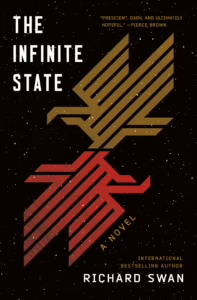 The novel is the first of the Decurion Saga, and is set in and around the Decurion Empire — an authoritarian interstellar power locked in an uneasy detente with the larger, but more diffuse United Free Nations. The UFN for its part is a useful trading zone for the Empire but is less a government than a sprawling coalition of planets whose loyalties range from enthusiastic support for the Empire to outright hostility. For Swan, it’s fertile territory for examining competing systems of government and that seems to be his main interest.
There’s been a real dearth of utopias in SF and a glut of dystopias. Swan deals quickly with the latter in order to redress the balance of the former. Like contemporary Russia or China, Pater Aeternus has a party-sponsored private economy to supplement massive state-owned industries. The plot kicks off when one of the Empire’s wealthiest industrialists dies under suspicious circumstances. His widow, Kathleen Fuller, inherits an immense fortune and promptly spends a chunk of it buying an entire planet which she names Gabriel, after their son who died before birth. Instead of escaping into luxury, she decides to build a new society from the ground up.
That shift transforms the novel from familiar military space opera into something more unusual. Swan tips his hand as less interested in overthrowing bad governments than in asking how good governments are actually constructed. Fuller finds an advisor — Lukah Walzingham — a university student who is an expert on governance and, after a few political science lectures, they are ready to set up an entirely new planet. Fortunately, they don’t need to worry about pre-existing communities because it is terraformed and free of anything more sentient than the “tygrosaurs” that eat the herbivores.
The founders have to resolve their differences and execute their decisions in order to set up systems in time to meet goals from the UFN about recognition. They face ideological opposition from the Empire as well as corporate and capitalistic piracy from those interested in dispossessing the vulnerable for more practical, lucrative reasons. Soon founding ideals run into the messy reality of economics, security and human nature – after all, the new citizens and officers of the new state are mostly refugees or forcibly displaced persons from the Empire.

Swan follows a constellation of fascist functionaries who soon sort out into goodies, baddies, and even-worsies. Of course, given the genre, any of them can (and do) switch allegiance at the flick of a switch given the incentive. In a world where only men can have power, Fuller gets to recruit, as best she can, from Inspektors Bill Lang (the young ideologue) and Cyprian Reis (the grizzled, disillusioned investigator), ministers Ruben Morozov (Permanent War), Gerolf Morita (Interior) and Jaroslav Droor (Information).
Swan is English, so the language is British English, which, as well as adding “colour” and “flavour” can also make some of the “bloody” cursing grate on American ears. On the other hand it makes the casting of the roles easy, there are cheap, excellent British actors aplenty. Maybe Idris Elba as Reis, and Bill Nighy is apparently already auditioning for the part of the dry, sly, menacing Droor in his role of The Director on Prime Video’s Ride or Die.
In order for the Empire to have a plausible self-mythology, Swan imagines a state that guarantees everyone the essentials — housing, healthcare and food. Even if it is not necessarily very good housing, healthcare or food, the people know that day-to-day loyalty will lead to survival. And, as well as bread, there are circuses — or, in this case, “hypersled” races. Within the novel, these entertain and excite the masses but as part of the novel, we readers are entertained by the pilots, their racing and their rivalry.
Swan has written a thriller where the stakes are democracy, though the tropes of gun battles, starship dogfights, and computer infiltration are more Star Wars: A New Hope than Star Wars: Endor.
Decisions have consequences. Compromises produce unexpected winners and losers. The challenge isn’t simply defeating tyranny but replacing it with something that functions and is also joyful. Still, this introduction to the saga leaves the Decurion Empire oddly underdeveloped. In an era when liberal democracies are increasingly criticized as slow, divided and captured by billionaire interests while authoritarian governments market themselves as efficient alternatives, there’s an obvious opportunity to explore why competent autocracies can sometimes appear attractive. Swan mostly sidesteps that debate. The Empire remains more narrative device than political argument.
Swan has written a fast-moving, intelligent novel about the difficulty of building better societies instead of merely tearing down bad ones. It’s an ambitious premise that so far either leaves fascinating ideas unexplored or clumsily has Walzingham explain them to Fuller, but the characters are fun enough and the political experiment at its center is compelling enough to make you want to see where Fuller and Gabriel end up next.
You May Also Like
-

-
 December 15, 2021
 -
 April 14, 2025
