
Jane Addiction
A new exhibition displays documents from Austen’s global fame
“Paper Jane: 250 Years of Austen,” an exhibition at Manhattan’s Grolier Club running through February 14, gives the lie to the notion that Jane Austen (1775–1817) wrote novels for the sole consumption of members of the elite society of Georgian Britain to which she belonged. It also helps demolish certain ideas about the male literary establishment of her time seeking to use any and all means it could to squelch any creative expression on the part of women writers.
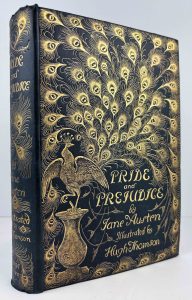
“Paper Jane” offers a look into the life and career of an author whose work spilled across class and national borders, attaining critical and commercial popularity around the world despite Austen’s initially having had to use the pen name “a Lady.” The exquisitely curated show features glass cases full of letters, posters, playbills, errata, newspaper clips, and various editions of her novels, from the first printings through cheap paperbacks printed for soldiers overseas, and including the more recent Signet and Penguin editions through which some of us came to know Austen in high school and college.
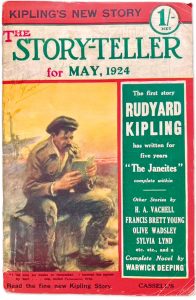
With books and journals from the time propped open behind the glass, the visitor can read portions of early editions along with Georgian-era critics’ takes on works including Emma, Sense and Sensibility, Persuasion, Northanger Abbey, Pride and Prejudice. The visitor can also check out literary journals that promoted Austen in one way or another many years after her death. An issue of Storyteller from May 1924, a caption informs us, featured an example of rising fascination with Austen in the form of Rudyard Kipling’s story “The Janeites,” in which front-line soldiers find solace in Austen’s work. “The term Janeites cements a growing cult of Jane,” the caption states.
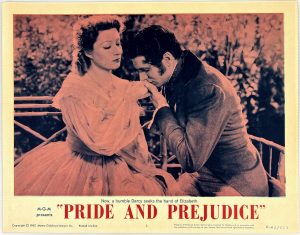
A section labeled “Hollywood” takes us into the world of Austen-based cinema, presenting lobby cards for Metro-Goldwyn-Mayer’s 1940 film Pride and Prejudice, and a press packet, title cards, and photos for a Spanish release of the movie the same year. A caption tells us that the film, starring Greer Garson and Laurence Olivier, took pains to present a proper, decent, literate Britain that would appeal to Americans as we weighed whether or not to jump into the growing conflagration on the other side of the pond and commit our blood and treasure to the defeat of fascism and the survival of, among many other things, the United Kingdom.
A vivid writer whose work lent itself to adaptation in cinema and art, Austen has provoked regular and differing interpretations — not least of her views on art. One scene in Pride and Prejudice — Elizabeth Bennet’s viewing of Mr. Darcy’s portrait at Pemberley — is the basis for seven images grouped under a section of the show entitled “Illustrating Austen.” The interpretations run from Charles E. Brock’s 1895 rendering for the publisher Macmillan all the way up to Anna and Elena Balbusso’s illustration for the 2013 Folio Society edition.
It is intriguing to see how visual artists with different sensibilities transferred one scene from the page onto the canvas. Brock’s illustration for Macmillan is a relatively minimalist sketch showing Elizabeth in profile among other gazers just as transfixed with other portraits as she is with the one of Darcy. By contrast, Angela Barrett’s 2013 stamp design for the Royal Mail — yet another index of Austen’s household-name status — captures Elizabeth from behind as she gazes up at the canvas from which a dark, handsome Darcy seems to make eye contact with her. The Balbusso rendering presents the scene from a similar angle.
Viewing the wildly divergent styles of the illustrations, the reader recalls the passage in the novel where Elizabeth’s aunt discusses the effect of the man’s likeness: “If I am not mistaken, my dear, you seem captivated by the portrait of Mr. Darcy.” Elizabeth denies any such hypnotic effect, claiming that Darcy’s complicated nature has vexed her. Whether Elizabeth’s reply to her aunt is truthful or not, the illustrations of the young woman and her love interest are likely to mesmerize the visitor.
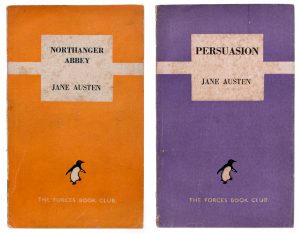
Other sections drive home the length and breadth of Austen’s influence, and, in particular, the growing variety of media through which readers of myriad backgrounds could access her vision. In “Wartime Jane,” the plain orange, purple, and pink covers on the Forces Book Club editions of Persuasion and Northanger Abbey, and a collection of essays, Talking of Jane Austen, respectively, testify to Austen’s international influence and her appeal to readers not from her social class — poor conscripts who needed a dose of fine literature to take their minds off their alternately dull and dangerous tours abroad.
Another section, “Austen at Railway Stations,” features cheap “yellow back” editions of Mansfield Park and Emma released in 1851 and 1857 by Simms and McIntyre and G. Routledge, respectively. “Her novels were sold at Victorian railway bookstalls for as little as one or two shillings,” a caption informs us — marking them as ancestors, in form if not in quality, of the paperback potboilers many people today snatch up at airports. Such editions of Austen spoke to a universal human condition of unrequited lust and longing, and of striving to transcend arbitrary and cruel limits predicated on class and breeding.
How does “Paper Jane” view Austen as a gifted woman within the highly traditional, and often unjust, social mores of the time? Early editions of works “by a Lady” on display behind the glass here remind visitors how difficult it could be for a woman writer to try her hand at the art of the novel. At the same time, reviews from established figures in the world of letters of the time — notably, Sir Walter Scott’s piece on Emma in Quarterly Review’s edition of October 1815 to January 1816 — are decidedly kind, indeed encouraging, to a writer whose prodigious talent was so much in evidence. To suggest that all female writers of the age were victims of a misogyny so severe that they could never find space to express themselves would be reductionist indeed.
In his review, Scott, the popular Scottish novelist and poet whose work included The Lady of the Lake, Waverley, and Ivanhoe (some of which were still ahead of him at the time), praises Austen’s development as a novelist, noting that, by the time of Emma’s publication in December 1815, she has already gone far to establish herself.
“The author is already known to the public by the two novels announced in her title-page,” Scott writes, presumably referring to her latest two books, Sense and Sensibility (1811) and Pride and Prejudice (1813), “and both, the last especially, attracted, with justice, an attention from the public far superior to what is granted to the ephemeral productions which supply the regular demand of watering-places and circular libraries.”
That is generous praise, but Scott is not done. Admiring the social realism on display in Austen’s oeuvre, Scott shares his view that her works “belong to a class of fictions which has arisen almost in our own times, and which draws the characters and incidents introduced more immediately from the current of ordinary life than was permitted by the former rules of the novel.”
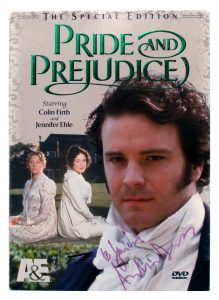
Here we have Sir Walter Scott, one of the most prominent male literary figures of the age, singling out for praise the contemporary talents of a female author and her contributions toward reshaping a traditional form. This praise helped open the door to greater public and critical appreciation. Other reviews excerpted in this section of “Paper Jane” are similarly kind to Austen, and supportive of her work. Whether critics, soldiers, or streaming audiences, people have always wanted more Austen.
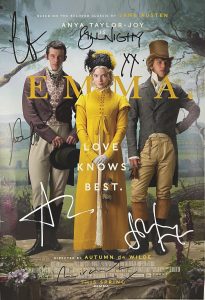
Of course, women should not be dependent on the opinions of men, but the consequences of such lavish praise from Scott and other male contemporaries are in evidence in other sections of the show charting Austen’s global rise. With the support of men, she gained millions of readers around the world, became a focus of university courses and academic conferences, inspired immensely popular movies and shows — still coming out more than two centuries after her death — and, now, is the force behind a fascinating exhibition of her manifold publications and reactions to them.
Readers of diverse profiles and backgrounds from across the centuries and across the continents have come down with some serious cases of Jane Addiction.
Amendment: On Feb 5, we changed a book to which Sir Walter Scott alluded. “Sense and Sensibility (1811)” is now included rather than Mansfield Park (1814).
You May Also Like
-
 December 4, 2013
-
 March 29, 2023
-
 July 26, 2024
