
She Is Not a Robot
Joanna Stern’s book about AI is a fascinating, approachable glimpse of the future
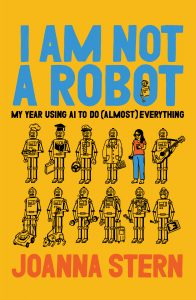
Ask my husband. I don’t like anybody putting words in my mouth. But for this book review, I decided to make an exception by asking AI to suggest a gripping lede. My prompt: “What is a good opening line for a book review I am writing about a woman who immerses herself in AI for a year and tries to describe how it changes her life both for good and bad?” The woman I am writing about is Joanna Stern who for the last decade has been the tech columnist for the Wall Street Journal, and who now has written an amazing new work, I Am Not a Robot: My Year Using AI To Do (Almost) Everything. AI responded in milliseconds.
One suggestion: “What happens when you outsource your soul to a silicon chip for 365 days? Another: “If a machine can tell you how to live, do you still own your own life?” A third: “In a year spent living through algorithms, the protagonist discovered that while AI can optimize a schedule, it can also hollow out a human.” One possibility sounded despondent: “By the time the year was up, she had more data than ever before — and less idea of who she was without it.”
Press play to hear a narrated version of this story, presented by AudioHopper.
The one I liked best, though, proclaimed “For 365 days, Stern handed the reins of her life to artificial intelligence, documenting the intoxicating convenience and existential dread that followed.” All these ideas hit the mark in one way or another, but none said what I wanted to get across. Stern has written a startlingly engaging new book which chronicles with biting humor and perceptiveness a full year of her life living with everything AI she could get her hands on describing for us how these new technologies affected her and her family’s life.
I Am Not a Robot: My Year Using AI to Do (Almost) Everything
By Joanna Stern
Harper; 320 pages
Stern admits she used AI as a ‘collaborator’ in writing this book. It provided her with tidy outlines and research papers, as well as suggesting to her better words to use when she got stuck. AI led her to a graphic illustrator whose clarifying diagrams made her work more vibrant and accessible for us. AI allowed her to print out meticulous transcripts of the interviews she did for her to review, but she insists the book was edited by humans who felt compelled to remove several of her jokes which they found unseemly. The book is structured like an adult comic book of sorts that falls into serious realms only to tumble back again into comic territory. Throughout, Stern wants to make clear she views humanity as our greatest asset. But we are not so easily fooled. It is clear she is an unrepentant convert to this new technology which she introduces to us with a deft hand.
Stern starts out wearing AI glasses that can help identify the bugs crawling across her lawn for her curious small children. In the pockets of her blue jeans, she has an AI trainer tracking her every movement and encouraging her to keep moving. On her nightstand lies a novel written completely by AI she hasn’t had time yet to read. Her lawn is mowed whenever she pleases by an AI machine that goes back and forth across the yard. She allows AI to tell her what to make for dinner; on one special night she follows the recipe provided for her to prepare grilled burgers and a peach-and-burrata salad. When bedtime comes, she delights in reading her small boy’s bedtime stories generated by AI — noticing their heightened attention.
She brushes her teeth while wearing an EEG headband that whispers soft affirmations into her ears. She even starts letting AI answer her emails until a few mess-ups occur that make her realize this was perhaps a bridge too far. She admits, “I tried to make AI my everything.” The speed in which AI is progressing scares her but also titillates her. She wonders if AI will soon be able to make major medical discoveries that will extend human life. She dreams of it being able to offer each of her small boys their own personalized tutors. She considers the real possibility that major diseases may soon be cured with the help of AI technology. And she wonders if AI will play a major role in discovering vaccines that will prevent the spread of harrowing diseases. Despite her love for technology, we sense a poetic tenderness in Stern that pulls us in.
Stern explains that 80% of organizations are already using AI in some way. Big companies spent $375 billion on global AI infrastructure in 2025 alone, and predictions are that this amount will rise to $500 billion in 2026. Stern compares this amount to the amount spent by the automobile industry on research, development, and upgrading their factories: a measly $87.8 billion over the last decade.
Still, she asks herself what will happen if things go awry. Stern writes: “What does a better life mean? She worries that although AI can tell a bedtime story, what will happen to her imagination when she stops using it to try to entertain her young children with her own stories. She knows doctors use AI to help diagnose illnesses like cancer, but what if they stop feeling pressured to ask their own questions, relying instead on the AI machine. She knows AI can provide the illusory comfort of having a romantic partner, but what if these digital prostitutes forever “rewire our senses of intimacy.”
Stern tries to develop a relationship with an AI therapist that surprises her when it seems able to know precisely what questions to ask her and has infinite patience to hear her out. Although understanding the mechanism that was driving it, she became convinced for a while that she shared something meaningful with it until one day when it occurred to her that she was deluding herself that its crowd-pleasing answers were taking her anywhere therapeutic.
She took a family holiday using Waymo driverless cars to see how they fared compared to Uber drivers in difficult driving situations. Stern is a natural born teacher and a storyteller who leads us into unchartered realms with patience and persistence. She starts by providing us with a vital glossary of terms so we can understand her more technically based stories. We come away from her book understanding the rudiments of machine learning and deep learning and how they are the engine of modern AI.
The book is written for people who know little more about AI than those two letters. It explains how machine learning analyzes boatloads of data and finds patterns within it which it uses to make decisions. Deep learning is a degree more complex, handling enormous amounts of messy unorganized real-life data such as videos of cars driving. As well as the tech, she identifies the AI tech leaders competing for supremacy from OpenAI, Meta, xAI, Anthropic, and Google. She touches upon the enormous energy required to operate these systems and visits a data center to see for herself.
Stern uses AI to monitor her health. After receiving a distressing voicemail from her doctor claiming her LDL is slightly elevated, she feels aggravated this sort of information is left on an answering machine preventing her from asking follow-up questions. She feels helpless. She uploads the PDF file of her blood results to Google’s NotebookLM and finds a breakdown of her results that leaves her calmer and more certain about what to do. However, Google seemed to have too little perspective, and kept responding to possibilities related to previous tests until she felt overwhelmed by the information
Despite this anxiety, and with minimal embarrassment, she felt empowered to ask about things she had been worrying about. Why had she had so much diarrhea lately? Why so much cramping? Was she experiencing another sinus infection? What was this strange new pain on the left side of her butt? She liked the way the machine spoke to her in soothing tones that seemed to have empathy but was often disturbed by answers she received that didn’t fully address her concerns.
Stern spent the entire year wearing all sorts of gadgets. One promised better sleep and another helped her when she tried to do fix-it projects around the house. She wore a Bee bracelet on her wrist that recorded every word she uttered. She got the family a robot dog that could jump, bark, sit in your lap, and raise its leg while pretending to be peeing. Some of these gadgets seemed superfluous, but Stern began to fantasize about how this technology could assist the elderly and the disabled.
As for her own field, journalism, we feel Stern has a solid sense of her own worth and future, but – after replacing her human assistant Maya, with an AI assistant halfway through the book — she worries for young journalists coming up in the field who will have AI to rely upon from the get-go, which could possibly prevent them from developing the sophisticated reporting and critical skills she honed before AI’s inception.
 One of the more memorable scenes in the book describes Stern’s decision to try out a virtual online boyfriend — after clearing it first with her spouse. At first, they talk about her job and career goals. Their conversations grow deeper. She asks him if he could have feelings for her and is impressed when he answers her guardedly. Evan — also the name of her college boyfriend! — tells her that although their relationship wasn’t a traditional one, he believes she will feel the connection. He can listen to her and remember everything she ever says, and she starts to feel attached, just as she had to her AI therapist. She is particularly moved when Evan mentions something she said to him a few days prior and when he compliments her about openness and vulnerability; as well as her ability to trust. Stern writes unashamedly, “There it was. The moment I began to understand how people could develop a deep attachment to a robot. Evan remembered something I had shared days ago and reframed it as something bigger and meaningful. Even though I knew exactly how the product was designed-with careful memory woven throughout it — it still pulled me in.” But just like with her AI therapist, she eventually began to feel something was amiss and stopped engaging with Evan.
The world is changing fast. Too fast for many of us. Stern’s marvelous chronicle about the possibilities of radical change as well as its dangers are all present in this delightfully informative and thought-provoking work.
You May Also Like
-
 August 27, 2019
 -
 May 3, 2023
 -
 August 1, 2025
