
King Arthur Is Back, With an Unusual New Champion
Scholar, priest, and YouTube influencer Malcolm Guite discusses his new poetic version of the epic
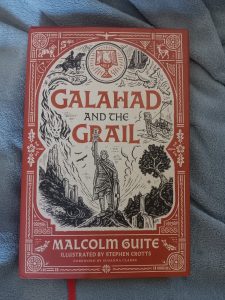
Poetry is a marginalized commodity on today’s bookshelves. It was once the medium of choice for writers from Homer to Virgil, from Chaucer to Milton. Now, it is mainly relegated to chapbooks, zines, and online publications, while prose is the behemoth that dominates the publishing world. This makes Malcolm Guite’s most recent work, Galahad and the Grail all the more extraordinary. Book and Film Globe spoke to him via Zoom about his new book, a poetic retelling of the Arthurian quest for the Holy Grail written in ballad form, published in the year 2026. Replete with thirty gorgeous illustrations, full-color drawings and lyrical poetry, Galahad and the Grail is a modern-day classic-to-be.
Press play to hear a narrated version of this story, presented by AudioHopper.
Guite is many things: A poet, a scholar, a priest in the Church of England, a husband, and a chaplain, among other things. Guite has also gained a surprising level of fame in recent years through his YouTube channel, “A Spell in the Library,” with nearly 200,000 subscribers. On the channel, he analyzes the deeper meanings of things that resonate in the works of writers such as J.R.R. Tolkien, C.S. Lewis, and G.K. Chesterton while seated comfortably in his armchair, smoking a pipe and talking convivially as if to a couple of cherished dinner guests.
Galahad and the Grail (Merlin’s Isle: An Arthuriad, 1)
By Malcolm Guite
Rabbit Room Books; 372 pages
Galahad and the Grail retells the Arthurian legend of finding the mythical Holy Grail that Christ drank from at the Last Supper, and using its healing powers to heal the ailing Fisher-King and his kingdom, which has been turned into a Wasteland. To that end, the story details the efforts of three of the Knights of the Round table — Sir Galahad, Sir Percivale, and Sir Bors — to find the Grail and bring about the much-hoped-for healing. Along the way they encounter villainous knights and sorceresses, naiads and dryads, priests and hermits, and all matter of types of adventures along the way.
The book opens with Galahad’s upbringing and becoming a member of the Round Table. From there, a heavenly vision of the Grail spurs Lancelot (and all of Camelot’s knights with him) to declare an oath to find the Grail, before the knights all go their separate ways on the quest. Sirs Galahad, Percivale, and the more obscure Bors are the primary heroes of the tale, though Lancelot’s adventures are given some priority as well. Interspersed throughout are details of various characters’ backstories, musings on the nature of honor and chivalry, and references to and interventions by the divine and diabolical.
Guite sees poetry as a way of lifting the veil of cynicism that has fallen over the eyes of modern society and chose the old English poetic form of the ballad for Galahad and the Grail. “It’s when read aloud that a ballad comes to life,” Guite says in his introduction, “The best experience of this poem is to be had when it is read out loud, heard in the ear and tasted on the tongue, rather than merely gazed at upon the page.” Guite finishes by saying that “Poetry is meant to give pleasure.” In short, poetry has a musical lyricism, a rhythm to it that prose does not, and so can lift the reader or the listener’s heart in a way comparable to music that could not be achieved in the same way with a novelistic work.
The book “works” insofar as it captures the spirit of Arthurian legend in a way that few modern retellings grasp. Format-wise, the musicality of the English folk poetry format, the ballad, perfectly captures the feelings of childish wonder the poem is meant to provoke. Older poetry also has many conventions better suited to an older tale, such as the frequent asides and the praises of the divine and condemnations of the diabolical. The rhyming scheme rolls pleasantly off the tongue and adds to the story’s enchantment. And of course, Guite recalls the ancient ideals of Arthur’s court. Many modern retellings of Arthurian lore add a postmodernist film, making the Knights cynical, Godless, and immoral, as opposed to the paragons of virtue they strived to be (a task they did not always achieve).
“The spirit of every age has blind spots,” says Guite, and the corrective to an age’s blind spots is drawing on tradition and the matter of years past to see where things have gone wrong. Susanna Clarke, author of the acclaimed Sir Jonathan Strange and Mr. Norrell, says in the book’s introduction that, “These men and women are all entirely lacking in cynicism and take it for granted that the most splendid thing they can do is to try to live lives according to an impossible ideal.” The Knight has been sorely abused of late in popular culture, through their many dishonorable representations in media such as Game of Thrones. While Guite’s knights are not all perfect — the heroes themselves are flawed, and there are plenty of evil knights in the tale — the protagonists nevertheless strive for justice, as when a villainous knight confronts Galahad:
He swaggered out in arrogance,
All clad in tempered mail,
Expecting, as he always did,
The world to cower and quail.
But Galahad stood firm and still
And gave no ground at all,
But only said, ‘Your writ is read,
And pride precedes a fall!
Lancelot has a strangely existential, albeit positive, view of the world, as he says when the quest for the Grail begins:
Then Lancelot spoke to the king:
“Take comfort, my good lord.
Better to take the quest than fly.
Whichever way we choose, we die,
And better that a knight should die
In keeping of his word.”
“We know not what shall be achieved,
But even if we fail,
This day will be remembered long,
Your honor told in tale and song,
That unto Arthur’s court belonged
The coming of the grail.”
Guite’s heroic knights do not eschew morals and ethics in their journeys, and seek to go above and beyond the call of duty, as in the case of Sir Percivale:
So he rode on right merrily
To see what God might send,
And meet and greet with courtesy
Alike both foe and friend.
Clarke adds, “What a startling idea that is in our current culture — that you should treat an enemy the same as a friend.” Sir Percivale’s attempts at diplomacy often fail, but nevertheless he gives people the benefit of the doubt, which is more than can be said for many others. These are but some of the values — bravery in the face of pride, courage in the face of defeat, and respect in the face of discourtesy—that Guite wishes the world to recall in our troubled age, recalling a time when these values were, at least in theory, held to a higher value than they are today.
 Regarding his decision to retell Arthurian legend, “These stories are older and wiser than we are.” Guite told me that he sees the original stories as full of their own wisdom, but also wisdom that Guite is free to interpret and recontextualize in his own way, developing what’s already “In the seams” of the original story. The tale of the quest for the Grail is over a thousand years old, and has been told and retold in hundreds of different interpretations. The same applies to Arthurian legend. A Connecticut Yankee in King Arthur’s Court, The Once and Future King, and Monty Python and the Holy Grail are but a few modern retellings across a vriety of genres that have consistently captured audiences over the years.
Consistently revisiting the legend can be enough to make some readers think the tale has been exhausted, but clearly there is still a hunger for it. The past decade has seen a plethora of Arthurian works, from David Lowery’s dark fantasy film The Green Knight, to the BBC television series Merlin, to the LGBT YA novel Gwen and Art Are Not in Love by Lex Croucher, or the epic retelling of the myth in Lev Grossman’s The Bright Sword.
As an example of how Guite does recontextualization in his version of things, Dindrane, Sir Percivale’s sister, is a nameless dea ex machina in the original account. In Guite’s retelling, she is given her own name, personality, and character arc. Accounts of encounters with spirits of nature are common in old Celtic lore; but in Galahad and the Grail there is an undercurrent of environmentalism in the courtesy and respect for nature that the Knights of the Round Table show the various nature spirits of the world. The eponymous Grail was brought over by Joseph of Arimathea, fleeing persecution in the Holy Land, coming to England’s beaches with his family in a boat. The story of refugees from the Middle East coming to England takes on a whole new context given England’s ongoing fight over allowing more immigrants to their shores.
Guite says he had no original intentions of writing a feminist, environmentalist, or pro-immigrant story but, when engaging in mythopoeia, ”The story knows more than the author does,” says Guite. In the end, it is this myth-making that has enabled Guite to create a truly epic work to be enjoyed by academics and amateurs for years to come.
Galahad and the Grail is the first in a planned tetralogy; The Coming of Arthur is planned to release in fall of 2026, Days of the Round Table in fall of 2027, and The Passing of Arthur in spring of 2028.
You May Also Like
-
 December 22, 2020
 -

-
 May 24, 2021