A School of Magic That Does Not Patronize the Viewers
‘Witch Hat Atelier’ represents an evolution for a genre mired in Harry Potter
In their corporate wisdom, Warner Brothers decided that, whether anyone wants it or not, they are adapting the J.K. Rowling’s boy wizard series once more. In our current era of brands, the Harry Potter series came out at pretty much the perfect moment to guarantee its perpetuity, and — despite Percy Jackson, Septimus Heap, and His Dark Materials — has essentially forced its place as the platonic ideal of the magic school genre. The new anime series Witch Hat Atelier, though, shows a different path this kind of storytelling could have taken, and indeed has taken, in a Japanese media market that continues to prize innovation, mixing genuinely adult themes with equally genuine whimsy that shines with contemporary relevance despite its medieval-styled setting.
Witch Hat Atelier stars Coco as a young girl who has always dreamed of magic, though as her mother often reminds her, witches are born, not made. A chance meeting with the witch Qifrey, a kindly, bespectacled man, leads Coco to learn that apparently it was her destiny to become a witch after all. But Witch Hat Atelier is no wish fulfillment fantasy. Coco is terrorized with the threat of oblivion via memory charms, and is quickly made to feel her general inferiority at the small magician’s workshop (atelier) where she studies under Qifrey, bullied by the curt girl Agott who resents Coco’s amateurish intrusion into a world she clearly doesn’t understand.
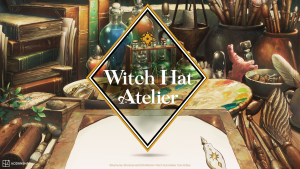
Perhaps the main immediate standout quality of Witch Hat Atelier is its animation style. The original manga is illustrated by Kamome Shirahama, and “illustrated” is the key word. Her style strongly resembles that of a picture book, and the anime often literally uses her frames for introductory shots, literally popping up with visages of a magical world where mastery is earned, not presumed as birthright. In Coco’s earliest adventure, she must prove a baseline of skill by taking a test to fly high up in the sky to pick flowers from a floating island. The beauty of this scene is matched by its vertigo-inducing terror, not due to any explicit bombastic visual effects, but because the greenery is refocused and recontextualized in such a way as to evoke real world grass while feeling like something entirely new. In another sequence, a labyrinth almost devoid of color likewise expresses a sense of cold unease, despite clearly being modeled in some way after a nearby city.
Witch Hat Atelier uses these visuals to evoke the sense of wonder that a child feels when seeing something for the very first time. It’s a very different kind of nostalgia from Harry Potter, though, because for the most part Witch Hat Atelier is entirely new in terms of its world-building and structure despite its general conformity to the magic school genre. One example is the way it treats magic. Despite its fans gushing about Witch Hat Atelier‘s stringent and detailed system of magic, I’ve been careful to avoid explaining how the magic works because, strictly speaking, it is a plot twist of the first episode. Coco’s slow learning process of how the magical world around her works is a critical part of the appeal of this bildungsroman.
Most of what the apprentices do is just tedious practice and repetition. As Qifrey explains at one point, with a personal story from his own life, the best way to get good at a task is to work it into your daily routine. Indeed, despite this being a magic school show, there are no magical solutions to people’s problems. Coco and the other apprentices are constantly encouraged to engage in lateral thinking, whether it comes to using a spell to solve an immediate problem, or just maintaining the secret of how magic works from outsiders. Though “muggles” by another name, even these minor characters are infused with a surprising degree of humanity compared to what we usually see in this genre. They’re neither helpless fools nor thoughtless bullies, but people with their own complex, genuine inner lives.
Not coincidentally, Qifrey emphasizes to his students, as any good teacher should, that they should think in terms of the purpose of magic rather than its effects. What is magic for? What ethical responsibilities do they owe to outsiders, and why? The story of Witch Hat Atelier is tightly wound around a moral, philosophical framework which presumes that everything about witch culture is designed around helping people and doing the greatest good for the most people. Whether this is actually true or just a pretense, well, we wait and see.
There are reasons to doubt. The Brimmed Hats, a group of rogue witches, seem sinister, given that the main thing they seem to be doing is give Coco — an ignorant child, I remind you — dangerous weapons. But as this society of witches is shown to have at least some prejudice to outsiders, it’s hard to guess to what extent the greater world of witches shares Qifrey’s beliefs about the purpose of magic being to do the most good in the world. For that matter, it’s hard to tell whether Qifrey himself is really the kindly mentor that he seems, since every so often he takes on a dark, threatening visage, though he’s quite careful to avoid letting any of the students see him like that.
All of which is to say that Witch Hat Atelier provides no simplistic contrast between good and evil. Events unfold in a dark fairy tale world, like those of the Grimm Brothers, before we as a society decided that children are too fragile and foolish to comprehend the unyielding indifference of nature and the convoluted rationalizations of men. Being ignorant isn’t the same as being stupid, and Witch Hat Atelier benefits tremendously from crediting its audience with the emotional maturity necessary to understand that.
You May Also Like
-
 June 20, 2019
 -
 September 28, 2018
 -
 July 9, 2020