
A Portrait of the Artist as a Young Sponge
‘How to Prepare for the Past’ reflects on lessons learned from rock stars and literary legends
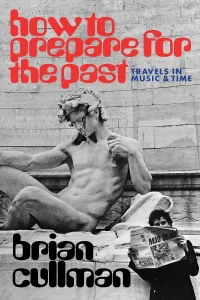
If you transcribed the kind of daydream where you visit a bygone era and insert yourself into historic circumstances, it might turn out a little like Brian Cullman’s new How to Prepare for the Past. But only if you had the same sort of gift for poetic prose as Cullman.
How to Prepare for the Past
By Brian Cullman
Ze Books; 248 pages
That particular literary superpower probably comes to Cullman as part of the skillset that comes with being both a veteran songwriter with several albums to his credit and a celebrated music journalist. And when he writes about the sounds that move him in his memoir, which runs from the 1960s through the 2010s, it’s easy to understand why he’s received multiple journalism awards. Even the smallest descriptions — “his face was too big for his face” or “a man with an emancipated mustache” are bursting with originality and humor.
Press play to hear a narrated version of this story, presented by AudioHopper.

Equally crucial to the impact of his rhapsodic waxings about music is the fact that he’s usually not coming at the artists and their works from any sort of safe distance. He’s more like an embedded wartime correspondent reporting from his place on the ground. Recalling his encounters with British folk queen Sandy Denny, he says, “The ghosts and spirits she sang about were real and holy and terrifying, and when she sang about Matty Groves, it wasn’t an old folk song anymore, but was fresh gossip, dirty news from the street. It was as if she’d just been drinking with Matty’s sister at the pub and on the way back had torn her skirt.”
How to Prepare for the Past chronicles Cullman’s maturation as writer, musician, and human being, each unavoidably and indelibly informing the others. And a big part of the engine that drives the narrative is his seemingly preternatural ability to be in the right place at the right time over and over again, dealing with a disparate array of artistic heavyweights in a one-to-one way. It’s not a Zelig/Forrest Gump type of thing, though. No writer decided to place Cullman in these situations — he just belonged there, either as a musician, a journalist, or just a seeking soul.
Some of the moments documented in the book seem like they come from some starry-eyed biopic. A young Cullman enters legendary music manager/impresario Danny Fields’ apartment while Jim Morrison is passed out on the couch, Andy Warhol protege Edie Sedgwick is in her underwear cutting pictures out of Vogue, and Leonard Cohen is calling on the phone in a desperate search for Nico. Another time, he walks into Holy Modal Rounders co-founder Peter Stampfel’s place to discover playwright Sam Shepard with his head under the couch. During a stint in England, he’s hanging out at folk-rock hero John Martyn’s house when Nick Drake drops by.
 But many of Cullman’s most poignant shards of memory reflect prosaic moments spent with the greats. Here he is, watching R&B pioneer Big Joe Turner wolfing down an ungodly number of hot dogs. There he goes walking in on Dr. John and trailblazing rock ‘n’ roll songwriter Doc Pomus sitting in a room seemingly ignoring each other during an ostensible writing session. And it’s not merely that Cullman was there. It’s what he does with the memories, spinning them into an engrossing tale that also contains plenty of characters you’ve never heard of who are equally as colorful.
The real magic in How to Prepare for the Past lies in the way Cullman ties it all together. You don’t enter into the book understanding the connection between the listening habits of hallowed rock critic Lester Bangs; a visit to Paul Bowles’ place in Tangier; a maniacal folksinger terrorizing a Greenwich Village coffeehouse; and a series of close encounters with intoxicating, inscrutable women. But by the time you reach the end, you can put it all together quicker than a toddler’s jigsaw puzzle.
It’s also one of the few memoirs that almost goes out of its way to downplay the accomplishments of its author. For instance, Cullman’s writing has been featured everywhere from The New York Times Magazine to The Paris Review, and he’s a three-time winner of ASCAP’s Deems Taylor/Virgil Thomson Award for outstanding music journalism. And on the other side of the fence, he’s done work in the studio with the likes of Lucinda Williams and Mark Knopfler.
But you won’t find out about any of that from How to Prepare for the Past, no matter how carefully you may pore through its pages. Like any journalist worth his salt, Cullman is here to tell you about where he’s been and what he’s seen.
He wants you to know about who he’s been with and what they’ve done, far more than he wants to fill you in about what he’s done. And like any writer with a passion for poetry, every moment that he captures and transforms ends up being about much more than merely that moment itself.
In what’s only part of an epic sentence about a guitar chord played by his friend and local NYC hero Jimi Zhivago, Cullman writes, “it hung in the air like the end of a journey, like a stamp on a letter ready to mail, a suspended ninth, augmented and straddling the major and the minor, the sun and the sunset, the last rays of light and the first hope of dawn, all in that chord, those notes you expected, those notes you’d never expect, not here, not now, as if a blues had just discovered Stravinsky or Stravinsky had gotten lost on a downtown train and decided to go for a beer, and I’d have to stop a moment and shake my head.”
Ultimately, what Cullman’s book seems to care most about sharing with us is passion about music and music about passion; the desire for words and the words for desire; and how to shake, rattle, and roll your way through it all without falling apart.
You May Also Like
-
 April 1, 1998
 -
 December 15, 2021
 -
 March 6, 2020
