
A Warrior in a Blade Arrives To Confuse a Monk
‘Daggerbound’ extends the cast of charming characters in the World of the White Rat
If you have read any of T. Kingfisher’s World of the White Rat series, you will enjoy Daggerbound, the delightful new novel from the prolific pen of Ursula Vernon. T. Kingfisher is, improbably for such a playful alias, the name Vernon uses to write fiction that is more “grown up” than the multiple award-winning YA books that she writes under her own name (most notably the Dragonbreath series). If you look up the sub-genre “cozy fantasy” in an illustrated dictionary you would see pencil drawings of this world: with its medieval setting presenting plenty of warm hearths, along with beds and meals all the more appreciated for the times they are missed on adventures.
If you haven’t read any of the work from this romantasy world yet (Clocktaur War series, Saints of Steel Series and now this Swordheart series), then you might start with either The Clockwork Boys, the first novel of the Clocktaur duology, or Swordheart, the first novel of what will surely be a trilogy. Initially self-published in 2018, Swordheart was picked up by major publishers and was re-released by Bramble in 2025 — the same folk who are publishing Daggerbound.
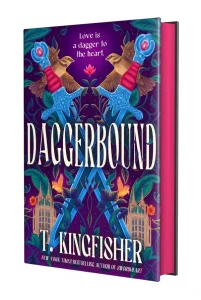
Daggerbound
By T. Kingfisher
Bramble; 448 pages
The name of the world comes from one of the many religions of Vernon’s world — the Temple of the White Rat. Adherents of the White Rat have chosen a practical, humanistic, legalistic religion in a setting where “religion” is almost a synonym for profession. Our world increasingly treats learning, experience, and skill with brash dismissals, so it’s comfortable to have a world like this, where schoolteachers, lawyers, doctors are respected.
 Unfortunately, of course, not every religion/profession is equally well-intentioned and, as with most institutions, many can be annoyed getting caught up by even benign bureaucracy. Daggerbound begins with Learned Edmund, a brother of the Many-Armed God, undertaking his final mission for that order. He and his donkey will, unbeknownst to his brothers, quit his calling once he has delivered the books and objects entrusted to him for this one last job.
Though Edmund is no grizzled cop, but a socially awkward, sexually inexperienced, and intellectually brilliant monk in his late 20s, readers will recognise the shape of the “one last day before retirement” adventure genre. Edmund sets out with his beloved and extremely stubborn steed only, to his surprise and no one else’s, to encounter good guys and bad guys aplenty.
Because this is fantasy, the “guys” come in all shapes and forms. They do not quite arrive as all of animal, vegetable, and mineral but certainly they comprise a menagerie of animals. As with Swordheart, where the narrative is significantly shaped by the perspective of Halla, the 40-something widow, the tone of Daggerbound is largely shaped by the voracious, open-minded, good-natured and curious Edmund.
The name of the series comes from three mercenaries who were bound by a magic smith to live inside three swords. The wielder of the sword can summon and command these now practically-immortal mercenaries who are bound to defend their wielders until death (which takes about a fortnight of real time in the sword to mend.). Without spoiling it too much, in Swordheart we meet Sarkis, the leader of the mercenaries, who essentially sold their souls in an ill-conceived pact, in Daggerbound we meet The Dervish — a charming, beautiful, polyglamorous dagger fighter, and in the third we will surely meet their empathetic colleague Angharad Shieldborn.

As well as having charmingly flawed characters, Kingfisher gleans maximum advantage from their flaws by having them continually question themselves. Though the not-very-subtle sexual intrigue grates a little by the end, rarely does a chapter go by without a major character second-guessing themselves and then questioning their actions, intentions and, sometimes, whole life premise.
“Good way to trap us inside and eat us later, the Dervish thought, but didn’t say. Really, it was just paranoid reflex. Large Francis might look like the greatest nightmare in creation, but he seemed almost sweet. Certainly a great deal like Edmund. Although Edmund is sweet too, come to that.
It was a good thing that the Dervish had no use for sweet men, even if they had interesting hands.”
It’s this constant sense of gentle self-critique that gives the series its air of Chaucerian light raillery. And, while this is no Chaucer, all of the books in the White Rat world are charming diversions for a fall evening in front of a roaring fire and Daggerbound is no exception.
You May Also Like
-
 June 10, 2021
 -
 January 16, 1997
 -
 April 2, 2020
