
The Devil Barely Cares About Prada
The crew is all back for this 20th anniversary sequel, but the world has moved on
Gird your loins! Disney is double-dipping into 20th Century Fox’s back catalogue for another blast of withering glares and bitchy asides with The Devil Wears Prada 2, exactly twenty years after the original fashionista comedy sashayed down the catwalk and right into the cultural zeitgeist. A sequel to the story of a freshly minted Northwestern grad and her ingenue comeuppance — especially two decades after the fact — seems absolutely irrelevant. But a sequel to a story set in a status-obsessed industry whose cultural cachet has absolutely cratered since 2006? That’s a little more interesting.
The Devil Wears Prada 2 ★★★ (3/5 stars)
Directed by: David Frankel
Written by: Aline Brosh McKenna
Starring: Meryl Streep, Anne Hathaway, Stanley Tucci, Emily Blunt, Justin Theroux, Kenneth Branagh
Running time: 119 mins
Reprising their roles are all the principal cast members: Meryl Streep as imperious Runway editor-in-chief Priestly; Anne Hathaway as former Priestly peon turned principled seasoned journalist Andy Sachs; Stanley Tucci as Runway’s long-suffering art director Nigel Kipling; and Emily Blunt as Emily Charlton, once Priestly’s first assistant and now, as head of Dior, the main advertiser keeping Runway afloat. Ice queen Miranda, try-hard Andy, clear-eyed quip Nigel, supreme bitch Emily: the quartet are such bespoke characters, so perfectly tailored to their actors, that watching this form-fitted dream team suit up in their haute couture armor once again is an absolute delight. There’s also a plot, though, which is progressively less compelling.
Prada 2 centers around a contracting Runway, whose relevance has faded and whose credibility has taken a big hit after it glowingly endorsed a fast-fashion clothing line that secretly uses sweatshops — a scandal that sparks a flurry of anti-Miranda memes (cue a Priestly version of Homer Simpson disappearing into a hedge). So, to course-correct and help restore Runway’s brand, publisher Irv Ravitz (Tibor Feldman) decides to hand over control of the features department to acclaimed New York Vanguard journalist Andy—newly unemployed due to a fresh round of cost-cutting layoffs and freshly in the news for an impassioned awards acceptance speech in which she declares, “Journalism still fucking matters!”
So Andy and her high-horse integrity re-enter the halls of Runway, where no one remembers her — least of all Miranda — and no one cares or even respects what she’s trying to do. All that matters is the dwindling ad revenue. “Who’s going to pay for your overpriced book?” barks Ravitz to Miranda about Runway, which has gone from regal expense accounts and photoshoots in Africa with Richard Avedon to mostly digital downloads and the ephemera of the internet. Even Miranda talks about how the latest September issue — once famously as thick as a phone book and stuffed with ads — is now so thin you could floss with it. “Remember when magazines were a thing?” says Emily with a wistful sneer.
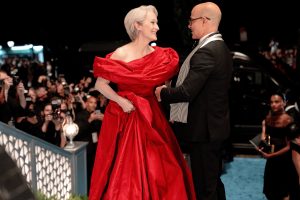
The film is dotted with reminders of Runway’s impending irrelevance, but it never really embraces that existential narrative. One of the most famous scenes in Prada was Miranda’s impromptu dissertation about how Andy’s cerulean blue cable-knit sweater reflects every facet of a clothing industry that, in part, takes its cues from decisions that issue from Miranda and Runway. No such speeches erupt in Prada 2; no one makes any compelling cases at all in praise of Runway. What we get instead are tech billionaires pontificating about how “the future keeps rushing at us,” corporate whispers about gutting Runway to crank up its EBITDA for a possible sale, and Miranda, in an uncharacteristically candid moment reflecting on her retirement, musing, “How will I know when it’s time?” No one’s giving cerulean-blue lectures anymore, Miranda, so I guess it’s time.
What made the first Prada such a touchstone, aside from chronicling a lost era when print media ruled the earth and the iPhone was just a twinkle in Steve Jobs’ eye, was the film’s unsentimental attitude towards demanding jobs in high-pressure industries. Suck it up, everyone barked at Andy: a million girls would kill for her assistant job. And, over the course of two hours, she eventually masters all the skin-deep superficialities as well as all the nuanced power plays surrounding her. Prada is a workplace ugly-duckling story; it’s aspirational and inspirational in all the best ways.
Prada 2 is a more bracing entertainment, where the mood is frothy but the flop sweat is palpable. “Did you want this job? Did you take this job?” scolds Nigel when Andy pouts. “Then figure out how to do this job.” A montage or two later, Andy figures it out — for the time being. But to what end? Miranda’s goal is to become the Chief Content Officer for Runway parent company Elias-Clarke (mirroring Miranda inspiration Anna Wintour and her current perch at Condé Nast). But what kind of future really awaits septuagenarians like Wintour and Priestly? Prada 2 would rather not say, preferring to content itself with shout-outs to Fendi and Cucinelli; celebrity cameos from Heidi Klum, Tina Brown, and Kara Swisher; and obligatory power-strut montages set to Madonna’s “Vogue.” Its characters know that Runway is the last piece of wood floating next to the Titanic. But damn, they sure do make drowning look luxurious.
You May Also Like
-
 April 29, 2024
 -
 April 26, 2022
 -
 May 21, 2019
