
‘The Emergency’ Can’t Outrun Its Own Allegory
George Packer’s new novel aims for Orwell and Huxley but that’s a high bar
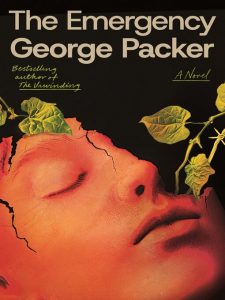
Veteran political essayist and current Atlantic staff writer George Packer brought a novelist’s sense of character and narrative to acclaimed previous books like National Book Award winner The Unwinding and the acclaimed family memoir Blood of the Liberals, which made his vivid, detailed, and nuanced accounts of the traditional bonds of American life coming apart all the more powerful. Packer’s new novel The Emergency, his third, has plenty to offer in terms of narrative, though its refreshing commitment to humanism gets held back by heavy handed symbolism and thinly veiled allegory.
Humane, idealistic Dr Hugo Rustin is the lead surgeon at a major hospital in a slightly futuristic city (how far into the future isn’t made exactly clear) by a river in a country known only as “the empire.” The titular emergency came about as a result of a hazy combination of military losses, natural disaster, general social mistrust, and rampant social inequality. We’re informed early on that “the empire… died of boredom and loss of faith in itself.” An interesting premise (ennui is what makes empires fall?) which ironically doesn’t describe the rest of the story. The crepuscular world of the novel is in fact quite dramatic, the narrative smoothly and briskly paced, and we travel to some pretty wild and exotic locations. If anything, the summary of causes is the kind of pithy explanation that Packer might use in an essay, and this slightly didactic tendency inserts itself into the narrative a bit too much.
The Emergency
By George Packer
Farrar, Straus, Giroux; 418 pages
The empire’s class distinctions aren’t very subtle. The Rustin family are Burghers, a privileged educated class of city dwellers whose futures are largely defined by their scores on a baccalaureate-style test. Their comfortable existence is a result of being in a multigenerational family Guild. The biggest social influence in the city is called Together, which combines an amorphous blend of Politically Correct, Woke-esque mantras and 70’s style hippie psychobabble (“I am no better and neither are you… No one is a Stranger… Listen to the young”). There is even a particularly elite group within this anti-elite movement known as “Wide Awakes” just in case the reader missed the point. Packer ably demonstrates the aggravations of “woke” thinking in a scene where Hugo’s bounced out of his position at the hospital by a Bolshevik-like panel of “Health practitioners” for refusing to get with the aggressively sensitive program.
Yet the point about the moral and social weaknesses of woke-ness gets hammered home more than it needs to, a constant repetition of the same blaring note. I found myself continually writing “GOT IT” in the margins whenever another not so thinly veiled reference to Together’s soupy collectivism came up. In a particularly heavy-handed and unnecessary scene Rustin’s feisty daughter Selva attends a meeting at a makeshift gallows built by advocates of Together where young people put their heads in a noose and publicly declare their moral unworthiness and duly repent, sparing their lives at the last minute. It’s an obvious and overly grim nod to the issue of “cancel culture” which is a topic long past being provocative.

In contrast, the Yeomen (a clear stand-in for the “white working class”) live in the sprawling country outside the city gates, where generations toil away at the land, harvesting unwarranted suspicions and unfounded conspiracies about how the Burghers secretly ruined their crops. They take patriotic songs as literal truth and nurse a cultural defensiveness which easily turns hostile. When Rustin and Selva go on a humanitarian mission deep into the country where they used to vacation, they discover that the bucolic world they’ve cherished from afar has gone to seed.
Packer has always had keen eye for the ways in which politics, or more specifically political hysteria, warps the relationships between otherwise sympathetic or relatable people. There’s plenty of reason to be annoyed at Rustin’s unintentionally naïve assumption that talking to everyone in the same way will fix everything as there is in Selva’s often shrill commitment to the lofty principles of Together.
A particularly eerie scene has Rustin discover a warehouse full of lifelike mechanized dolls with the all-too-human imperfections methodically smoothed out. A proud and creepy technocrat (possibly modeled on Elon Musk or Steve Jobs) pontificates how they are creating the future. Rustin is shocked to see a replica of Selva among the prototypes. It’s definitely a Brave New World-type scenario and very much a relevant concern in the age of AI, deepfakes, and human bioengineering.
At one point Rustin earnestly tries to explain his motivations to a hostile crowd of Yeomen. Despite his best efforts at appealing to reason, anger and paranoia takes the upper hand, as it often does:
‘At my hospital a few weeks ago I operated on a Yeoman boy—that couldn’t happen today. It’s hurting everyone.’
‘Whose fault is that?’ Gandorig shot back.
‘It’s an unfortunate result of the Emergency. We have to find a way to communicate again.’
‘You must think we’re dumber than farm animals…. you planned it,’ Gandorig said, jabbing the air with his machete.
There’s an urgent argument to be made about the usefulness of humanism and rationality in the face of those who hate it or simply don’t care. And if that other person happens to be your fellow citizen this doesn’t bode well for the future of the country. One effective moment has Rustin’s wife Annabelle talking to a Yeoman’s wife who “insisted that the birds were ‘working’ for some group of people somewhere in the empire who wanted to make life difficult for the Cronks…’That’s ridiculous!’ Annabelle’s face went hot with contempt for the woman’s foolish certainty. ‘Who would believe such a story?’ Mrs. Cronk’s fleshy features stiffened, and she returned to kneading flour and eggs. ‘I don’t really know, but it could be true.” Variations on that last sentence are unfortunately everywhere in America these days and our society is still reeling from the implications.
 Selva castigates her father about how his humanist beliefs don’t hold up, asserting that “humans aren’t so wonderful, papa” and even if one is inclined to disagree it’s hard to argue that she’s not right in some ways. The Rustins discover that the shy son of an old friend has been lost to a primitive cult known as Dirt Thought, scrawling crudely drawn manifestoes of hypermasculine gibberish and doing primitive, tribalist cosplay like a character from Lord of the Flies. Easy to read and think of Paleo diets and the whiny, goofy, and highly lucrative discourse that floats back up to the mainstream every twenty years or so about the how modern man must flee the office park, pound his chest, paint his face, and reclaim the warrior within.
Amid all the apocalyptic doom-and- gloom, it is refreshing to see that the story ends on a relatively hopeful note. Even though Rustin’s been quietly pressured into removing the official crest with its grand motto of HUMAN FIRST from his front door — a motto he’s tried to believe in his whole life — he resolutely sticks up for the humanity in others. As the city and country’s culture clash keeps raging outside his home, reaching comically outrageous proportions as the Yeomen (in a possible nod to a pungent scene in Gulliver’s Travels) start to literally catapult their waste over the walls, Rustin and his family create a makeshift clinic out of their home using whatever is available, treating the wounded whoever they are however they can. It’s reminiscent of the old adage that the only real place you can change the world is your little corner of it.
Clearly, Packer has closely studied the bracing dystopic visions of Orwell, Camus, and Huxley. The Emergency is astutely satirical, engaging, and has a good moral center. The problem is that the line between fictional imagination and analytic essay gets a little thin. At certain points the novel doesn’t seem to know when or if it wants to split the difference between being an old-fashioned novel of Big Ideas or a page-turning thriller with a wary eye on the zeitgeist. Nothing wrong with having inspirations, but ultimately The Emergency doesn’t rise above its various influences to tell us something important about these urgent, desperate, chaotic times which we haven’t heard before.
You May Also Like
-
 July 14, 2022
 -
 September 21, 2020
 -
 September 2, 2020
