‘Steel Ball Run’ Hits Its Strangest Stretch Yet
JoJo’s latest bizarre adventure races through saints, dinosaurs, conspiracies — and Hirohiko Araki’s singular brand of beautiful madness. newest edition of ‘Jojo’s Bizarre Adventure’ from Hirohiko Araki continues its transcontinental race
Of all the major long-running manga series, JoJo’s Bizarre Adventure casts a long shadow for just being really, really weird. This weirdness is the main reason why the (official) English translation of JoJo’s Bizarre Adventure Part 7: Steel Ball Run is only coming out from VIZ twenty years after its original publication in Japanese. But these days, weird is good which explains why Netflix has also greenlit a Steel Ball Run anime for Netflix due early next year.
But just what makes Hirohiko Araki’s work worth looking at? Why are JoJo’s Bizarre Adventure in general, and Steel Ball Run in particular, so popular — aside from being the inspiration for countless outrageous poses?
Just like the other “parts” of the JoJo’s Bizarre Adventure series, Steel Ball Run is a standalone story, sharing some character designs with others in the JoJo world as well as the strange “stand” powers that effectively amount to assistance from invisible ghosts. One example of just how weird these can get? Johnny Joestar has the power to shoot his fingernails as if they were projectile weapons.
JoJo’s Bizarre Adventure Part 7: Steel Ball Run – Volume 4
By Hirohiko Araki
Translated by Nathan A. Collins
VIZ Media; 392 pages
What can we learn from such ghosts? Well, in this volume, the disgraced executioner Gyro Zeppeli and humbled jockey Johnny Joestar finally discover — from a man with the ability to turn people into dinosaurs — that the strange powers they’ve observed and unlocked are related to a saint who traveled to the American continent 1900 years ago. The characters themselves find this about as baffling as you probably do, although given the frequent references to the Vatican (built about 1600 years ago, not in America), it does seem possible that Araki, or his characters, might just be mixing the dates up or making a rounding error.
Also, accidentally — from the Presidential aide who discovered they were trying to find the saint’s body — Zeppeli and Joestar discover that the President of the United States also wants pieces of the corpse for some unknown but sinister purpose. The aide assumed that duo must have some idea what the corpse was if they were going to the trouble of gathering its constituent pieces. But no!
The riddles leading the characters to locate new pieces of the corpse are about as fascinatingly bizarre as everything else in Steel Ball Run. When Zeppeli and Joestar find one piece of the corpse, some mysterious power inscribes a cryptic clue on their bodies. The actual clues themselves are strange, difficult to interpret symbols. Sometimes they reference constellations. Other times latitude. Like the saint whose presence in America predates the Mormons, these anachronisms are so obvious even our nineteenth century heroes have no idea what sort of weird wizardry they’re dealing with.
This generally preposterous conspiracy underpinning Steel Ball Run is almost quaint. But what’s really wild is how it is barely even necessary. The cross-country race — the Steel Ball Run of the title — secretly sponsored by the President to acquire more saintly relics, was plenty compelling before we learned about this backstory. Indeed it’s a shame that only one of the six chapters in volume 4 is about the race at all, with much more room taken up by battles and chases between ever-weirder stand users.
There’s more of a puzzle-like element to the battles in Steel Ball Run than in typical shonen fare where battles are more about kapow power level beat-downs and rock-paper-scissors matchups than more elaborate solution. That’s true of the periodic explicit showdowns between stand users each trying to grab a piece of the corpse, but even the main complete story in this volume starts out as a mystery.
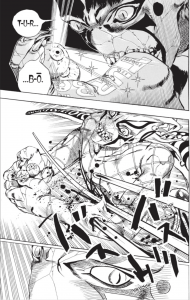
As the previous dinosaur story ends, and shortly after that the end of the current stage of the race, the main story this volume spotlights Zeppeli and Joestar getting trapped in a small, wooded area, focused on escaping not so much for personal safety or to recover the body parts, but mainly because they’re concerned about winning the race still in progress. It takes a few rounds of trial and error before they finally figure out the supernatural way they are being prevented from leaving, forced to fight yet another battle because the president means business. He really, really wants the full corpse.
But JoJo’s Bizarre Adventure has long blurred the line between combat-obsessed shonen (aimed at young adult) and the headier stuff of seinen (aimed at 18-40 year-old men) style manga. There’s a surprisingly large amount of detail in here about the nature of masculinity and purpose, with one villain even demanding that worthy foes attempt to kill him in fair single combat, to better assist in his own existential enlightenment.
For that matter, this volume holds the chapter that may have resulted in JoJo’s Bizarre Adventure moving from the Shonen Jump youth publication to the more adult Ultra Jump — a disturbing depiction of a child defending himself from what appears to be a rapist night stalker.
At times, it’s difficult to imagine how people transforming into dinosaurs and pedophilic flashbacks can coherently exist in the same story. It certainly helps that Araki is doggedly sincere with every individual character, stylistically tying together even the most grotesquely villainous ones. Characters aren’t evil so much as they just take things. This is an intriguing conceptualization of conflict and who wins them.
As is to be expected from a JoJo’s Bizarre Adventure, Steel Ball Run is aggressively stylized, featuring many solo panels of characters standing in epic, awkward poses, that quickly transition on a panel-by-panel basis to absolute chaos as someone activates a stand power and everything takes on a very different look — often literally. Many stand powers literally alter perception, whether through x-ray vision or time travel, and Araki always sells the visuals even if the exact logic of his visual script isn’t always that easy to follow, particularly in the more intense fight scenes.
JoJo’s Bizarre Adventure has always been a case study in how far a unique style can go to sell a plot that sounds like the ravings of a schizophrenic when laid out in terms of its story beats. Yet Steel Ball Run moves by the rhythm of its own coherent, yet indecipherable logic. Araki makes mistakes in his depiction of the historical United States, for example, but they aren’t obvious or relevant despite the setting being grounded in a world where very few people are aware that these magical stand powers exist, and those that have them are trying their best to keep it that way.
Although Araki wrote the text 20 years ago, the book — and its strangeness — are oddly timeless. Living life to find justice and acceptance, even while experiencing the consequences of our preexisting choices is something that people can relate to. Even if in our own lives, this doesn’t often involve calling upon the aid of a ghost to fire our fingernails as if they were bullets.
You May Also Like
-
 April 27, 2024
 -
 December 16, 2019
 -
 November 22, 2021