‘Animal Farm’ Gets the Super Mario Bros. Treatment
A surprisingly faithful adaptation of George Orwell’s classic can’t escape its context
Angel Studios is the somewhat notorious film distribution studio from Utah that burst onto the scene in 2023 with Sound of Freedom, which made a simple “good guy takes on sex traffickers” plot controversial by using it as a vehicle for bizarre right-wing conspiracy theories and misleading depictions of human trafficking. Last year they dipped their toes into religiously themed animated films like The King of Kings and David. But, with Animal Farm on May 1, they’ll have achieved the surprising feat of defying their right-wing branding and somehow releasing an animated film with big names like Seth Rogen, Glenn Close, Woody Harrelson, and even Andy Serkis (Gollum, Caesar), with the latter sitting in the director’s chair.
The big names presumably signed onto the project because of the pedigree of Animal Farm. George Orwell’s 1945 novella about farm animals rising up to seize the means of production from their cruel human master is a bitter, but simple allegory of the events in Russia from the 1917 revolution until World War II. Because it is a historical satire, Animal Farm lacks the fame of his later novel, 1984. whose speculation about the evils of Ingsoc (English socialism) and Big Brother is more broadly interpretable as totalitarianism yet to come rather than the totalitarianism of the past. Nevertheless, as a text used by the left and right alike to score political points, it’s easy to see how Hollywood liberals and Utah conservatives could come together to release a new version of Animal Farm.
Animal Farm ★★★ (3/5 stars)
Directed by: Andy Serkis
Written by: Nicholas Stoller
Starring: Seth Rogen, Gaten Matarazzo, Kieran Culkin, Glenn Close, Steve Buscemi, Woody Harrelson, Jim Parsons
Running time: 94 minutes
Given the genuinely dreadful trailer — so bad it prompted Serkis to write a letter defending his changes — it’s a surprise how faithful Animal Farm is to the spirit of its progenitor, even if not to the exact text. To simplify the plot, Animal Farm‘s political critique is that Napoleon the pig, here voiced by Seth Rogen, is basically Stalin. In Orwell’s vision, Josef Stalin as Napoleon was a cruel, calculating manipulator standing in contrast to the more technocratic, well-intentioned communism of Leon Trotsky, represented by Snowball the pig (Laverne Cox).
Napoleon’s tone here is a bit different from how the character is usually conceived. Rogen’s Napoleon is more of a petty, vicious buffoon. As in the book, Napoleon’s implied source of power is his relationship with the farm dogs, who express violence on his behalf. But for the most part, Napoleon takes control of and slowly ruins the farm by taking a frat boy attitude of mocking anyone who suggests a course of action different from whatever ill-advised, short-term scheme he’s plotting at the moment for maximum personal benefit, with any benefit to anyone else being incidental.

What’s interesting about this change is that it’s not as far off the book as you might think. Orwell’s critique of the Soviet Union centered around factionalist politics incentivizing ruthless behavior in the face of a legitimate external existential threat. More modern popular interpretations of the inter-war Soviet Union, such as those of historians Timothy Snyder and Anne Applebaum, minimize the material conditions of the period to emphasize a more hypnotic Stalin who won obedience more from inertia than fear even as his orders became more and more cruel.
The form of Napoleon’s evil is less important than the backdrop here. Indeed, the single most significant change in this movie version is that there aren’t really any human farmers at all. Mr. Jones, voiced by Serkis, is an incompetent drunk who disappears after the opening scene. Far from any other human risking their lives to restore Mr. Jones to power, the bank simply takes possession of his farm. Surprisingly, though the bankers underestimate the animals, these particular capitalists care more about Mr. Jones’ debt than they do the dangerous precedent the animals set by trying to run the farm by themselves without a human overseer.
In one sense this is a whitewashing of the book’s themes. In the book, the fact that human farmers violently lash out at the animals is crucial because it proves that, whatever Napoleon’s personal motives, the animals are entirely correct to heed his warnings about humans seeking to destroy the revolution. But it’s a whitewashing that also takes place with our contemporary historical perspective of this time period. In Orwell’s day, Stalin’s consolidation of power was understood in terms of long term purpose and strategy. Today, Stalin’s actions are often treated as arbitrary whims. Whether Napoleon is a calculating psychopath or a greedy frat boy, either form of his selfish rule leads to the same natural endpoint — Orwell’s closing words: “the creatures outside looking from pig to man, and from man to pig, and from pig to man again; but already it was impossible to say which was which.”
Despite analyzing the politics of this rather silly adaptation replete with fart jokes and bad sound mixing, I don’t mean to suggest there’s a great deal of gravitas here. There is, however, just enough fidelity to the original text and its broader mission of identifying how power corrupts that I don’t think Animal Farm can be easily dismissed as a cheap bad movie. Andy Serkis worked with the Orwell estate for 15 (!) years to make this movie, and recruited a lot of big name help. Woody Harrelson doesn’t just voice Boxer, the put-upon workhorse who nobly struggles to persevere no matter what. He’s also the executive producer. Why did he, or any of the other couple of dozen producers, go to such efforts to release this movie when its very existence just seems like a horrible punchline to our soulless modern media landscape?

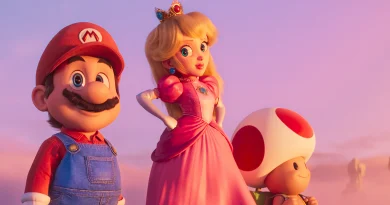
The short answer is, because Animal Farm does have pretensions of at least trying to say something of significance. It’s based on the Orwell brand in the same way that The Super Mario Galaxy Movie is based on the Mario brand. There’s a presumption of value in making a movie about untrustworthy leaders in the “age of Big Brother.” Loath as I am to admit it, there’s a definite nobility in how Animal Farm is at least making a sincere effort in the face of bad press to argue for its ethical vision of pigs corrupted by creature comforts in contrast to The Super Mario Galaxy Movie which aspires to nothing more than being feature length reference to Mario, who we all love and whose merchandise we should buy.
Paradoxically, Animal Farm is stymied mainly by the pedigree of its source material demanding some sort of high artistic vision when Orwell’s original story is very unsubtly about absolute power turning certain unscrupulous pigs into man, the most dangerous animal of all. Rogen’s Napoleon may be a frat boy, but the greater arc of his moral corruption is still mostly the same and the script still hits all of the book’s most memorable poetic beats in establishing the evolution of Napoleon’s cruelty. Despite being the villain, Rogen’s Napoleon is also for all practical intents and purposes the main character of this story though Lucky the piglet (Gaten Matarazzo) — a new perspective character not from the book — is technically the protagonist.
The fact that I’ve made it this far without mentioning Lucky should be a clue as to his actual importance. His presence as a cipher is just one of many elements that’s so perfunctory there’s just not anything interesting to say about him. We are, after all, surrounded by mediocre leaders, and their buffoonery certainly doesn’t deemphasize the danger they pose. If anything, it makes them that much more dangerous since it’s so easy not to take them seriously.
In general Animal Farm, the 2026 animated feature film, is more interesting as an abstract concept than as a movie. It’s a mirror of all the flawed frameworks we use to try and understand our world, from politics as a smugmaxxing contest to trying to construct an ideologically correct children’s cartoon that still conforms to the dominant fart joke trends of the industry. You can’t even really criticize the film’s relation to Orwell without getting deep enough into his beliefs that some of the cracks start to seem like they were already there, and not invented by Serkis solely to try and sell this project to a major distributor.
This is the great irony of Animal Farm. Its worst aesthetic crime is simply that it’s trying to be a profound and politically relevant fable in an era where we take for granted that it’s impossible to get children to sit still unless we’re showing them the attention-span-deficient content that we all freely admit is garbage that probably no one should be watching. Consequently, Animal Farm has to conform to that rubric too.
Whether because this is the film Serkis wanted to make, or the film he had to make to get distributed even via Angel Studios, is beside the point. The moral of Animal Farm was always that hierarchical political systems inevitably produce these kinds of outcomes because they incentivize toxic, adversarial behavior. That Napoleon uses locker room talk (a metaphor, perhaps, for social media) rather than attack dogs to keep the animals in line seems true to our cultural moment. So is the fact that Pilkington prefers trying to get the pigs to sell out rather than using a militia to force them out. All of this is a direct consequence of the fact that even words as straightforward as “capitalism” and “corruption” don’t mean the same thing now that they did in Orwell’s day. They manifest differently. Today’s Animal Farm is hideous more because of the ugliness of what passes for discourse than because Orwell’s original message has been meaningfully perverted.
You May Also Like
-

-
-
 August 7, 2025